Emily Harlan learned early that some houses do not need ghosts to be haunted.
Her childhood home looked ordinary from the sidewalk, with white siding, a narrow porch, and two flower boxes Linda replanted every spring as if color could prove peace.
Inside, the truth lived in quieter places.
It lived in the dent behind the hallway door where Rob had thrown a chair when Emily was twelve.
It lived in the bedroom lock that never quite caught because he had kicked it once and told everyone the wood was cheap.
It lived in Linda’s careful voice whenever neighbors asked whether everything was all right.
“We’re fine,” she would say.
Emily hated that word by the time she was old enough to understand it.
Fine meant no one asked twice.
Rob Harlan worked odd jobs when he wanted to and drank when he did not.
He could charm people at hardware stores, slap men on the back at gas stations, and tell funny stories at cookouts that made people call him a character.
At home, character peeled off him with the smell of whiskey.
Emily had spent years trying to predict which version of him would come through the door.
There was the loud Rob, who shouted before dinner was on the table.
There was the quiet Rob, who sat with one hand around a glass and made the room wait for him to choose a target.
There was the sentimental Rob, who cried about being disrespected and then used those tears as permission to become cruel.
Linda survived by becoming small.
She folded towels.
She wiped counters.
She apologized for things no one had accused her of doing.
When Emily was young, she thought her mother was afraid because she loved her.
Later, she understood Linda was afraid because fear had become the center of her marriage, and Emily was just another thing orbiting it.
That was the wound Emily did not know how to explain to anyone.
A bruise could be photographed.
A mother looking away had to be carried inside the body.
By seventeen, Emily had started documenting everything.
Not because she was brave.
Because she was tired of being unbelievable.
She took pictures of purple marks under bathroom light and saved them in a hidden folder titled Biology Notes.
She wrote dates on scraps of paper and tucked them inside the lining of an old backpack.
She learned the difference between a hospital intake form, a school absence note, and a police incident report that was started but never finished because Linda begged the responding officer not to ruin the family.
The first time Emily told someone at school, Rob found out before she got home.
He was waiting in the living room with his boots still on.
“You talk about this house again,” he said, “and I’ll make sure nobody believes a word you say.”
After that, Emily became more careful.
She did not stop.
At Westbrook Community Clinic, a counselor named Denise had noticed the way Emily flinched when a door slammed down the hall.
Denise did not push in the blunt way adults sometimes push when they want to feel helpful more than they want to be safe.
She gave Emily a card.
On the back, she wrote a secure email address and one sentence.
If you need to send proof, send it here.
Emily kept the card for two months before using it.
The night everything happened began with the sound of glass.
Not breaking.
Worse.
A heavy bottle slammed against wood with the kind of force that made the house seem to flinch.
Emily was standing in the hallway with her backpack strap in her hand.
Inside were three shirts, her ID, twenty-seven dollars, a copy of her clinic intake form, and the envelope she had built slowly, piece by piece, like a lifeboat.
At 7:18 p.m., she sent the email to Denise.
Subject line: If I Disappear.
Attached were photos, dates, a scan of the intake form, and an audio clip from the previous week when Rob had stood outside her bedroom door promising to teach her obedience.
At 8:41 p.m., Emily pressed record on her phone and slid it under the loose sofa cushion.
She did not think of herself as someone making evidence.
She thought of herself as someone leaving a trail.
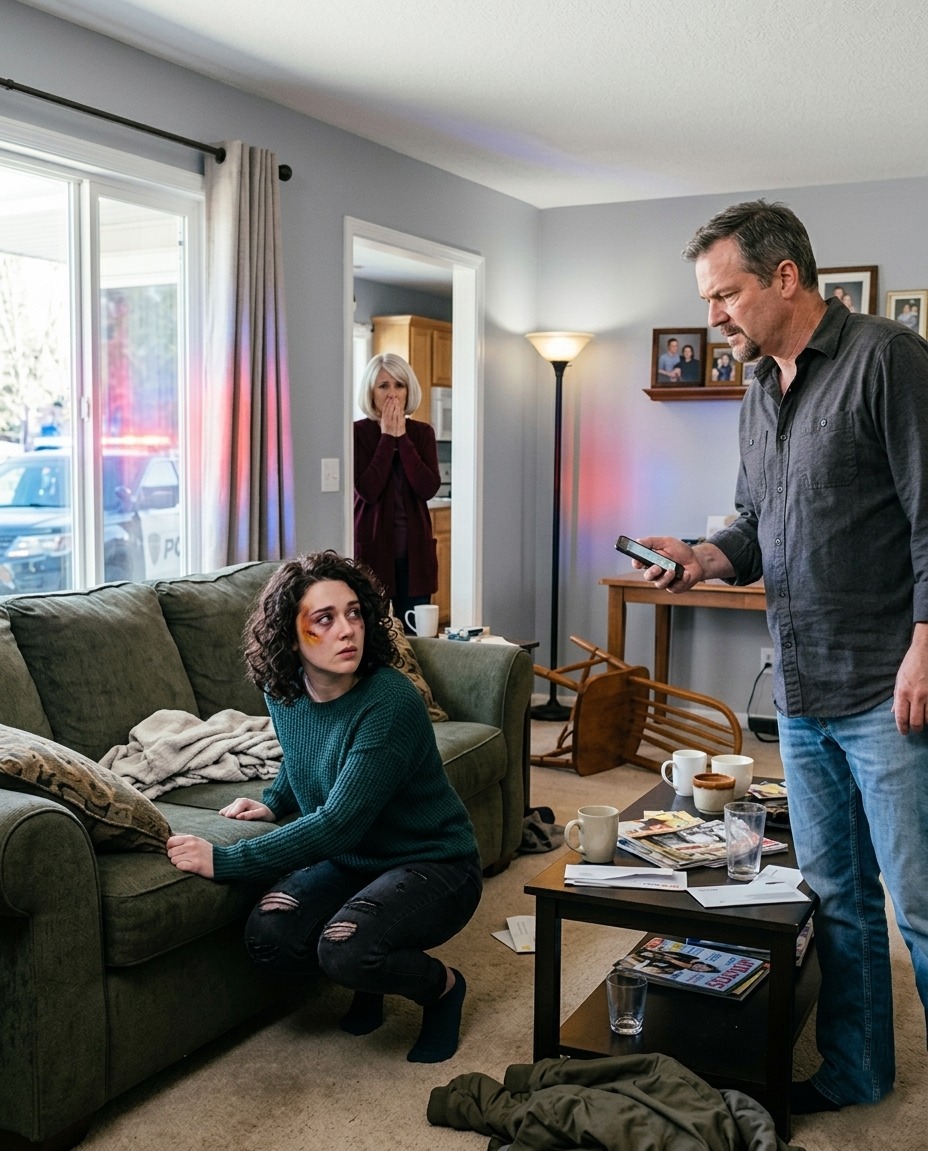
The living room smelled like whiskey, dust, and old smoke sunk so deep into the curtains that clean air felt like a visitor.
The lamp in the corner buzzed under a yellow shade.
Rob sat at the table with his shoulders rounded and his belt already loosened from his jeans.
Emily saw the belt before she truly saw his face.
That was how she knew.
“You think you can run from me, Emily?” he asked.
His words were slurred, but his attention was sharp.
Linda stood in the kitchen with one hand on the counter and the other gripping a dish towel.
She had heard the same bottle.
She knew the same belt.
Still, she did not step between them.
Emily’s hand tightened on the doorframe until a curl of old paint pressed under her fingernail.
“I’m leaving,” she said.
Her voice sounded thin to her own ears.
Rob smiled without warmth.
“You walk out that door,” he said, “you don’t come back alive.”
The chair scraped backward.
The belt came free.
Emily stepped back, but her body was slower than her fear.
The first strike landed across her shoulder with a crack that seemed to split the air.
Pain flashed bright and immediate, spreading down her arm like fire.
She stumbled sideways and hit the wall.
The phone under the sofa cushion kept recording.
That detail later mattered more than anyone in that room understood.
Rob grabbed her hair and forced her down.
Her knees struck the carpet.
The fibers burned against her skin.
The belt came again, the metal edge catching her ribs hard enough to steal the breath from her body.
“Rob,” Linda whispered from the doorway. “Stop, please.”
It was the smallest possible protest.
It barely crossed the room.
Rob did not look at her.
Emily did.
For one second, she believed her mother might finally choose movement over fear.
Linda’s fingers tightened around the dish towel.
Then she stayed where she was.
The kitchen clock ticked.
The refrigerator hummed.
A slow drip sounded from the sink.
Linda stared toward that sink like an answer might rise from the drain.
Emily reached toward her.
Nobody moved.
That was the sentence that would come back to Emily later, again and again.
In therapy.
In court.
In the quiet hours when people told her survival was a victory and she wanted to ask why victory still felt so lonely.
Nobody moved.
Rob struck her again.
The ringing in her ears grew high and thin.
She tasted blood on her tongue.
Copper and salt.
Her chest tightened until every breath became a scrape.
“I can’t breathe,” she gasped.
Rob leaned close enough for her to smell whiskey on him.
“No one will ever save you,” he said.
It was not shouted.
That made it worse.
He said it like a fact.
Emily tried to crawl toward the sofa.
Her mind was no longer thinking in complete sentences.
Phone.
Proof.
Keep going.
She did not believe she could reach the door.
She was not even sure she could reach consciousness.
But she knew the phone was under that cushion, and she wanted the truth to outlive her body if her body could not get out of that house.
Rob saw her moving.
“Still trying?” he said.
He raised the belt again.
The buckle caught the lamp glow.
Then Emily’s heart began to misfire.
At first, she thought it was panic.
A racing pulse.
A normal body reacting to terror.
Then the rhythm changed.
It skipped, slammed, fluttered, and skipped again.
Her hands tingled.
Cold spread through her arms.
The room narrowed around the yellow lamp until everything else became edges and noise.
“Mom,” she whispered.
Linda made a small broken sound.
She did not come closer.
Emily tried to inhale.
No air came.
Her body trembled once, a violent shiver that seemed to pass through her from chest to fingertips.
Then she went still.
For several seconds, the room did not understand what had happened.
Rob stood over her with the belt hanging from his fist.
Linda stared at her daughter on the carpet.
The phone under the sofa cushion kept recording.
At 9:07 p.m., Denise from Westbrook Community Clinic saw Emily’s email.
She had been finishing paperwork when the subject line caught her eye.
If I Disappear.
She opened the attachments.
She listened to thirteen seconds of Rob’s earlier threat before calling 911.
She gave the dispatcher Emily’s address, the name Rob Harlan, and the warning that there was likely active violence in the home.
That call created the first official timestamp.
The second came from the phone recording still running in Rob’s living room.
The third came from the body camera footage of the first officer who reached the porch nine minutes later.
Inside the house, Linda finally moved toward the wall phone.
Her hands shook so badly the receiver knocked against the cradle twice.
Rob turned on her.
“You say I did this,” he warned, “and I’ll tell them she attacked me.”
Then Emily’s phone vibrated under the sofa cushion.
Denise had replied to the email before the police arrived, not knowing whether Emily would ever read it.
Emily, help is coming.
The screen glowed beneath the gap in the cushion.
Linda saw it first.
Her face changed.
Rob followed her stare.
He crossed the room and shoved the cushion aside.
The recording timer was still running.
One hour, six minutes, and seventeen seconds.
His voice was there.
His threat was there.
Emily’s words were there.
I can’t breathe.
For the first time that night, Rob looked afraid.
He grabbed the phone, but the screen slipped against his palm.
Outside, red and blue light washed across the front window.
Someone pounded on the door.
“Rob Harlan, open up.”
Linda backed away from him.
It was not a heroic movement.
It was only three steps.
But for Linda, three steps away from Rob was almost a confession.
The officers forced entry when he refused to open the door.
Body camera footage later showed the living room exactly as Emily remembered it in fragments: the overturned chair, the bottle on the table, the belt in Rob’s hand, Linda shaking near the kitchen, Emily motionless on the carpet.
One officer moved Rob away.
Another dropped beside Emily and checked for a pulse.
There was none he could find at first.
The audio captured his voice changing.
“Start compressions.”
Paramedics arrived four minutes later.
Emily’s heart had gone into a dangerous rhythm brought on by trauma, lack of oxygen, and shock.
For a short time, it stopped doing what a heart is supposed to do.
The official medical language came later.
Cardiac arrest.
Respiratory distress.
Blunt force trauma.
Multiple contusions.
Possible hypoxic episode.
Emily did not know any of those words while she was gone from herself.
She knew nothing.
Then she knew light.
Then a ceiling.
Then a tube.
Then Linda crying somewhere she could not see.
At St. Agnes Medical Center, detectives collected the first full statement from Denise.
They retrieved Emily’s email.
They secured the phone recording with a digital chain of custody log.
They photographed the living room.
They took the belt.
They documented the bottle, the overturned chair, the blood on the carpet, and the cushion where the phone had been hidden.
Evidence turns private terror into public language.
It does not heal the wound.
It stops the wound from being denied.
Rob tried to deny it anyway.
He told police Emily had been unstable.
He said she had fallen.
He said Linda was hysterical and confused.
He said the belt was in his hand because he had been getting dressed.
Then detectives played the recording.
After that, Rob stopped talking.
Linda’s first statement was weak.
She said she did not see everything.
She said it happened fast.
She said Rob had only meant to scare Emily.
The prosecutor asked her one question during the preliminary hearing that made her cover her mouth.
“Mrs. Harlan, when your daughter said she could not breathe, where were you standing?”
Linda looked at the photograph of the kitchen doorway.
Then she looked at Emily.
“In the doorway,” she said.
“And what did you do?”
Linda began to cry.
“Nothing.”
That answer did not save Emily from what happened.
But it changed the shape of the room.
For the first time, her mother’s silence was not invisible.
It was on record.
The trial took place eleven months later.
Emily had scars by then, some visible and some not.
She had learned how to sleep with a light on.
She had learned that healing is not a straight road but a series of rooms you keep reentering with different tools.
She had learned that people love asking why victims did not leave sooner because it lets them pretend a locked life is only a door problem.
Rob appeared in court wearing a navy suit that did not fit his shoulders.
He looked smaller without the house around him.
That surprised Emily.
For years, she had thought he filled rooms because he was powerful.
In court, she realized he had only filled rooms because everyone else had been trained to shrink.
The prosecutor did not rely on emotion first.
She relied on evidence.
At 7:18 p.m., Emily sent the email.
At 8:41 p.m., the phone recording began.
At 9:07 p.m., Denise called 911.
At 9:16 p.m., officers arrived.
The jury saw the clinic intake form.
They saw the photographs.
They saw the body camera footage.
They heard Rob say, “No one will ever save you.”
Emily watched one juror close his eyes when her own recorded voice said, “I can’t breathe.”
Rob’s attorney tried to suggest the recording lacked context.
The prosecutor let that hang for a moment.
Then she played the full section again, from Rob’s threat to Emily’s silence.
The courtroom went so quiet that Emily could hear paper shift at the defense table.
Linda testified on the third day.
She looked older than she had ever looked at home.
Her hair was pinned badly.
Her hands trembled around the oath card.
She admitted she had seen the belt.
She admitted Emily had begged.
She admitted Rob had threatened to blame Emily if Linda called for help.
“And why did you look away?” the prosecutor asked.
Linda stared down.
“Because I was afraid of him,” she said.
The prosecutor’s voice softened.
“Were you more afraid of him than you were for your daughter?”
Linda could not answer for a long time.
When she finally did, it came out almost too quietly to hear.
“Yes.”
Emily did not feel satisfaction.
She felt something heavier.
The truth is not always a clean blade.
Sometimes it is a mirror, and everyone bleeds looking into it.
Rob was convicted of aggravated assault, domestic violence resulting in serious bodily injury, witness intimidation, and related charges tied to the threats captured in the recording.
The judge referenced the audio before sentencing.
He said the recording revealed not a single loss of control but a pattern of control.
That distinction mattered to Emily.
Rob had always called it temper.
The court called it what it was.
When the sentence was read, Rob did not look at Emily.
He looked at Linda.
Maybe he expected the old version of her to appear.
The woman in the doorway.
The woman who would soften consequences into excuses.
Linda cried, but she did not speak for him.
Emily left the courthouse with Denise on one side and a victim advocate on the other.
Reporters stood near the steps, but she did not give them a speech.
She had already spoken in the only way that mattered.
She had survived.
The recording had spoken.
The documents had spoken.
The courtroom had listened.
Months later, Emily moved into a small apartment with thin walls, bright windows, and a front door that locked cleanly.
The first night there, she sat on the floor and cried because silence sounded different when it was not waiting for violence.
She kept the old backpack for a while.
The lining was torn from where she had hidden the envelope.
Eventually, she placed it in a box with copies of the court documents, the clinic card, and the printed email with the subject line that changed everything.
If I Disappear.
She did not disappear.
That became the sentence she chose to keep.
Linda entered counseling after the trial.
Emily did not forgive her quickly.
She did not pretend three steps in a living room erased years in a doorway.
But one afternoon, Linda sent a letter that did not ask for absolution.
It said, “I should have moved.”
Emily read that line many times.
It did not fix the past.
It did something smaller.
It named it.
There are betrayals that bruise louder than fists, and there are truths that arrive too late to prevent damage but not too late to prevent denial.
Emily learned to live in that difficult middle.
She learned that being saved did not mean someone burst through the door at the perfect moment.
Sometimes being saved meant the proof you hid under a sofa cushion kept breathing when you could not.
Sometimes it meant a counselor opened an email.
Sometimes it meant a jury believed the sound of your fear more than the face of the man who caused it.
And sometimes it meant admitting the hardest truth of all.
Nobody moved.
Then the evidence did.