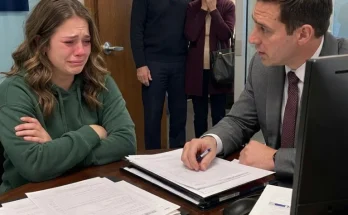
I was twenty-three when the truth hit me with the weight of a house collapsing: in my own family, I was not essential. I was not the beam holding anything up.
I was the drywall—useful, silent, and easy to replace the moment I cracked.
It happened two days before my birthday. The evening air was heavy with summer humidity, the kind that made every breath feel slow and damp. I came through the front door with my steel-toed boots dragging like anchors after an eleven-hour shift at Mason Hardware & Supply.
I had spent the day hauling concrete bags, stacking lumber, and sorting endless boxes of nails until my back throbbed and my skin was coated in sawdust.
In my hand was a cheap chocolate cake from the grocery store. It had cost six dollars and forty-two cents. The words Happy Birthday were written in blue frosting, already starting to melt under the plastic dome. It looked sad, almost embarrassed to exist. But I bought it anyway, because I knew if I didn’t bring my own cake home, there would be no cake at all.
The moment I stepped inside, I felt it—the strange, tense silence of a family meeting. My parents, Linda and Carl, were sitting in the living room like judges waiting to deliver a sentence. My younger sister, Ashley, sat on the edge of the sofa, her face arranged into soft, wounded tragedy, like she had been rehearsing in a mirror.
Linda looked up first. She didn’t ask how work was. She didn’t notice the dust on my clothes or the exhaustion in my face.
“Jordan,” she said gently, in the voice she used when she wanted cruelty to sound like concern, “we’ve talked about it, and we’ve decided we won’t be doing anything for your birthday this year. Ashley has been feeling very overlooked lately. She’s fragile right now, and she needs the family’s attention. You’re the strong one. You understand, don’t you?”
That sentence was not a question. It was a command to disappear politely.
I looked at Ashley. Right on cue, one perfect tear slipped down her cheek.
Something inside me snapped. Not loudly. Not dramatically. It was more like a wire breaking in the dark.
“I understand,” I said.
My voice was calm. Too calm.
I didn’t argue. I didn’t remind them that I worked sixty hours a week to pay for my own college classes while they spent money on Ashley’s dreams, costumes, lessons, and excuses. I simply placed the little cake on the coffee table, turned away, and walked upstairs.
Behind me, I heard Ashley whisper, “Is she mad? I can’t handle it if she’s mad right now.”
That night, I packed.
To understand why I left, you need to understand what that house had become. For most of my life, it had been a shrine to Ashley’s average talents. When she was eight, she won a small plastic trophy in a local pageant, and from that moment on, my parents treated her like a star waiting for the world to catch up. Every extra dollar went to dresses, acting classes, singing lessons, and competitions she rarely won.
My achievements barely made a ripple. Straight A’s got me a distracted “That’s nice.” Ashley’s participation ribbons were framed like sacred awards. My father worked double shifts until his shoulders permanently slumped, not from age, but from the cost of keeping her fantasy alive. He had become a quiet man, someone who avoided conflict so completely that he eventually avoided protecting me too.
Only my grandfather, Arthur, saw it clearly.
He lived across town in a small house that smelled like books, cedar, and sawdust. My mother disliked him because he refused to fund Ashley’s “future.” He would meet me at the library or the park with sandwiches and say things no one else said.
“A house built on a bad foundation falls eventually,” he told me once. “Doesn’t matter how pretty they paint the walls.”
A few hours before my birthday was canceled, I had come home early and heard Ashley through her cracked bedroom door.
“Yeah, I told Mom I’m depressed again,” she laughed into her phone. “Who cares if it’s Jordan’s birthday? I need the attention. Besides, they still don’t know I flunked out three weeks ago. When the letter comes, I’ll just say I left because everyone was stressing me out by focusing on her.”
Then she laughed again.
Forty thousand dollars. That was what my parents had borrowed against the house for her college. The same parents who told me they couldn’t help me buy textbooks.
So that night, I packed with cold, precise focus. Clothes. Documents. My birth certificate. Social security card. Everything that proved I existed, placed into two duffel bags.
Around midnight, Carl knocked softly and came into my room. He looked smaller than I remembered. Without a word, he pressed five crumpled hundred-dollar bills into my hand.
“This is all the fight I have left, Jordan,” he whispered. “I know we failed you. I don’t know how to fix it.”
“You can’t fix it,” I said. “You can only survive it. And I’m done surviving.”
I left at two in the morning.
The fog was thick as my old Honda rolled away from the curb. I didn’t look back. I drove toward the only person who had ever seen me as more than the family’s backup plan.
Arthur opened the door at 2:30 a.m. and didn’t ask questions. He just stepped aside and pointed toward the spare room.
“Stay as long as you need,” he said. “But finish that degree. Living well is the cleanest revenge.”
For the next three years, I became focused in a way that almost frightened me. I worked full-time at Mason Hardware during the day, went to community college at night, and studied at Arthur’s kitchen table until my eyes burned.
Arthur taught me more than school ever did. He had worked construction and flipped small houses before retirement. He taught me how to see a building properly—not the paint, not the curtains, not the surface, but the bones. He showed me how to spot a solid foundation under ugly carpet, how to recognize hidden value, how to tell when something broken could be rebuilt.
“People are like houses,” he said. “Most folks only notice the paint. You look at the foundation.”
He had saved eight thousand dollars for me over the years. He called it investment capital.
Two weeks after I left, Ashley’s dismissal letter arrived. My mother called me seventeen times in one day. I watched the phone vibrate and felt nothing. They had lost the “strong one,” and now they had to live with the fragile queen they had created.
I graduated at twenty-four. Only Arthur came. He brought me a real cake from a bakery and a check for another thousand dollars.
“Find your first deal,” he said. “Build something they can’t touch.”
That summer, I found a foreclosed three-bedroom house in a rough neighborhood outside Dayton. The bank wanted fifty-two thousand. The yard was wild, the inside was filthy, and the walls looked like they had survived a war. But the hardwood floors were oak, and the foundation was solid.
I offered forty-five thousand. They accepted.
I moved in with a mattress and a toolbox.
Renovating that house became my baptism. I learned how to patch drywall, repair plumbing, replace light switches, and survive on coffee, stubbornness, and cheap sandwiches. I worked until my hands blistered. Then I worked until the blisters became calluses.
Six months later, the house was beautiful.
It appraised for eighty-nine thousand dollars.
I didn’t sell it. I rented it to two young teachers. The rent covered the mortgage and left money behind. At twenty-five, I owned something that worked for me while I slept.
Then came the second property. A duplex. Then a third house with a destroyed kitchen. Each project made me smarter, faster, and harder to intimidate. By twenty-eight, I owned seven units. By thirty, I had a small real estate company.
My mother’s messages changed over time. They were no longer soft and disappointed. They became desperate.