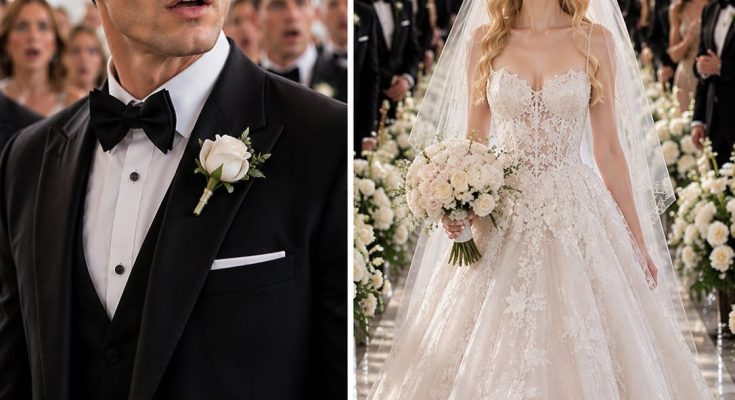
The music was still playing behind us. Guests were smiling, photographers were moving backward to capture the perfect wedding-exit shot, and white flower petals drifted through the air.
Yet Peter wasn’t seeing any of it.
His eyes were locked on the screen of his phone.
The expression on his face wasn’t fear.
It was disbelief.
“Peter?” I asked quietly.
He didn’t answer.
His thumb moved across the screen.
Reading.
Scrolling.
Reading again.
For a moment, I wondered if this was some corporate emergency. A problem with the stock market. A crisis involving one of his companies.
Then I noticed something else.
His hand was shaking.
Only slightly.
But enough to make me notice.
The man standing beside me was known for remaining calm during billion-dollar negotiations.
He wasn’t calm now.
“Sir?”
His assistant, Daniel, appeared from the crowd.
Peter immediately locked the phone.
“Not here,” he said.
Daniel frowned.
“Is it serious?”
“Yes.”
The answer came too quickly.
Peter looked at me.
For a brief second, something unreadable crossed his face.
Then the cameras moved closer.
His expression instantly changed.
The billionaire mask returned.
Perfect.
Controlled.
Untouchable.
He wrapped an arm around my waist.
“Smile,” he murmured.
The photographers cheered.
“Beautiful!”
“Look this way!”
“Perfect!”
I smiled automatically.
But my thoughts remained fixed on the message.
URGENT. CHECK THE FILE.
And whatever had been inside it.
Because it clearly involved me.
Or my family.
Or both.
The reception was held at Strickland Manor, an enormous estate overlooking the coastline.
The property looked more like a luxury resort than a private home.
Crystal chandeliers hung from vaulted ceilings.
Fresh flowers filled every room.
A live orchestra played softly near the ballroom entrance.
Everything was flawless.
Everything except the groom.
Peter spent most of the evening distracted.
Guests approached him.
Business partners congratulated him.
Investors shook his hand.
Yet every few minutes, his attention drifted elsewhere.
Toward his phone.
Toward me.
Toward thoughts he wasn’t sharing.
At one point, I found him standing alone on a terrace overlooking the ocean.
The sunset painted the water gold.
For several moments neither of us spoke.
Then Peter broke the silence.
“How much do you know?”
I folded my arms.
“About what?”
“The merger.”
My eyebrows rose.
“The merger between your company and my family’s investment group?”
“Yes.”
“Enough.”
His jaw tightened.
“That isn’t an answer.”
“Neither was your question.”
For the first time all day, something resembling a smile appeared.
Small.
Reluctant.
Almost amused.
“You’re different from what I expected.”
I laughed softly.
“I imagine that’s happening a lot today.”
His expression darkened.
The memory of what he’d said before the ceremony lingered between us.
Neither of us mentioned it directly.
Yet it remained there.
Invisible.
Heavy.
Peter looked away first.
“The file mentioned your grandfather.”
That surprised me.
“My grandfather?”
“Yes.”
“What’s that supposed to mean?”
“I don’t know yet.”
The honesty caught me off guard.
Peter Strickland wasn’t a man who admitted uncertainty.
Yet he sounded genuinely confused.
“I received an internal report,” he continued.
“It suggests your grandfather may have been involved in the original formation of Strickland Technologies.”
I stared at him.
“That makes no sense.”
“That’s exactly what I thought.”
The company had been founded nearly forty years earlier.
Long before Peter became CEO.
Long before I was born.
My grandfather had spent most of his life teaching engineering at a university.
He wasn’t a businessman.
At least, not that I knew of.
Peter studied my face.
“You really didn’t know.”
“No.”
The ocean breeze lifted a strand of hair across my cheek.
For several seconds, neither of us spoke.
Then a voice interrupted.
“There you are.”
A woman approached from the ballroom.
Tall.
Elegant.
Perfectly dressed.
I recognized her immediately from photographs.
Victoria Strickland.
Peter’s older sister.
She smiled at me.
The smile never reached her eyes.
“Congratulations,” she said.
“Thank you.”
Victoria glanced between us.
“Father wants a family photograph.”
Peter sighed.
“Of course he does.”
As Victoria walked away, I noticed something strange.
She glanced back once.
Not at Peter.
At me.
And the look on her face wasn’t hostility.
It was concern.
The realization lingered long after she disappeared into the crowd.
The formal celebrations ended near midnight.
Most guests departed.
The orchestra packed away their instruments.
The mansion gradually fell quiet.
Peter and I finally found ourselves alone.
Or as alone as newlyweds could be inside a house staffed by dozens of employees.
A maid guided us toward the master suite.
When the door closed behind us, silence filled the room.
The suite was enormous.
Floor-to-ceiling windows overlooked the ocean.
A fireplace flickered softly.
Fresh flowers stood beside the bed.
Everything had been prepared for a romantic wedding night.
Neither of us seemed interested.
Peter loosened his tie.
I removed my earrings.
The distance between us felt oddly comfortable.
Not hostile.
Just unfamiliar.
Like two strangers sharing an unexpected journey.
“You heard everything before the wedding?”
His voice broke the silence.
I looked at him in the mirror.
“Yes.”
He nodded slowly.
“I figured.”
“Did you?”
“When you lifted the veil.”
The memory returned instantly.
His shock.
His guilt.
His realization.
Peter sat in a chair near the window.
For a moment he seemed older than he had earlier.
Not physically.
Emotionally.
The confidence remained.
But some of the certainty had disappeared.
“I owe you an apology.”
The words surprised me.
“You do.”
“I judged you.”
“Yes.”
“I believed things without verifying them.”
“Yes.”
A faint smile touched my lips.
“You’re not very good at apologizing.”
A reluctant laugh escaped him.
“No.”
“Clearly.”
Peter rubbed the back of his neck.
“I deserve that.”
For the first time all day, the tension eased slightly.
Not gone.
But softer.
More human.
“Why did you agree to this marriage?” he asked.
The question lingered in the air.
I considered several answers.
The simple answer.
The complicated answer.
The honest answer.
Finally, I chose honesty.
“My grandfather asked me to.”
Peter frowned.
“That’s it?”
“Not entirely.”
I walked toward the window.
Moonlight reflected across the ocean.
“My family has always valued loyalty.”
“Enough to marry a stranger?”
“Enough to trust someone we love.”
He watched me carefully.
“And do you trust your grandfather?”
“Completely.”
The answer came without hesitation.
Because it was true.
Peter looked thoughtful.
As if filing that information away.
Then his phone vibrated again.
The atmosphere changed instantly.
He checked the screen.
His expression hardened.
“What is it?”
He stood.
“I need to make a call.”
“At midnight?”
“Yes.”
“About the file?”
His silence answered the question.
Peter moved toward the door.
Then paused.
Something seemed to occur to him.
“Adelaide.”
“Yes?”
“If someone contacts you about your grandfather…”
His voice trailed off.
“Tell me immediately.”
“Why?”
Another pause.
Longer this time.
“Because I think we’re missing part of the story.”
Then he left.
And I spent the rest of the night wondering exactly what story he meant.
Three days later, the honeymoon was officially canceled.
Publicly, the explanation involved urgent business obligations.
Privately, neither Peter nor I argued with the decision.
Too many questions remained unanswered.
The file had triggered investigations.
Lawyers were reviewing old records.
Corporate historians were digging through archives.
Meanwhile, life settled into an unusual routine.
We lived together.
Attended public events together.
Played the role of newlyweds whenever cameras appeared.
Yet behind closed doors, our relationship remained undefined.
Not enemies.
Not friends.
Not quite partners.
Something in between.
And slowly, despite myself, I began noticing things about Peter.
Things that didn’t match the arrogant man I’d overheard before the wedding.
He worked absurdly long hours.
He treated employees with respect.
He remembered names.
Birthdays.
Family details.
He listened more than he spoke.
One afternoon I visited company headquarters.
The building overlooked the city skyline.
Glass walls reflected sunlight in every direction.
Peter was leading a meeting when I arrived.
I watched through the conference room window.
Confident.
Focused.
Sharp.
People listened when he spoke.
Not because they feared him.
Because they trusted him.
It was difficult reconciling that man with the one who had mocked me.
Perhaps both versions existed.
Perhaps neither told the full story.
After the meeting ended, Peter joined me in his office.
“You look surprised.”
“Maybe.”
“Why?”
I hesitated.
“You weren’t what I expected.”
A grin appeared.
“That sounds familiar.”
I rolled my eyes.
“Don’t enjoy it too much.”
“Too late.”
For a moment, we simply laughed.
The ease between us felt strange.
Unexpected.
Dangerous.
Because attraction complicated everything.
And despite my efforts, I couldn’t deny it anymore.
The spark from the wedding day hadn’t disappeared.
It had grown.
Quietly.
Steadily.
Neither of us acknowledged it.
Yet it lingered in every glance.
Every conversation.
Every accidental touch.
As though something larger waited beneath the surface.
Something neither of us fully understood.
A week later, the mystery deepened.
I received a call from my grandfather.
“Come visit me.”
His tone immediately caught my attention.
“Is everything okay?”
“Yes.”
Pause.
“No.”
My stomach tightened.
“Grandpa?”
“I need to show you something.”
The next morning I drove to his estate outside the city.
The property had belonged to our family for generations.
Rolling hills surrounded the house.
Ancient oak trees lined the driveway.
My grandfather was waiting on the porch.
Eighty-two years old.
Sharp-minded.
Strong-willed.
The person I trusted most in the world.
He hugged me tightly.
Then led me inside.
Neither of us discussed the weather.
Or marriage.
Or anything else.
We went directly to his study.
The room smelled of old books and polished wood.
He opened a drawer.
Removed a small leather box.
Placed it on the desk.
“What is it?”
“Something I should have shown you years ago.”
A strange feeling settled over me.
He opened the box.
Inside lay several photographs.
Letters.
Documents.
And one faded black-and-white image.
I picked it up.
My breath caught.
A much younger version of my grandfather stood beside another man.
The second man looked familiar.
Very familiar.
I stared harder.
Then realization struck.
“That’s…”
“Yes.”
“Peter’s grandfather.”
My grandfather nodded.
The room suddenly felt smaller.
“Why do you have this?”
“Because we built something together.”
I looked up.
“What?”
His expression became distant.
Thoughtful.
As if traveling backward through time.
“The company.”
My heart pounded.
“Strickland Technologies?”
“Yes.”
The answer landed like thunder.
“You helped create it?”
“Not helped.”
His eyes met mine.
“I co-founded it.”
Silence.
Complete silence.
I could barely process the words.
Every assumption I had ever held about my family shifted.
“But nobody knows that.”
“Very few people.”
“Why?”
A shadow crossed his face.
“Because I left.”
“Why?”
My grandfather stood.
Walked toward the window.
For several moments he said nothing.
Then he spoke quietly.
“Because someone betrayed me.”
The story unfolded slowly.
Piece by piece.
Forty years earlier, two young engineers had built a revolutionary technology company from nothing.
My grandfather.
And Peter’s grandfather.
Partners.
Friends.
Visionaries.
Together they created inventions that transformed entire industries.
Then something happened.
A disagreement.
A legal conflict.
An event that ended the partnership.
Public records showed only one founder.
The Strickland name remained.
My grandfather disappeared from company history.
“What really happened?” I asked.
He sighed.
“I never learned the full truth.”
“How is that possible?”
“Because evidence vanished.”
That answer only created more questions.
“Did Peter know?”
“I doubt it.”
“Then why reveal it now?”
My grandfather hesitated.
A rare occurrence.
“Because someone contacted me.”
My pulse quickened.
“Who?”
“I don’t know.”
“What do you mean?”
“The message was anonymous.”
He handed me an envelope.
Inside was a single sheet of paper.
Five words.
THEY ARE LOOKING AGAIN.
Nothing else.
No signature.
No explanation.
No clues.
A chill traveled down my spine.
“What does that mean?”
“I was hoping you could tell me.”
But I couldn’t.
Because I understood even less than before.
That evening I returned to Strickland Manor.
Peter was waiting in his office.
The moment he saw my face, he knew something had happened.
“What is it?”
I placed the photograph on his desk.
His eyes widened.
“Where did you get this?”
“My grandfather.”
Peter picked it up carefully.
Studied it.
Then sat down slowly.
“It’s real.”
“You recognize him?”
“Yes.”
His voice sounded distant.
“My grandfather kept one copy.”
I stared.
“You knew?”
“Not exactly.”
“Peter…”
“I knew there had been another man.”
His gaze remained fixed on the photograph.
“But nobody ever talked about him.”
The room fell silent.
Both of us were processing different versions of the same history.
Then Peter opened a drawer.
Removed a folder.
And handed it to me.
“What’s this?”
“The file.”
My heartbeat accelerated.
The same file that had appeared on our wedding day.
The one that changed everything.
I opened it.
Pages of research.
Financial records.
Archived correspondence.
Legal documents.
At the very end sat a handwritten note.
I read it once.
Then again.
And again.
Because the words seemed impossible.
Finally I looked up.
“Peter…”
He nodded grimly.
“I know.”
The note contained only a single sentence.
A sentence written decades earlier.
A sentence that connected our families in a way neither of us had imagined.
If authentic, it meant the original company had never belonged solely to the Stricklands.
And it meant someone had spent forty years hiding that fact.
But the final page contained something even more unsettling.
A date.
A recent date.
Just six months ago.
Someone had reopened the investigation.
Someone still alive.
Someone still searching.
“Who found this?” I asked quietly.
Peter’s expression darkened.
“That’s the problem.”
“What problem?”
“The person who sent it disappeared two days later.”
A cold silence settled over the room.
“Disappeared?”
“No forwarding address.”
“No contact information.”
“Nothing.”
I stared at him.
The mystery that began on our wedding day suddenly felt much larger than either of us.
Much older.
And far from over.
Then another realization struck me.
“Wait.”
Peter looked up.
I slowly turned the final page.
Toward the bottom sat a name.
One neither of us had noticed before.
A researcher.
An archivist.
The person who had reopened the investigation.
My stomach dropped.
Because I recognized it immediately.
Peter saw my reaction.
“What is it?”
I looked from the page to him.
My pulse thundered in my ears.
“That name.”
“Adelaide?”
I swallowed.
“She called me last month.”
Peter froze.
“What?”
“She said she had information about my family.”
The room went silent.
“Why didn’t you tell me?”
“Because I thought it was a scam.”
Peter stood.
“Did you meet her?”
“No.”
“Did she leave a number?”
I searched my memory.
Then suddenly remembered something.
A voicemail.
One I had never deleted.
“I think so.”
Hope flickered across Peter’s face.
For the first time, we had a lead.
A real lead.
I reached for my phone.
Opened the old message.
Pressed play.
The voicemail crackled softly through the room.
A woman’s voice filled the silence.
“Adelaide, if you’re hearing this, please call me back immediately. Your family deserves the truth.”
Then came a pause.
A long pause.
As though she had hesitated before saying the next words.
And when she finally spoke, every hair on my arms stood up.
Because the last sentence changed everything.
“Before I disappear, there’s something you need to know.”
The recording ended abruptly.
Peter and I stared at each other.
Neither speaking.
Neither moving.
Because beneath the voicemail sat a timestamp.
A date.
The exact same day Peter had received the mysterious file.
And for the first time, we both realized the same terrifying possibility.
The woman hadn’t vanished after sending the file.
She had known she was about to vanish before she sent it.
The voicemail ended.
The silence that followed seemed louder than the message itself.
Peter stood motionless beside his desk.
I stared at my phone.
The timestamp glowed on the screen.
The same date.
The same day.
The same moment everything had begun.
Finally Peter spoke.
“Play it again.”
I did.
The woman’s voice filled the office once more.
Calm.
Professional.
But now that I listened carefully, I noticed something else.
Fear.
Not panic.
Not desperation.
Certainty.
As if she already knew what was coming.
“Before I disappear, there’s something you need to know.”
The recording ended.
Peter exhaled slowly.
“She wasn’t guessing.”
“No.”
“She expected something to happen.”
“Yes.”
His gaze shifted toward the window overlooking the city.
For several seconds, neither of us spoke.
Then he turned back toward me.
“We need to find her.”
The next morning began with a name.
Margaret Hayes.
Archivist.
Historical researcher.
Independent consultant.
The woman who had reopened the investigation.
Peter’s legal team had spent weeks trying to locate her.
Without success.
But unlike lawyers and investigators, I possessed something they didn’t.
The voicemail.
And sometimes small details mattered.
I listened to it repeatedly during breakfast.
Again in the car.
Again in Peter’s office.
By the twentieth replay, I noticed something.
A sound.
Faint.
Barely audible.
Behind Margaret’s voice.
Peter leaned closer.
“What is it?”
“Listen.”
I restarted the message.
There.
A bell.
Soft.
Distinct.
Three chimes.
Peter frowned.
“A church?”
“Maybe.”
The sound repeated.
Not random.
Regular.
Scheduled.
Peter immediately called his assistant.
Within an hour, Daniel arrived carrying a list.
Churches.
Cathedrals.
Historic buildings.
Any location within fifty miles that used a similar bell pattern.
The list contained twenty-three possibilities.
Not ideal.
But better than nothing.
“Where do we start?” I asked.
Peter studied the page.
Then pointed.
“Here.”
I looked down.
St. Andrew’s Historical Library.
An old church converted into an archive center.
My pulse quickened.
“Why that one?”
“Because Margaret specialized in historical records.”
It was the best lead we had.
So we went.
The building sat on a quiet street near the harbor.
Red brick walls.
Stained-glass windows.
Weathered stone steps.
Inside, rows of books stretched endlessly beneath vaulted ceilings.
An elderly librarian greeted us warmly.
“Can I help you?”
Peter showed Margaret’s photograph.
The woman’s expression changed immediately.
Recognition.
“Yes.”
My heart skipped.
“You know her?”
“She worked here frequently.”
“When was the last time you saw her?”
The librarian thought for a moment.
“About six weeks ago.”
“Did she say where she was going?”
“No.”
Disappointment settled heavily in my chest.
Then the librarian smiled faintly.
“Although she did leave something.”
Peter and I exchanged glances.
“What?”
Without answering, the woman disappeared into a back room.
Several minutes later she returned carrying a sealed envelope.
Across the front was written a single name.
ADELAIDE.
My breath caught.
The librarian handed it to me.
“She asked me to give this to you if anyone ever came looking.”
My fingers trembled slightly as I opened it.
Inside lay a handwritten letter.
Nothing else.
I unfolded the paper.
The first line made my stomach tighten.
If you’re reading this, then you’ve already discovered the partnership.
Peter stepped beside me.
Together we continued reading.
The letter explained that Margaret had spent years researching the early history of Strickland Technologies.
What began as a routine project had uncovered contradictions.
Missing documents.
Altered records.
Disappearing witnesses.
The deeper she investigated, the stranger everything became.
Then came the most surprising part.
She believed the truth had never been hidden to protect money.
It had been hidden to protect someone.
I looked up.
“Protect who?”
Peter read the line again.
His expression mirrored my confusion.
The letter didn’t say.
Instead, it ended with directions.
A storage unit.
A harbor warehouse.
And one final instruction.
Trust the journal.
The warehouse stood near the water’s edge.
Rust-colored shipping containers lined the docks.
Seagulls circled overhead.
Wind whipped across the harbor.
Peter unlocked the storage unit using the key enclosed with the letter.
The metal door rattled upward.
Dust floated through sunlight.
The room contained only one item.
A wooden chest.
Nothing more.
My pulse hammered.
Peter opened it carefully.
Inside rested dozens of notebooks.
Journals.
Files.
Research materials.
Margaret’s entire investigation.
For hours we sat inside the warehouse reading.
Cross-referencing dates.
Studying photographs.
Reviewing interviews.
And gradually a different picture emerged.
Not one of betrayal.
But misunderstanding.
A misunderstanding that had lasted forty years.
The original conflict between our grandfathers had never centered on ownership.
It centered on responsibility.
One invention.
One decision.
One disagreement about how it should be used.
Both men believed they were protecting the future.
Both believed they were doing the right thing.
Neither realized how completely their partnership would collapse.
Yet even that wasn’t the biggest revelation.
Near sunset, Peter discovered a journal unlike the others.
Older.
Worn.
Leather-bound.
The cover contained two initials.
E.S.
My grandfather.
I stared.
“How did Margaret get this?”
Peter opened the first page.
A photograph slipped out.
It landed face-up on the floor.
And suddenly everything changed.
Because the picture showed four people.
Peter’s grandfather.
My grandfather.
A young woman.
And a little boy.
The boy couldn’t have been older than five.
“What am I looking at?”
Peter’s voice sounded distant.
I turned the photograph over.
A date.
Forty-two years earlier.
Along with a handwritten caption.
Family.
The word echoed in my mind.
Family.
But neither of us recognized the woman.
Or the child.
Peter slowly flipped through the journal.
Page after page revealed memories.
Business meetings.
Friendship.
Shared dreams.
Inside those pages our grandfathers weren’t rivals.
They were brothers in everything except blood.
Then Peter stopped turning pages.
His eyes widened.
“What?”
He handed me the journal.
A paragraph had been underlined.
I read it once.
Then again.
Because I could hardly believe it.
If anything ever happens to me, William promised he would raise my son as his own.
The room seemed to tilt.
I looked at Peter.
He looked at me.
Neither speaking.
Neither breathing.
Because suddenly one impossible question demanded an answer.
Whose son?
The next several days became a whirlwind.
More journals.
More letters.
More interviews.
More questions.
For every mystery solved, another appeared.
Yet one thing became increasingly clear.
Margaret had been right.
Someone had hidden the truth.
But not for greed.
Not for power.
For love.
The realization felt almost absurd after everything we’d imagined.
One evening Peter and I sat together on the manor’s terrace overlooking the ocean.
The same terrace where we’d first discussed the file.
The same place where suspicion had once filled every silence.
Now everything felt different.
Gentler.
Warmer.
Peter handed me a cup of coffee.
“You know,” he said.
“I hated this marriage.”
I laughed.
“Only hated?”
“Fine.”
He smiled.
“I absolutely hated it.”
“That’s better.”
His eyes met mine.
“And now?”
The question lingered.
The ocean shimmered beneath moonlight.
A cool breeze drifted across the water.
I thought about everything that had happened.
The wedding.
The secrets.
The investigations.
The unexpected partnership forming between us.
Then I smiled.
“Now I’m glad I stayed.”
Something softened inside his expression.
For a moment neither of us looked away.
The attraction we’d spent weeks avoiding no longer felt avoidable.
Or necessary.
Peter reached for my hand.
This time neither of us pretended not to notice.
The breakthrough arrived three days later.
It came from Victoria.
Peter’s sister.
The same woman whose concern I’d noticed at the wedding.
She appeared unexpectedly at breakfast carrying an old document box.
“I think you need to see this.”
Peter frowned.
“Where did that come from?”
“Dad’s attic.”
That immediately captured our attention.
Victoria placed the box on the table.
Inside sat decades-old correspondence.
Letters.
Photographs.
Financial records.
Personal notes.
Then she removed one sealed envelope.
Addressed to Peter’s grandfather.
Never opened.
Never mailed.
My grandfather’s handwriting covered the front.
A silence settled over the room.
Peter carefully unfolded the letter.
And began reading aloud.
The words transported us forty years into the past.
No accusations.
No anger.
No betrayal.
Only regret.
My old friend,
If you’re reading this, then I finally found the courage to write.
We both made mistakes.
We both allowed pride to speak louder than trust.
But none of that matters compared to what happened afterward.
The child deserves better than our silence.
One day he will ask questions.
When he does, tell him the truth.
Tell him he was loved by both families.
Tell him neither of us ever stopped caring.
The letter ended there.
No names.
No explanation.
Only more mystery.
Yet one fact had become undeniable.
The child from the photograph mattered.
Perhaps more than anything else.
That afternoon Peter’s father arrived.
Until then he had remained mostly distant from the investigation.
Busy.
Reserved.
Reluctant.
But when Victoria showed him the letter, everything changed.
He sat quietly for several minutes.
Reading.
Thinking.
Remembering.
Then he looked up.
Older.
Sadder.
And somehow lighter.
As though carrying a burden he’d held for decades.
“I know who the child is.”
The room went completely silent.
Peter stood immediately.
“You what?”
His father nodded.
“Yes.”
“Who?”
The older man stared at the photograph.
For a long moment he said nothing.
Then he smiled sadly.
“Me.”
Nobody spoke.
Nobody moved.
I felt Peter freeze beside me.
His father continued quietly.
“I wasn’t my parents’ biological son.”
Shock rippled through the room.
“What?”
Peter whispered.
His father nodded.
“I was adopted.”
The revelation settled heavily around us.
Not scandalous.
Not shocking in the way mysteries usually ended.
Simply profound.
Human.
Unexpected.
His father looked toward me.
“Your grandfather helped raise me after my mother died.”
My breath caught.
“He did?”
“Yes.”
“He visited every birthday.”
Every Christmas.
Every school play.”
His eyes glistened.
“I had two fathers.”
Suddenly everything began fitting together.
The photograph.
The journal.
The promises.
The silence.
The protection.
The hidden history.
Not a business conspiracy.
A family story.
One complicated by grief.
Loss.
Miscommunication.
And time.
Peter sat down slowly.
Trying to absorb decades of secrets all at once.
“Why hide it?”
His father smiled faintly.
“Because people were different back then.”
The room remained quiet.
“Your grandfather wanted to protect everyone involved.”
“Even if it meant erasing part of the truth?”
“Yes.”
A long pause followed.
Then his father added something none of us expected.
“There’s one more thing.”
By evening we gathered in the library.
The entire family.
Peter.
Victoria.
His father.
My grandfather.
And me.
The atmosphere felt strangely emotional.
As though all of us sensed a chapter ending.
My grandfather sat beside the fireplace.
The years suddenly visible in his face.
Yet his eyes remained sharp.
Warm.
Steady.
Peter’s father stood beside him.
Not across from him.
Beside him.
Where he belonged.
Then he revealed the final piece.
The part nobody had known.
Not even Peter.
Not even me.
Years earlier, after the company split apart, both grandfathers secretly established a trust.
A private foundation.
Shared equally.
Never connected publicly to either family.
The foundation funded scholarships.
Research grants.
Educational programs.
Thousands of students benefited over four decades.
Neither founder ever claimed credit.
Neither wanted recognition.
They simply wanted to continue building something together.
Even after their friendship fractured.
Even after they stopped speaking.
Tears appeared in Victoria’s eyes.
Peter stared at the documents.
Speechless.
Because suddenly the legacy looked entirely different.
The company had never been the most important thing.
People were.
Always people.
Dreams.
Opportunities.
Future generations.
The values they shared had survived even when their friendship hadn’t.
My grandfather looked toward Peter.
Then toward me.
A gentle smile touched his face.
“You two were never meant to fix the past.”
“What do you mean?” I asked.
“You were meant to finish what we started.”
Several months later, the foundation held its first public event.
For the first time in forty years, the truth became known.
Not through scandal.
Not through lawsuits.
Not through accusations.
Through honesty.
Historical records were corrected.
Recognition was restored.
Both founders received equal acknowledgment.
The story made national headlines.
Yet the public response surprised everyone.
People weren’t interested in conflict.
They were inspired by reconciliation.
By two families choosing understanding over resentment.
By a legacy finally made whole.
The event took place at a university auditorium.
Hundreds attended.
Students.
Researchers.
Families.
Scholarship recipients.
As applause filled the room, I glanced toward the front row.
My grandfather sat beside Peter’s father.
Talking.
Laughing.
Looking younger than either had in years.
Nearby sat Victoria.
Daniel.
And dozens of people whose lives had been changed by the foundation.
The mystery was over.
But somehow something better had emerged.
A future.
That night Peter and I returned home long after sunset.
The manor felt different now.
Not because it had changed.
Because we had.
The ocean stretched endlessly beyond the windows.
Moonlight danced across the water.
For several minutes we stood together in comfortable silence.
Then Peter spoke.
“Remember what you told me on our wedding day?”
I smiled.
“Which part?”
“Five years.”
I laughed softly.
“Yes.”
His eyes held mine.
“I don’t want five years.”
The warmth in his voice stole my breath.
“No?”
He shook his head.
“Not even close.”
My heart raced.
The contract.
The arrangement.
The marriage that began as obligation.
All of it suddenly felt very far away.
Peter reached into his pocket.
I blinked.
“What are you doing?”
“Something I should have done properly the first time.”
Then, to my complete astonishment, he knelt.
Not because he had to.
Not because lawyers required it.
Not because families expected it.
Because he wanted to.
His smile was nervous.
Genuine.
Real.
“Adelaide Strickland.”
Tears filled my eyes instantly.
“I already married you.”
“I know.”
“Twice seems excessive.”
He laughed.
“So is falling in love with my wife after I married her.”
I couldn’t argue with that.
The ring he held wasn’t extravagant.
Wasn’t symbolic of wealth.
It was simple.
Elegant.
Meaningful.
Just like the moment itself.
Peter’s voice softened.
“This time there’s no contract.”
“No obligations.”
“No expiration date.”
He took a breath.
“Just me.”
The ocean waves echoed softly beyond the windows.
“Will you choose me anyway?”
The answer came easily.
The easiest answer of my life.
“Yes.”
His eyes closed briefly.
Relief.
Joy.
Gratitude.
All visible at once.
Then he stood and kissed me.
And this time there were no cameras.
No guests.
No business arrangements.
No secrets.
Only two people who had finally seen each other clearly.
Exactly as they were.
One year later, a bronze plaque was installed at the entrance of the foundation’s new headquarters.
Visitors passed it every day.
Most paused to read the inscription.
It contained only a few words.
A simple tribute.
To friendship.
To second chances.
To truths worth finding.
And beneath those words stood two names side by side.
Equal at last.
Neither forgotten.
Neither erased.
A legacy restored.
A family reunited.
And a future brighter than either founder could have imagined.
THE END