“Mrs. Vale?”
Elena froze at the bottom of the stairs.
Antonio stood near the foyer doors, his black suit immaculate, his expression carefully blank. He was one of Marcus’s oldest men, older than most of the guards, with silver at his temples and eyes that noticed everything without ever seeming to look.
His gaze dropped to the suitcases.
Then lifted to her face.
For one fragile second, Elena wanted to pretend.
A trip, she could say. A last-minute visit to a friend. A Christmas surprise.
But she was tired of pretending.
“Antonio,” she said softly, “please open the door.”
His jaw tightened. “Does Mr. Vale know you’re leaving?”
“No.”
The answer landed between them like a broken glass.
From the ballroom, laughter rose again, rich and careless. A woman’s voice sang along to the music. Somewhere, a cork popped. The house was alive below, while upstairs, on Marcus’s desk, the truth waited like a blade.
Antonio did not move.
Elena’s fingers curled around the handle of her suitcase. “I’m not asking permission.”
“I understand that, ma’am.”
“Then open the door.”
His eyes shifted—not to the door, but toward the hallway leading to Marcus’s study. A silent calculation. A loyal man trapped between orders and conscience.
Elena stepped closer.
“You have always been kind to me,” she said. “Please do not make my last memory of this house be another man standing in my way.”
Something in Antonio’s face cracked.
Not much.
Just enough.
He lowered his gaze and reached for the door.
Cold air rushed into the foyer, sharp with snow and the scent of winter. Elena pulled her coat tighter around herself. The black car waiting beyond the gate looked like salvation and exile at once.
Antonio lifted her suitcases without another word and carried them down the steps.
“Thank you,” Elena whispered.
He placed the bags beside the car, then opened the back door for her.
For a moment, she turned back.
The mansion blazed with golden light. Every window glowed. The great house Marcus had built for her, for them, stood like a palace made of ice. She remembered the first night he brought her here, newly married, his hand warm at the small of her back.
“Anything you want,” he had said. “This house is yours.”
She had not known then that a house could belong to a woman and still become her cage.
Elena got into the car.
Antonio leaned slightly toward the open door.
“Mrs. Vale,” he said quietly, “where should I tell him you went?”
She looked at him for a long moment.
Then she said, “Tell him to go upstairs.”
The door closed.
The car moved.
And Elena Vale left the mansion on Christmas Eve.
Inside the house, Marcus Vale was smiling.
It was the kind of smile that made men relax just enough to make mistakes.
He stood near the library fireplace with a glass of untouched whiskey in his hand while Dominic Russo explained why the South Side shipments had been delayed. Dominic spoke smoothly, with open palms and a humble tilt of the head. A good performance.
Marcus watched him without blinking.
Across the room, men laughed. Women sparkled beneath chandeliers. Christmas music spilled through the house. Outside, snow thickened over the gates, softening the city’s sharp edges.
But Marcus was not listening to the music.
He was listening to the tremor beneath Dominic’s confidence.
“You lost two trucks,” Marcus said.
Dominic swallowed. “Temporarily misplaced.”
“Trucks do not misplace themselves.”
“It was an internal error.”
Marcus smiled faintly. “Then correct it internally.”
Dominic’s face paled.
Before he could answer, Antonio appeared in the doorway.
He did not interrupt. He simply stood there.
Marcus’s gaze slid to him.
In twenty years, Antonio had never walked into a room during negotiations unless blood had been spilled or betrayal had been confirmed.
Marcus excused himself with a nod that made every man in the library go silent.
In the hallway, the noise of the party dulled behind them.
“What is it?” Marcus asked.
Antonio’s face was unreadable.
“Mrs. Vale has left the house.”
Marcus stared at him.
The words made no sense at first. They existed, but they did not arrange themselves into meaning.
“Left,” he repeated.
“Yes, sir.”
“For where?”
“She did not say.”
Marcus’s fingers tightened around the whiskey glass. “Who drove her?”
“Her own car service.”
“Why was I not told before she left?”
Antonio did not answer quickly enough.
Marcus stepped closer. “Why?”
“She asked me to open the door.”
“And you obeyed her?”
“She is your wife.”
The sentence struck harder than accusation.
For years, Marcus had heard men call Elena many things in hushed, respectful tones. Mrs. Vale. The boss’s wife. The woman upstairs. The untouchable one.
But Antonio said wife as if reminding him of a debt.
Marcus’s voice went low. “Where did she go?”
Antonio lifted his eyes.
“She told me to tell you to go upstairs.”
The party seemed to vanish.
Marcus turned without another word.
He crossed the foyer, taking the stairs two at a time. Guests moved aside before they knew why. Conversations stopped as he passed. He did not look at anyone.
At the bedroom door, he paused.
The room was dark except for the fire dying low in the hearth and the silver wash of snowlight through the windows.
At first, nothing seemed wrong.
Then he noticed the empty wardrobe door standing open.
The missing coat from the chair.
The bare vanity.
The silence.
It was not the silence of an untouched room. It was the silence of something abandoned.
Marcus stepped inside.
“Elena?”
Her name came out sharper than he intended.
No answer.
He moved toward the closet. Half-empty hangers swayed slightly, disturbed by her departure. Her perfume still lingered, faint and floral, a ghost refusing to leave.
His gaze moved to the desk.
White papers.
A black pen.
And something small resting on top.
Marcus approached slowly.
The first words he saw were not legal terms.
They were her name.
Elena Carter Vale.
Signed with a steady hand.
His eyes moved down the page.
Petition for Dissolution of Marriage.
For one moment, Marcus felt absolutely nothing.
No anger.
No shock.
No grief.
Just a vast, cold emptiness opening in his chest.
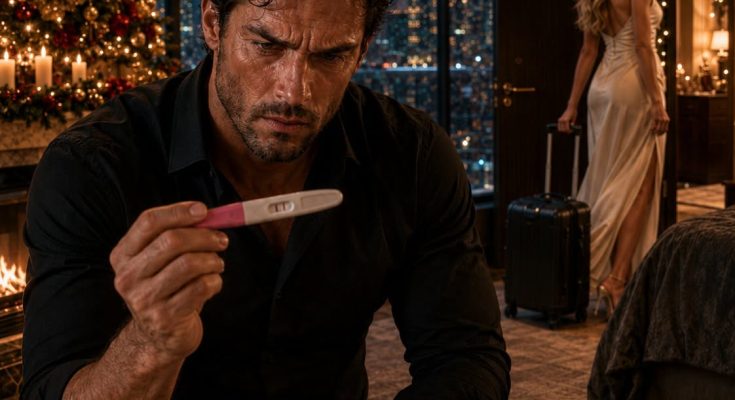
Then he saw the pregnancy test.
Two pink lines.
Bright.
Unmistakable.
The world narrowed.
Marcus picked it up as if it were made of glass.
His hand, which had held guns steady under fire, trembled.
He stared at it.
Once.
Twice.
As though the meaning might change if he looked long enough.
It did not.
Elena was pregnant.
His wife was pregnant.
And she had left him.
Marcus sat down slowly in the chair by the desk. The papers rustled beneath his wrist. The Christmas music from downstairs sounded distant and obscene.
He tried to breathe.
Could not.
A memory flashed through him without mercy.
Elena laughing in this room on their first winter here, barefoot on the rug, holding up two mugs of hot chocolate because she said whiskey was not a proper Christmas drink.
Elena asleep on his shoulder in the back of the car after a charity gala, her fingers tangled in his coat.
Elena at breakfast, waiting for him to look up from his phone.
Elena in the dining room last month, candles burning low, a second plate untouched across from her.
He had noticed.
That was the cruelty of it.
He had noticed everything.
The way she stopped asking when he would be home.
The way she stopped reaching for him in bed.
The way her smiles became polite, then rare, then absent.
He had told himself it was safer this way.
Distance protected her.
Coldness kept enemies from seeing what she meant to him.
Indifference made her untouchable.
He had built a fortress around her and forgot that fortresses looked like prisons from the inside.
Marcus bent forward, elbows on his knees, the pregnancy test trapped in his fist.
On the desk, the divorce papers waited for his signature.
He read the first page again.
Then the second.
Then the third.
His face turned white.
Not from fear of losing money. Not from public humiliation. Not from the insult of being left on Christmas Eve with half the city’s criminal elite downstairs drinking his champagne.
Marcus Vale, who had survived bullets, betrayal, prison threats, and wars between families, went pale because he finally understood that Elena had not left to hurt him.
She had left because she believed there was nothing left to save.
The door opened behind him.
“Marcus?”
His sister, Valentina, stood in the doorway wearing emerald silk and diamonds. Her smile faded when she saw his face.
“What happened?”
He did not answer.
Her gaze moved to the papers.
Then to the pregnancy test in his hand.
Her lips parted.
“Oh my God.”
Marcus rose.
“Find her.”
Valentina stepped inside. “Marcus—”
“Find her now.”
“Do you even know where she went?”
He turned on her, eyes dark and hollow. “That is why I said find her.”
Valentina crossed the room and snatched the divorce papers from the desk. Her eyes scanned the pages fast.
“She signed them,” she said quietly.
“I can see that.”
“And she left the test for you.”
His jaw flexed.
“She wanted you to know.”
He looked toward the window, where snow blurred the city lights.
“No,” he said. “She wanted me to know too late.”
Downstairs, a guest shouted with laughter.
Marcus’s voice hardened. “End the party.”
Valentina looked at him sharply. “You cannot just throw everyone out. Russo is here. The alderman is here. Half the men downstairs came because—”
“I said end it.”
The tone left no space for argument.
Valentina inhaled slowly. Then nodded.
As she turned to leave, Marcus spoke again.
“Quietly.”
She gave a humorless laugh. “You still care about quiet?”
His eyes returned to the pregnancy test.
“No,” he said. “But Elena does.”
Within twenty minutes, the mansion emptied.
Cars rolled away through snow. Men who once believed themselves powerful left without complaint after one look at Marcus Vale standing motionless in the foyer.
Dominic Russo lingered near the door, watching too closely.
Marcus noticed.
He always noticed.
“Problem, Dominic?” he asked.
Dominic smiled. “No problem. Family emergency?”
Marcus walked toward him.
The room went still.
Dominic’s smile weakened.
Marcus stopped inches away. “My family is not your concern.”
“Of course.”
“Then leave.”
Dominic did.
Marcus waited until the door closed before turning to Antonio.
“Her phone.”
“Turned off, sir.”
“Credit cards?”
“No activity yet.”
“Airport?”
Antonio hesitated. “We have people checking.”
Marcus heard the hesitation.
“What?”
Antonio glanced at Valentina.
Marcus’s patience vanished. “Speak.”
“She booked a flight to San Diego.”
Marcus moved instantly toward the door.
Antonio added, “But she never boarded.”
Marcus stopped.
The temperature in the foyer seemed to drop.
“What do you mean she never boarded?”
“The driver took her toward O’Hare. According to traffic cameras, the car exited before the airport. After that, it disappeared near West Grand.”
Marcus turned very slowly.
Antonio’s face had gone grim.
“That area has blind spots,” Antonio said. “Construction. Cameras down.”
Marcus said nothing.
Valentina gripped the stair railing. “Maybe she changed cars.”
“Maybe,” Antonio said.
But no one believed it.
Marcus’s phone rang.
Unknown number.
He answered on the first ring.
For a second, there was only static.
Then a man’s voice, distorted and calm, said, “Merry Christmas, Vale.”
Marcus did not move.
“Where is my wife?”
A soft laugh. “Your wife? That’s interesting. She seemed very alone when we found her.”
Marcus’s hand tightened until the phone creaked.
Valentina went white.
The voice continued, “Do not start a war tonight. Do not call your friends in blue. Do not send your dogs into the streets. Wait for instructions.”
Marcus’s voice was low enough to freeze blood.
“If she has one scratch on her—”
“She is alive.”
The pause that followed was deliberate.
“For now.”
The call ended.
No one spoke.
Then Marcus hurled the phone against the marble floor so hard it shattered.
For the first time in years, Antonio looked afraid.
Not of the men who had taken Elena.
Of Marcus.
“Get everyone,” Marcus said.
“Sir, he said—”
“I heard what he said.”
Valentina stepped in front of him. “Marcus, think. Elena is pregnant.”
The word cut through his rage.
Pregnant.
His child.
Their child.
Marcus closed his eyes once.
When he opened them, the fury was still there, but sharpened now into something colder.
“Then we do this carefully,” he said. “No police. No noise. I want every camera, every toll record, every burner phone ping in this city looked at. I want to know who knew she was leaving. I want the driver found first.”
Antonio nodded. “And when we find who took her?”
Marcus picked up the pregnancy test from the foyer table where he had placed it.
His fingers closed around it gently.
“When we find them,” he said, “I will decide whether they are allowed to die quickly.”
Elena woke to the taste of metal.
For several seconds, she did not understand where she was.
The room was dim. Concrete walls. A single bulb overhead. Her wrists were not tied, but the door was metal and locked. A blanket had been thrown over her. Her coat was gone.
She sat up too quickly and nausea rolled through her.
Her hand flew to her stomach.
The baby.
A sob rose in her throat, but she swallowed it down.
Panic would not help.
She forced herself to remember.
The car.
Snow against the windows.
The driver taking a wrong exit.
Her asking, “Where are we going?”
Then another car blocking the road.
A man opening her door.
A cloth over her mouth.
Darkness.
Elena breathed slowly.
Once.
Twice.
She stood on unsteady legs and moved to the door.
“Hello?”
Her voice echoed.
No answer.
She tried the handle.
Locked.
Of course.
A laugh escaped her, brittle and humorless. She had left a mafia boss because she wanted freedom, only to be kidnapped before reaching the airport.
The irony was almost elegant.
Footsteps approached.
Elena backed away.
The door opened.
A woman entered carrying a paper cup and a plastic container of soup. She looked about fifty, with dark hair pulled into a severe bun and a face that had once been beautiful before bitterness carved through it.
“You should eat,” the woman said.
Elena stared at her. “Who are you?”
“Someone who knows what it is to be married to a man like Marcus Vale.”
Elena’s blood chilled.
The woman placed the food on a small table.
“Where am I?”
“Safe enough.”
“That is not an answer.”
“No,” the woman said. “It is not.”
Elena’s hand remained over her stomach. The woman noticed.
“I was told not to hurt you.”
“By whom?”
The woman smiled faintly. “Men who still believe they are in charge.”
Elena studied her. “You’re not one of Russo’s people.”
The woman’s eyes sharpened.
So Elena had guessed right. Dominic Russo had looked at her too closely at parties. He had always smiled as if he knew something dirty about everyone.
The woman folded her arms. “You know more than they think.”
“I’ve spent six years in rooms where dangerous men forgot I could hear.”
A shadow of approval crossed the woman’s face.
“Then hear this. Your husband has enemies. Tonight, one of them made a desperate move.”
“Dominic.”
“Dominic is ambitious. Ambitious men are useful and stupid.”
Elena’s pulse quickened. “Then who are you?”
The woman stepped closer.
“My name is Sofia Marino.”
Elena knew that name.
Everyone in Marcus’s world knew that name, though no one said it loudly.
Twenty-five years ago, the Marino family had ruled half the city. Then came a war. Betrayals. Bodies in rivers. Deals made in courtrooms and churches. By the end, the Marino men were dead, imprisoned, or absorbed into other families.
Sofia Marino had vanished.
Marcus once told Elena she had died.
“You’re supposed to be dead,” Elena whispered.
Sofia smiled.
“Yes,” she said. “That has been very convenient.”
Elena took a step back. “Why am I here?”
“Because your husband is about to discover that not every ghost stays buried.”
The door closed before Elena could ask anything else.
Marcus found the driver at 2:17 in the morning.
Alive.
Barely.
He had been dumped behind an abandoned meatpacking warehouse with a broken nose and enough fear in his eyes to make him talk before Marcus asked the first question.
“I didn’t know,” the driver sobbed from the concrete floor. “They paid me to take the exit, that’s all. Said they just wanted to talk to her. I swear, Mr. Vale, I didn’t know.”
Marcus crouched in front of him.
Snow melted from his black coat onto the floor.
“Who paid you?”
The driver shook so badly his teeth clicked. “Russo’s man. A guy named Nicky. Nicky Bell.”
Marcus looked at Antonio.
Antonio nodded once and stepped away to make a call.
Marcus returned his gaze to the driver.
“Did she scream?”
The driver cried harder.
Marcus asked again, quieter. “Did my wife scream?”
“No,” the driver whispered. “She… she fought. She tried to run. One of them grabbed her. She hit him with her purse. Then they used something. I’m sorry. I’m sorry.”
Marcus stood.
For a moment, he saw Elena not as she had been that morning, silent across the breakfast table, but as the girl he met eight years ago outside a courthouse in the rain.
She had been twenty-four, furious, and carrying a box of legal files for a nonprofit that had just lost funding because some alderman Marcus controlled had cut the budget. She had marched straight up to him, not knowing who he was, and called him “a beautifully dressed parasite.”
He had fallen in love before she finished insulting him.
That Elena would fight.
That Elena would protect their child with her bare hands if she had to.
Marcus turned away.
“Let him live,” he told Antonio.
The driver sobbed in relief.
Marcus added, “For now.”
By 3:05, Nicky Bell was found in a strip club office, trying to leave town with a duffel bag full of cash.
By 3:22, he was on his knees in front of Marcus.
By 3:24, he had given them Dominic Russo.
By 3:31, he had given them something worse.
“It wasn’t just Russo,” Nicky gasped, blood on his mouth. “He was working with someone else. A woman. Older. Scary. Paid in cash. Knew things. Knew your house. Knew your schedule.”
Marcus went still.
“What woman?”
“I don’t know her name.”
Marcus stepped closer.
Nicky started crying. “I swear! Russo called her the widow. That’s all. The widow.”
Antonio crossed himself.
Marcus saw it.
“What?”
Antonio’s face had gone gray.
“There were rumors,” he said slowly. “Years ago. After the Marino war. Some said Sofia Marino lived.”
The room changed.
Even the men behind Marcus seemed to stop breathing.
Marcus stared at Antonio.
“You told me she was dead.”
“We all believed she was.”
Marcus looked down at Nicky. “Where did they take my wife?”
“I don’t know.”
Marcus’s silence was worse than shouting.
Nicky began babbling. “But Russo has a place. Not in his name. Old church on Halsted. Basement rooms. He uses it when he needs people hidden.”
Marcus turned to leave.
Antonio followed. “Sir, if Sofia Marino is involved, this is not just ransom.”
“I know.”
“She may not want money.”
“I know.”
“She may want you there.”
Marcus stopped at the door.
His face was calm now.
Terribly calm.
“Good,” he said. “Then she will have me.”
Elena counted time by footsteps.
Some passed the door and continued.
Some stopped.
Once, she heard men arguing in the hallway.
Dominic Russo’s voice was unmistakable.
“You were supposed to keep this clean,” he snapped. “No drama. No speeches. We make him sign over the dock routes, then she goes home.”
Sofia’s voice answered, smooth and dry. “You kidnapped a pregnant woman on Christmas Eve and expected cleanliness?”
Elena pressed herself against the wall near the door.
Dominic cursed. “You said she was leverage.”
“She is.”
“She is Marcus Vale’s wife.”
“No,” Sofia said. “She is the one thing Marcus Vale cannot afford to lose.”
A pause.
Then Dominic, quieter: “You really think he loves her?”
Sofia laughed softly.
“Men like Marcus always love too late.”
Elena closed her eyes.
The words should not have hurt.
But they did.
Because some ruined part of her still wanted them to be true.
Not the too late.
The love.
The door opened suddenly.
Elena stumbled back.
Dominic Russo entered wearing a wool coat over his tuxedo shirt. His hair was mussed, his handsome face tight with nerves.
“Elena,” he said, as if they were old friends meeting at brunch. “I am sorry for the inconvenience.”
“Inconvenience?” Her voice shook with fury. “You drugged me.”
“Yes, well. That was not my preference.”
“What do you want?”
“Your husband to be reasonable.”
She laughed once. “Then you’ve already failed.”
Dominic’s mask slipped.
“You have no idea what he is, do you?”
“I know exactly what he is.”
“No. You know the marble floors and the diamonds. You know the silent dinners. You know the lonely bed.” He stepped closer. “But you don’t know what he did to build that house.”
Elena lifted her chin. “I know enough.”
“You know nothing.”
Dominic reached into his coat and pulled out a folded photograph. He tossed it onto the table.
Elena did not want to look.
She did anyway.
It was old, grainy, taken in winter.
A young woman stood beside a little boy in front of a modest brick house. The woman had dark hair and proud eyes.
Sofia.
The boy looked maybe six.
Elena’s stomach tightened. “What is this?”
Dominic smiled without warmth.
“Ask your husband.”
Sofia appeared in the doorway behind him. “Get out.”
Dominic turned. “I’m handling this.”
“You’re frightening her for sport.”
“She should know who she married.”
“She already knows more than you think.”
Dominic’s eyes narrowed. “Careful, Sofia. This works because we both need each other.”
Sofia looked at him as if he were an insect on her sleeve.
“No,” she said. “It works because you think I need you.”
Dominic’s face darkened, but he left.
Sofia closed the door behind him, then looked at Elena.
“I told you to eat.”
Elena pointed to the photograph. “Who is the boy?”
For the first time, Sofia’s expression shifted.
Not much.
Just enough for Elena to see grief beneath the iron.
“My son.”
“What does he have to do with Marcus?”
Sofia walked to the table and picked up the photograph.
“Everything.”
Elena waited.
Sofia’s thumb brushed the boy’s face.
“His name was Luca. He was seven when your husband’s father ordered the fire.”
Elena went cold.
“Marcus’s father?”
“Do not look relieved. Marcus was there that night.”
Elena shook her head. “No.”
“You are certain?”
“He would have told me.”
Sofia’s eyes softened in a way that was almost cruel.
“Would he?”
Elena had no answer.
The room seemed to tilt.
Marcus had secrets. She had always known that. But there were secrets like locked rooms, and then there were graves.
Sofia slid the photograph into her pocket.
“I did not take you because I hate you, Elena. I took you because Marcus Vale took everything from me and then built himself a beautiful life. A wife. A palace. A future.” Her gaze dropped to Elena’s stomach. “And now, a child.”
Elena’s protective hand returned there instinctively.
Sofia noticed.
“I wonder what he would trade for that future.”
Elena’s voice was barely audible. “What do you want from him?”
Sofia leaned close.
“The truth first,” she whispered. “Then his kingdom.”
At dawn, Marcus entered the old church on Halsted alone.
At least, that was what he wanted them to believe.
He wore no coat now, only his black suit and white shirt open at the throat. His hands were visible. Empty.
The church had been abandoned for years. Snow pushed through cracks in the stained glass. Broken pews lined the nave like ribs. A statue of the Virgin Mary stood near the altar, her painted eyes chipped away.
Dominic Russo waited near the front with four armed men.
Sofia Marino stood behind him.
Marcus saw her and understood immediately that Nicky Bell had been wrong.
Dominic was not leading this.
Dominic had never been leading this.
Sofia looked older than the photographs, but her eyes were the same. Winter-hard. Patient. Merciless.
“Merry Christmas, Marcus,” she said.
His eyes moved over the room. “Where is Elena?”
“Safe.”
“I asked where.”
Sofia smiled. “Still giving orders in a house of God?”
Marcus looked at Dominic. “You involved yourself in family business.”
Dominic’s mouth twitched. “You ignored your family so thoroughly, I assumed there was a vacancy.”
Marcus took one step forward.
Every gun lifted.
Sofia raised a hand, and the guns lowered slightly.
“Enough,” she said. “This is not a street corner.”
Marcus’s eyes returned to her. “You want me. You have me. Let her go.”
“You think it is that simple?”
“It can be.”
“No.” Sofia’s voice hardened. “It cannot.”
She gestured to Dominic, who pulled a folder from beneath his arm and threw it at Marcus’s feet.
“Sign,” Dominic said.
Marcus did not look down.
“What is it?”
“Transfer documents,” Dominic said. “Your dock operations. Certain construction holdings. Three council contacts. Enough to make me very comfortable and you less untouchable.”
Marcus’s gaze stayed on Sofia.
“And you?”
Sofia’s smile vanished.
“I want you to tell your wife what happened on Ashland Avenue twenty-five years ago.”
Something flickered in Marcus’s face.
Sofia saw it.
“So you do remember.”
Marcus was silent.
Dominic’s interest sharpened. “This should be good.”
Sofia stepped closer. “Tell her why my son died.”
Marcus’s jaw tightened.
At that moment, a side door opened.
Elena was brought in by a young guard who looked too nervous to be trusted with a weapon. Her hair was loose around her pale face. She wore no coat, only the cream sweater she had left home in.
Marcus turned.
The sight of her did something visible to him.
For one second, all the power drained out of his face.
“Elena.”
She stared at him.
Not with relief.
With questions.
That wounded him more than any gun.
“Are you hurt?” he asked.
“No.”
“The baby?”
Her lips parted slightly.
He had said it.
The baby.
For the first time, the truth existed between them aloud.
“I don’t know,” she said. “I think I’m okay.”
He closed his eyes for half a heartbeat.
Then looked at Sofia. “Let her leave.”
“After the story,” Sofia said.
Elena’s voice came quietly. “What happened on Ashland Avenue?”
Marcus did not answer.
Sofia did.
“There was a house. My house. Your husband’s father believed my husband had betrayed him. So he sent men to burn it in the night.”
Elena looked at Marcus.
His face was stone.
Sofia continued, “My husband was not there. I escaped through the back window. My son was upstairs.”
Elena’s hand went to her mouth.
Sofia’s voice did not break, but the room seemed to bend around her grief.
“Luca was seven.”
Elena whispered, “Marcus?”
He looked at her then.
And in his eyes, she saw something she had almost never seen.
Shame.
“I was nineteen,” he said.
Dominic scoffed. “Old enough.”
Marcus ignored him.
“My father sent me with the men. I was supposed to watch. Learn.” His voice was flat, each word dragged over glass. “I did not know there was a child inside.”
Sofia’s eyes burned. “Liar.”
“I didn’t.”
“You were there.”
“Yes.”
“You stood outside while my son screamed.”
Marcus flinched.
Elena saw it.
A real flinch.
“I heard him,” Marcus said. “I ran in.”
The church went silent.
Sofia stared at him.
“No,” she said.
Marcus’s voice remained low. “The stairs were already burning. I tried to get up. One of my father’s men pulled me back. I fought him. He broke two of my ribs dragging me out.”
Sofia shook her head. “No.”
“I went back after the roof fell.”
“No.”
“I found him.”
The word cracked.
Elena had never heard Marcus’s voice break.
Not once.
Marcus looked at Sofia. “I carried him out.”
Sofia staggered as if struck.
“You left him on the snow near the alley,” Marcus said. “You were gone. Police were coming. My father’s men were watching. If they knew I had tried to save him, they would have killed me too.”
Sofia’s face emptied.
“That is not true.”
Marcus reached into his pocket slowly.
Every gun rose again.
He pulled out a small object wrapped in worn cloth.
Antonio had once asked him why he kept it. Marcus had never answered.
Now he unfolded the cloth.
Inside was a tiny silver Saint Christopher medal, blackened at the edges by fire.
Sofia made a sound that did not seem human.
Marcus held it out.
“He was wearing this.”
Sofia did not move.
Elena’s tears fell silently.
Marcus placed the medal on a broken pew.
“I killed my father six months later,” he said. “Not for power. Not at first.”
Sofia looked at him, devastated and disbelieving.
Marcus’s voice lowered. “For Luca.”
Dominic broke the silence with a sharp laugh.
“Well. Touching. Truly. But unless Saint Christopher can sign over Lake Michigan access, I suggest we return to business.”
Sofia turned on him slowly.
Dominic did not notice the danger quickly enough.
“Enough,” she said.
His brows lifted. “Excuse me?”
“I said enough.”
Dominic’s hand moved toward his gun.
Marcus moved faster.
So did the church.
A stained-glass window shattered.
Antonio’s men came through the side exits like shadows. Dominic’s guards turned too late. Two shots cracked. Someone shouted. Elena screamed as Marcus lunged toward her, pulling her behind a pillar and covering her body with his own.
The world became noise.
Gunfire.
Breaking wood.
Men cursing.
Sofia stood strangely still in the center aisle, staring at the little medal on the pew as if the war around her belonged to someone else.
Dominic grabbed her from behind and pressed a gun beneath her jaw.
“Everybody stop!” he roared.
The gunfire died.
Marcus rose slowly, keeping Elena behind him.
Dominic dragged Sofia backward, his face twisted with panic and rage.
“You think I came this far to lose everything to a dead child story?”
Sofia’s expression was calm now.
Too calm.
“Dominic,” she said softly, “you were always small.”
His face flushed. “Shut up.”
“You borrowed my grief and mistook it for permission.”
“I said shut up!”
Marcus’s voice cut through the church. “Let her go.”
Dominic laughed. “Now you care about her too? How generous.”
Elena saw something then.
A movement near the altar.
The nervous young guard who had brought her in was not watching Marcus.
He was watching Sofia.
With tears in his eyes.
Sofia looked at him once.
Only once.
The boy raised his gun.
Dominic saw too late.
The shot struck his shoulder. He cried out, stumbling. Sofia twisted free. Marcus moved like a blade, crossing the distance before Dominic could lift his gun again.
He slammed Dominic against the altar.
The gun clattered away.
For a moment, Marcus’s hand closed around Dominic’s throat.
The old Marcus would have ended him there.
Everyone knew it.
Dominic knew it most of all.
His eyes bulged. His mouth opened uselessly.
Marcus looked back at Elena.
She stood trembling, one hand over her stomach, snow blowing through broken glass behind her.
Not pleading.
Just watching.
Marcus released Dominic.
Dominic collapsed, choking.
“Take him,” Marcus said.
Antonio’s men dragged him away.
No one spoke.
Sofia walked to the pew and picked up the medal with shaking fingers. She held it to her lips, and for the first time, the iron woman broke. Not loudly. Not theatrically. Just a silent collapse inward, grief finally finding air after twenty-five years buried alive.
Elena turned to Marcus.
“You kept it,” she said.
He looked at the medal in Sofia’s hand.
“Yes.”
“Why didn’t you tell her?”
“Because truth from me would have sounded like mercy I did not deserve.”
Elena’s eyes filled again, but her face was unreadable.
Marcus stepped toward her.
She stepped back.
He stopped immediately.
That hurt more than if she had slapped him.
“Elena,” he said, “I am taking you to a doctor.”
She nodded. “Yes.”
“And after that—”
“After that,” she interrupted, “I decide where I go.”
His mouth closed.
For a second, the mafia boss of Chicago looked like a man learning how powerless love could make him.
“Yes,” he said. “You decide.”
The hospital room was quiet by sunrise.
Snow still fell beyond the window, but the city had begun to wake beneath it. Somewhere down the hall, a nurse laughed softly. Christmas morning had arrived whether anyone was ready for it or not.
Elena lay propped against pillows, pale but stable.
The doctor had confirmed what the tests had already said.
Pregnant.
Six weeks.
The baby was fine.
When Elena heard the heartbeat, impossibly faint and fast, she closed her eyes and cried.
Marcus stood near the wall, silent as a shadow.
He had not tried to touch her.
Not once.
That restraint frightened her almost as much as his rage once had, because it showed her that he could have chosen differently all along.
When the doctor left, silence settled between them.
Elena stared at the blanket over her knees.
Marcus finally spoke.
“I signed the papers.”
She looked up sharply.
He reached into his coat and placed the divorce documents on the small table beside her bed.
His signature was there beneath hers.
Marcus Vale.
Dark ink.
Final.
Elena’s chest tightened.
“I thought you would fight me.”
“I wanted to.”
“Why didn’t you?”
His eyes met hers.
“Because I have spent years confusing possession with protection.”
She looked away.
He continued, voice rougher now. “I thought keeping you outside the ugly parts of my life was love. I thought if no one could see how much I needed you, no one could use you against me.” He swallowed. “But I made you invisible to everyone, including myself.”
Elena’s fingers curled around the blanket.
“You forgot me,” she whispered.
“No.”
The word came too fast, too wounded.
Then he corrected himself.
“I made you feel forgotten. That may be worse.”
She laughed softly through tears.
“You missed birthdays, Marcus.”
“I know.”
“Our anniversaries.”
“I know.”
“I ate alone in that house so many nights I started talking to the walls.”
His face tightened with pain.
“I know.”
“No,” she said, looking at him now. “You don’t. You know facts. You know dates. You know what you failed to do. But you don’t know what it felt like to wait for your footsteps and hear nothing.”
Marcus had no answer.
That was the first honest thing between them.
Elena touched her stomach.
“I won’t raise a child inside a mausoleum.”
“I don’t want you to.”
“And I won’t let our baby become another piece of your empire.”
His eyes darkened, not with anger, but fear.
“No.”
“You don’t get to decide that by saying no.”
“I know.”
She studied him carefully.
He looked exhausted. Not physically. Marcus could survive days without sleep and still terrify a room. This was different. Something in him had been stripped bare.
“Where is Sofia?” she asked.
“With Valentina.”
“Will you kill her?”
“No.”
Elena searched his face. “Dominic?”
Marcus’s silence answered.
She closed her eyes.
“I don’t want to know.”
“Then you won’t.”
“That is not the same as being innocent.”
“No,” he said. “It is not.”
A long quiet followed.
Then Marcus reached into his pocket.
Elena stiffened.
He noticed and moved slowly, placing her wedding ring on the table beside the signed papers.
Only then did Elena realize her finger was bare.
She must have removed it before leaving, sometime between packing and placing the test on the papers. She barely remembered doing it.
“I found it on the dresser,” he said.
She looked at the ring.
Six years of marriage in a circle of gold and diamond.
“I thought you would keep it,” she said.
“It is yours.”
“I’m not sure I want it.”
“Then throw it away.”
Her eyes lifted to his.
His voice was quiet. “But do not leave it with me. I have kept enough things that did not belong to me.”
Elena’s throat tightened.
For one terrifying moment, she wanted to reach for him.
Not because everything was forgiven.
It was not.
Not because the pain was gone.
It was not.
But because love, the stubborn, foolish creature, still moved somewhere beneath all the wreckage.
Then Marcus’s phone vibrated.
He ignored it.
It vibrated again.
Elena said, “Answer.”
He checked the screen.
His expression changed.
“What?” she asked.
Marcus did not answer immediately.
Then he turned the phone toward her.
A message from an unknown number.
No words.
Just a photograph.
Elena’s breath stopped.
It showed the bedroom at the mansion.
Marcus’s desk.
The pregnancy test.
The divorce papers.
And beside them, placed neatly where neither Elena nor Marcus had left it, was a tiny pair of white baby shoes tied with a red ribbon.
Under the photo was one sentence.
Congratulations, Mr. Vale. I look forward to meeting the heir.
Elena’s blood went cold.
Marcus took the phone back, his face turning into something older and darker than rage.
“Elena,” he said quietly, “did anyone else know?”
She shook her head. “No.”
“Simone?”
“No. I hadn’t told her yet.”
“Doctor?”
“I hadn’t gone.”
He stared at the message.
Outside the hospital room, footsteps approached, then stopped.
A soft knock sounded at the door.
Marcus turned.
Antonio entered, but he was not alone.
Behind him stood Sofia Marino, pale and composed, Luca’s blackened medal hanging from her fingers.
Her gaze moved first to Elena.
Then to Marcus.
Then to the phone in his hand.
“I received one too,” Sofia said.
She lifted her own phone.
On the screen was the same photograph.
But her message was different.
The child will finish what the fathers began.
Elena’s hand flew to her stomach.
Marcus stepped in front of her bed.
Sofia looked at him, and for the first time, there was no hatred in her eyes.
Only fear.
“Marcus,” she said, “Dominic was never the one who planned this.”
The hospital lights flickered.
Once.
Twice.
Then every monitor in Elena’s room went dark.
PART 3 — THE BABY SHOES IN THE DARK
The moment the hospital room went black, Elena stopped being afraid for herself.
Her hand flew to her stomach.
The monitors died with a soft, horrifying sigh. The green lines vanished. The gentle rhythm that had filled the room seconds before disappeared into silence.
“Elena,” Marcus said.
His voice was calm, but it was the kind of calm that meant something inside him had already drawn a weapon.
“I’m here,” she whispered.
A red emergency light blinked once above the door, then failed too.
For two breaths, there was only darkness.
Then came the scream from the hallway.
Marcus moved instantly, placing himself between Elena’s bed and the door. Antonio pulled his gun. Sofia stepped backward, Luca’s blackened medal clenched in her fist, her face pale not with weakness but recognition.
“They found us,” Antonio said.
“No,” Sofia whispered. “They were already here.”
Marcus turned his head slightly. “Who?”
Before she could answer, the hospital’s backup generator coughed to life. Dim yellow light spread through the room, weak and trembling. Elena saw Marcus’s profile, hard as carved stone. She saw Antonio’s gun raised. She saw Sofia staring at the door as if a ghost had finally learned to knock.
Then the hospital intercom crackled.
A child’s lullaby began to play.
Soft.
Distorted.
Wrong.
Elena’s blood turned cold.
The tune floated through the halls, sweet and broken, the melody skipping like an old music box.
Marcus looked at Sofia.
Sofia’s eyes filled with a terror Elena had not seen even in the church.
“That song,” Sofia said.
“What song?” Elena asked.
Sofia swallowed. “Luca’s father used to sing it to him.”
The door handle moved.
Antonio stepped forward.
Marcus lifted one hand, stopping him.
A white envelope slid beneath the hospital door.
No one breathed.
Marcus crouched, picked it up, and opened it.
Inside was another photograph.
Elena’s bedroom again.
The divorce papers.
The pregnancy test.
The baby shoes.
But this time, there was something else beside them.
A chess piece.
A black king, lying on its side.
On the back of the photo, written in elegant handwriting, were five words:
The heir is not yours.
Elena stared at the sentence.
The room seemed to drop beneath her.
Marcus did not move.
Not at first.
Then his eyes slowly lifted to Elena’s face.
For one unbearable second, she saw the wound before the mask covered it.
“No,” she said immediately.
Her voice cracked.
“Marcus, no.”
He said nothing.
“I have never—” Her breath caught. “I have never betrayed you.”
The silence that followed was worse than accusation.
Marcus walked to her bedside. Slowly. Carefully. As though she were made of glass and he had already broken her once.
“I know,” he said.
Elena blinked.
He looked down at the photo in his hand, then back at her.
“I know.”
Sofia frowned. “Then why send that message?”
Marcus’s face hardened. “Because whoever is doing this does not want me angry.”
Antonio understood first. “They want you divided.”
Marcus nodded. “They want Elena unsafe beside me.”
Elena’s heart pounded. “Who could know about the baby?”
Sofia looked toward the dark hallway. “Someone who knew before you did.”
That sentence entered the room like winter.
Elena thought of the pregnancy tests in the bathroom. Four boxes. The pharmacy. The receipt. The guard at the door. The staff in the house. The phone she had used. The driver. Simone, who did not know. The doctor she never saw.
No.
Someone had known because someone had been watching her.
For weeks.
Maybe months.
Marcus turned to Antonio. “Lock this floor down.”
Antonio disappeared into the hall.
Marcus looked at Sofia. “Talk.”
Sofia’s lips pressed tight. For a moment, Elena thought the older woman would refuse. Then Sofia sat slowly in the chair near the window, as if her knees could no longer hold the weight of history.
“Before your father burned my house,” Sofia said, “there was another family.”
Marcus’s eyes narrowed. “The Bellantis.”
Sofia nodded.
Elena had heard that name only once, years ago, at a dinner where a man had gone silent after saying it. Marcus had changed the subject with one glance.
“The Bellanti family disappeared before I was born,” Marcus said.
“No,” Sofia said. “They were erased from conversation. That is different.”
Marcus stared at her.
Sofia continued, “Your father, my husband, and Vittorio Bellanti built the old empire together. Three men. Three houses. One city. Then Vittorio discovered something neither of them wanted exposed.”
“What?”
Sofia looked at Elena.
“The children.”
Elena’s fingers tightened around the blanket.
“What children?”
Sofia’s voice lowered. “For years, men in your world used children as bargaining pieces. Not always their own. Sometimes the children of debtors, witnesses, mistresses, enemies. They were hidden, moved, renamed, raised under protection or threat.”
Elena felt sick.
Marcus’s face had gone dangerously still.
“My father was part of this?” he asked.
Sofia’s eyes did not soften. “All of them were.”
“No.”
The word came from Elena, not Marcus.
Sofia turned to her.
Elena shook her head. “No. Marcus would know.”
Marcus said nothing.
That was the answer.
Elena looked at him.
“Marcus?”
He stared at the floor.
“I knew there were protected families,” he said slowly. “I knew money was sent. New identities. Safe houses. I thought they were witnesses. Widows. People my father paid to stay quiet.”
Sofia laughed without humor. “Some were.”
“And the others?” Elena whispered.
Sofia’s eyes darkened.
“The others were bloodlines.”
The lullaby outside stopped.
A gunshot cracked in the hallway.
Elena gasped.
Marcus turned toward the door, but before he could move, Antonio shouted from outside, “Clear!”
A second later he returned, dragging a man in hospital scrubs by the collar. The man’s mask had been ripped away. He was young, terrified, and bleeding from the eyebrow.
Antonio threw him to the floor.
“Found him near the nurse’s station,” Antonio said. “He had a transmitter and this.”
He tossed a small white baby shoe onto the bed.
Elena recoiled.
Marcus crouched in front of the man.
“Who sent you?”
The man shook his head violently. “I don’t know his name.”
Marcus did not touch him.
Somehow, that was worse.
“Describe him.”
“Old. Maybe sixty. White hair. Scar near his mouth. He said if I put the envelope under the door, he’d pay my brother’s debt.”
Sofia made a sound.
Marcus looked at her. “You know him.”
Sofia’s face had lost all color.
“No,” she whispered. “He died.”
Marcus stood. “Who?”
Sofia’s voice barely came out.
“Vittorio Bellanti.”
Antonio froze.
Marcus’s eyes turned black.
“That is impossible.”
Sofia looked at the baby shoe on Elena’s bed.
“Tonight,” she said, “I have learned dead people have become very fashionable in Chicago.”
Elena looked from Sofia to Marcus.
“Why would this Bellanti man care about my baby?”
Marcus did not answer.
But Sofia did.
“Because if Vittorio is alive,” she said, “then this is not about Marcus’s empire.”
She looked at Elena’s stomach.
“It is about who inherits the city after him.”
And for the first time since she had left the mansion, Elena understood something that chilled her deeper than snow:
Her unborn child was not being hunted because of Marcus’s power.
Her unborn child was being hunted because someone believed the baby was the key to ending it.
PART 4 — THE WOMAN WHO KNEW THE SAFEHOUSE
By morning, Elena was no longer in the hospital.
Marcus did not ask her to come with him. He did not command. He did not touch her elbow as if guiding meant owning.
He simply stood by the door and said, “This building is compromised.”
Elena looked at the signed divorce papers on the bedside table.
Then at the little white baby shoe sealed in an evidence bag.
Then at Marcus.
“Where would you take me?”
“Somewhere no one knows.”
Sofia laughed softly.
Marcus looked at her.
She lifted one eyebrow. “You do not have such a place.”
The truth struck the room hard.
Marcus Vale owned warehouses, mansions, apartments under false companies, hotel suites, lake houses, quiet rooms beneath legitimate restaurants. But every place belonged to his system. And if the enemy had reached Elena’s bedroom and hospital room, then his system had holes.
Elena sat up slowly.
“I know a place.”
Marcus frowned. “No.”
“You don’t even know what I’m going to say.”
“If it belongs to Simone, no.”
Elena’s mouth tightened. “You don’t get to veto my friends.”
“If they know about her, they will use her.”
“They already know about me in your world, Marcus.”
He absorbed that.
The argument died before it could begin.
Elena looked at Antonio. “My mother had a cabin in Wisconsin. Not in my married name. Not in my father’s name. My grandmother bought it in cash forty years ago. No one has been there since she died.”
Marcus’s eyes searched hers. “Why have you never mentioned it?”
“Because I wanted one thing in my life that had nothing to do with you.”
The sentence landed softly.
Still, it cut.
Marcus nodded once.
“Then we go there.”
Sofia stood. “I’m coming.”
“No,” Marcus said.
“Yes,” Elena said.
Marcus turned to her.
Elena held his gaze. “She knows Bellanti. You don’t.”
Sofia’s smile was faint. “Your wife is smarter than you.”
Marcus looked like he wanted to object to wife, then remembered the papers he had signed.
“My ex-wife,” Elena said quietly.
No one spoke.
The word changed the air.
Marcus looked away first.
They left through a service tunnel beneath the hospital laundry wing. Valentina arranged clothes, false plates, and a car that did not belong to anyone in Marcus’s organization. By noon, Chicago was behind them, vanishing beneath snow and distance.
Elena sat in the back seat, wrapped in a gray coat too large for her. Sofia sat beside her, silent, watching the road. Marcus drove. Antonio followed in a separate car a mile behind.
For three hours, no one said much.
The world beyond the windows turned white and bare.
Fields.
Pines.
Frozen streams.
Elena’s exhaustion deepened until her bones felt hollow, but sleep would not come. Every time her eyes closed, she saw the baby shoes. The black king. The words: The heir is not yours.
Marcus’s voice broke the silence.
“I never thought that.”
Elena looked up.
He kept his eyes on the road.
“The message. I never believed it.”
“I know.”
“No,” he said. “You deserved to hear it clearly.”
Sofia glanced between them, then looked away.
Elena studied the back of Marcus’s head. Six years of marriage, and he had said more honest things in twenty-four hours than in the last three years combined.
That made her angry.
And sad.
And afraid.
Because what did a woman do when the man who broke her finally learned the shape of the wound?
“You don’t trust easily,” Elena said.
“No.”
“But you trusted me?”
Marcus’s hands tightened on the wheel.
“With the only part of me I did not know how to keep alive.”
Elena looked out the window before he could see her tears.
Sofia spoke suddenly.
“Vittorio Bellanti had a daughter.”
Marcus’s eyes flicked to the mirror.
Sofia continued, “Isabella. Beautiful. Wild. Spoiled by her father and feared by everyone else. She disappeared the same night Vittorio supposedly died.”
“How?” Marcus asked.
“Explosion at the Bellanti estate. Officially, a gas leak. Unofficially, your father and mine decided Vittorio had become dangerous.”
“What did he discover?” Elena asked.
Sofia turned to her. “A ledger.”
“What kind of ledger?”
“The kind men kill their friends to bury.”
The cabin appeared just before dusk.
It stood at the edge of a frozen lake, half-hidden among black pine trees, its roof heavy with snow. The place was small compared to the Vale mansion, almost fragile, with dark green shutters and a stone chimney.
Elena stepped out of the car and breathed in.
Cold.
Wood smoke from some distant home.
Pine.
Silence.
For the first time since Christmas Eve, she felt something close to air in her lungs.
Marcus watched her face.
“This was yours?” he asked.
“My grandmother’s.”
“You came here as a child?”
“Yes.”
He nodded, as if storing that away with painful care. Another piece of her life he had never asked about.
Inside, the cabin smelled of dust, cedar, and old memories. The furniture was covered in sheets. Elena found the breaker box, the fireplace matches, the old canned goods her mother always insisted on replacing and never used.
Marcus checked every room.
Sofia stood by the window, watching the tree line.
Antonio arrived twenty minutes later and secured the perimeter.
Night fell hard.
The four of them gathered around the kitchen table beneath a yellow lamp. Sofia drew three circles on a napkin.
“Vale. Marino. Bellanti.”
She tapped each name with the pen.
“Three families built the old machine. But Vittorio was different. Your father wanted fear. My husband wanted status. Vittorio wanted continuity.”
“Meaning?” Marcus asked.
“Children,” Sofia said. “Bloodlines. He believed the city should be inherited like a crown.”
Elena’s hand moved unconsciously to her stomach.
Sofia saw it.
“Vittorio collected secrets about every child connected to the families. Legitimate, illegitimate, hidden, adopted. If blood could claim power, he wrote it down.”
Marcus leaned back.
“The ledger still exists.”
“Yes.”
“And he thinks Elena’s baby belongs in it.”
Sofia nodded. “Or threatens what is already in it.”
Elena frowned. “But why me? Why now?”
A sound came from the porch.
Soft.
Wood creaking under weight.
Marcus was on his feet instantly.
Antonio moved toward the back door.
Sofia lifted a knife from the table.
Elena stood too quickly and dizziness swept through her.
Marcus caught her without thinking.
His hands were careful.
Warm.
For one second, she forgot to pull away.
Then the front door opened.
A woman stepped inside wearing a red winter coat, snow in her dark hair, and a pistol pointed straight at Marcus’s heart.
Elena stopped breathing.
The woman looked at Marcus.
Then at Sofia.
Then at Elena.
Her mouth curved in a smile.
“Merry Christmas,” she said.
Sofia whispered one name.
“Isabella.”
Marcus’s gun rose.
Isabella Bellanti smiled wider.
“Put that away, Marcus. If I wanted you dead, I would have let my father finish what he started.”
Elena stared at her.
“Your father?”
Isabella’s gaze moved to Elena’s stomach.
“Oh, sweetheart,” she said softly. “You really don’t know anything, do you?”
Marcus stepped forward. “Speak carefully.”
Isabella’s eyes glittered.
“Careful is how we all ended up here.”
She reached into her coat and pulled out a small leather book, cracked with age, bound with a brass clasp.
Sofia gripped the table.
“The ledger,” she breathed.
Isabella placed it gently in front of Elena.
“Open it.”
Elena hesitated.
Marcus said, “Don’t.”
But Elena was tired of men telling her what truths she was allowed to touch.
She opened the ledger.
The pages were yellowed, filled with names, dates, locations, payments, coded notes.
Then she saw her own name.
Elena Carter.
Her mother’s name beneath it.
Her grandmother’s.
And beside them, written in faded ink, a note that made the room tilt:
Marino bloodline — concealed female heir.
Sofia staggered backward.
Elena looked up slowly.
“What does that mean?”
Isabella smiled sadly.
“It means, Elena, that Marcus Vale did not marry outside the old families.”
She leaned closer.
“It means he married the last Marino heir.”
PART 5 — THE DIVORCE THAT SAVED HER LIFE
Elena could not hear the lake wind anymore.
She could not hear the fire.
She could not hear Marcus saying her name.
All she could hear was the sentence Isabella had spoken.
The last Marino heir.
“No,” Elena said.
It was a small word.
A useless word.
The ledger lay open in front of her, the ink old but merciless. Her name. Her mother’s name. Her grandmother’s. A bloodline she had never claimed, never known, never wanted.
Sofia stood across the table as if looking at a resurrection.
“My sister,” she whispered.
Elena’s eyes snapped to her.
“What?”
Sofia’s face had become unsteady. “My younger sister, Lucia. She disappeared before the fire. I thought my father sent her away because the war was coming.”
Isabella’s voice softened. “He did. But not only to protect her.”
Sofia pressed a trembling hand against the table. “Lucia had a child?”
“Years later,” Isabella said. “A daughter. That daughter had Elena.”
Elena laughed once, sharp and broken. “No. My mother was a schoolteacher. My grandmother baked terrible lemon cookies and watched soap operas.”
“She also carried a false birth certificate,” Isabella said. “And a bank account funded by three dead men.”
Marcus was silent.
Too silent.
Elena turned to him.
“You knew?”
His answer came immediately. “No.”
Isabella smiled. “He didn’t. That is the funny part. His father arranged the marriage before he died, but Marcus ruined the plan by actually falling in love with you first.”
Elena’s stomach twisted.
Marcus’s eyes darkened. “Explain.”
Isabella sat down without invitation, as if she had waited years for this performance.
“Your father discovered Elena’s bloodline before you did. He planned to use her one day. A Marino heir married into the Vale family would end old disputes and give your future child claim to all three houses.”
“All three?” Antonio asked from the doorway.
Isabella tapped the ledger.
“Vale by Marcus. Marino by Elena. Bellanti by contract.”
Sofia’s eyes narrowed. “What contract?”
Isabella looked at Marcus.
“Your father and mine signed an agreement before their alliance collapsed. If a child ever carried two of the three bloodlines, that child could inherit the old council’s assets, provided the third family acknowledged them.”
Marcus’s voice was cold. “Ancient paper means nothing.”
“It means accounts,” Isabella said. “Properties. Political favors. Offshore holdings. Judges. Records. Names of every man who ever sold his soul to your fathers.” She smiled. “It means a kingdom buried under legal dust.”
Elena felt suddenly sick.
“So my baby…”
“Is not just your baby to them,” Isabella said. “Your baby is the key.”
Marcus slammed his hand on the table.
The lamp shook.
“Elena and the child belong to no one.”
Isabella’s expression sharpened. “Then why did she need divorce papers to escape your house?”
The room went silent.
Marcus looked as if he had been struck.
Elena closed her eyes.
It hurt because it was true.
Sofia spoke quietly. “Why reveal this now?”
Isabella’s smile disappeared.
“Because my father wants the baby. Alive. Raised under his name. He believes Marcus is too emotional, Sofia is too damaged, and Elena is too innocent to control what comes next.”
Elena opened her eyes.
“I am not innocent.”
Isabella looked at her.
For the first time, she seemed almost pleased.
“No,” she said. “You are not.”
Marcus turned to Isabella. “And you? What do you want?”
Isabella looked at the fire.
For a moment, her polished confidence cracked.
“I want my father gone.”
No one moved.
“He is alive?” Sofia asked.
“Yes.”
“Where?”
Isabella’s mouth tightened. “Everywhere. Nowhere. He spent twenty-five years as a ghost, building through men who thought they were independent. Dominic Russo. Judges. doctors. bankers. drivers. Half the city has touched his money without knowing his hand.”
Elena thought of the hospital. The baby shoes. The message.
“He was in my house.”
Isabella nodded. “Or someone loyal to him was.”
Marcus’s gaze became lethal.
Isabella met it calmly. “He has your mansion compromised. Your businesses watched. Your phones cloned. Your doctor lists purchased. Your staff touched. He wanted Elena to leave because divorce made her legally vulnerable.”
Elena frowned. “How?”
Sofia understood. “If she divorces Marcus before the child is born…”
“The child can be claimed through maternal blood without Vale protection,” Isabella said. “Especially if something happens to Marcus.”
Marcus’s face did not change.
Elena’s did.
Something happens to Marcus.
She looked at the signed papers inside her bag.
The divorce she thought was her escape might have been the door someone opened for a predator.
Her hands shook.
Marcus saw.
“Elena,” he said quietly, “this is not your fault.”
She looked at him with burning eyes. “Do not comfort me like I am fragile.”
He stopped.
Good.
She stood.
The men in the room seemed to brace, as if her rising had changed the weather.
“I left because you made me lonely enough to believe leaving was the only way to survive,” she said to Marcus. “I signed those papers because our marriage had become a room with no air. That part is real.”
His face tightened.
“But if someone used my pain to reach my child,” Elena continued, voice trembling with fury, “then I will not run crying into another cage.”
Sofia’s eyes glistened.
Isabella smiled.
Antonio murmured, “Madonna.”
Elena placed one hand over the ledger.
“I want to know everything.”
Marcus looked at her.
This time, he did not say no.
Isabella leaned back. “Then we start with the safest place in the world.”
Marcus frowned. “Which is?”
Isabella’s smile returned.
“The one place your enemy believes you would never go.”
Two hours later, they were back on the road.
Not to Chicago.
Not to San Diego.
Not to any safehouse Marcus owned.
They drove south through a white storm, following Isabella’s directions to a forgotten town near the Illinois border, where an old convent stood abandoned behind iron gates and leafless trees.
Sofia recognized it first.
“No,” she whispered.
Marcus glanced at her. “What is this place?”
Sofia stared through the windshield.
“The Sisters of Saint Agnes.”
Elena looked at the building, its windows dark, its roofline sharp against the moon.
“My grandmother used to send donations here,” she said slowly.
Isabella nodded. “Because this is where she hid after leaving the Marino name behind.”
Inside the convent, dust covered the pews. The chapel smelled of wax and time. Isabella led them behind the altar, down narrow stairs into an archive room lined with metal cabinets.
“This,” she said, “is where women kept the truth while men burned each other’s houses down.”
Elena looked around.
Boxes.
Files.
Photographs.
Birth records.
Letters.
Sofia found Lucia’s name first.
Her hands trembled as she opened the folder.
A photograph slipped out.
A young woman with Sofia’s eyes and Elena’s mouth stood in a garden, holding a baby wrapped in yellow cloth.
On the back was written:
For Sofia, if the truth ever becomes safer than silence.
Sofia covered her face.
Elena picked up the photograph with shaking fingers.
“My grandmother,” she whispered.
Marcus stood behind her but did not touch.
Elena looked at him.
He looked wrecked.
Not by danger.
By the sight of her finding roots he had never known to ask about.
Then Antonio called from the chapel.
“Marcus.”
Everyone froze.
His voice came again, strained.
“You need to see this.”
They returned upstairs.
On the altar, where there had been only dust minutes before, stood a small wooden cradle.
Inside it lay a folded blanket.
And on top of the blanket was a note.
Elena already knew, somehow, that it would be for her.
Marcus opened it.
His face changed.
Elena took it from him.
The handwriting was elegant.
Old-fashioned.
Cruel.
My dear granddaughter,
You have been surrounded by liars since birth. Come home, and I will tell you which one still sleeps beside you.
Elena stared at the words.
Granddaughter.
Her knees weakened.
Sofia whispered, “No.”
Isabella looked confused for the first time.
Marcus’s voice was barely audible.
“Vittorio is not claiming the baby.”
He looked at Elena.
“He is claiming you.”
PART 6 — THE GRANDFATHER WHO SHOULD HAVE BEEN DEAD
Elena read the note six times.
Each time, the same word cut deeper.
Granddaughter.
It was impossible.
It was obscene.
It was a trick.
It had to be.
Sofia paced the chapel like a woman trying not to tear apart the past with her hands.
“My sister was Marino,” she said. “Lucia was my sister. If Elena is Lucia’s granddaughter, then Vittorio Bellanti cannot be—”
“Unless Lucia’s child was not fathered by a Marino man,” Isabella said.
Sofia turned on her. “Careful.”
Isabella lifted both hands. “I am not accusing. I am reading the board.”
Marcus stood near the altar, the note in his hand. He looked at Elena, and for the first time all night, he seemed afraid to speak.
Elena hated that.
“Say it,” she said.
His jaw flexed. “If Vittorio is your biological grandfather, then your child carries Vale, Marino, and Bellanti blood.”
Antonio crossed himself again.
“That would make the baby the sole living claim to everything,” Sofia whispered.
Isabella’s eyes were fixed on Elena. “Not the baby.”
Everyone looked at her.
Isabella swallowed.
“Elena too.”
The chapel seemed to shrink around her.
Elena took a step backward.
Her entire life had become a document someone else had hidden.
A marriage someone else had predicted.
A pregnancy someone else had waited for.
A child someone else wanted to crown.
“No,” Elena said.
Marcus moved slightly, but stopped himself before reaching for her.
She saw it.
That restraint.
That effort.
It broke something open in her that she did not have time to feel.
“I am not a bloodline,” she said. “I am not a claim. I am not some key to a dead men’s kingdom.”
Sofia looked at her with wet eyes. “No. You are Lucia’s granddaughter.”
Elena’s voice softened. “And yours.”
Sofia froze.
For a moment, there was no mafia. No ledger. No enemy.
Only two women connected by a sister who had chosen silence to keep a baby alive.
Sofia reached out, then stopped, unsure if she had the right.
Elena closed the distance and hugged her.
Sofia made a small broken sound and held on.
Marcus turned away, giving them privacy even in the open chapel.
Outside, wind screamed against the stained glass.
Inside, a family assembled from wreckage breathed together for the first time.
Then the bells rang.
All of them.
The convent had no power.
No working system.
But the bells in the tower began to toll, deep and thunderous, shaking dust from the rafters.
Once.
Twice.
Twelve times.
At the final strike, the chapel doors opened.
A man stood in the entrance.
Tall despite his age. Silver-haired. Dressed in a dark overcoat. A thin scar curved beside his mouth like a permanent half-smile.
Vittorio Bellanti had entered like a man returning to a home he had never stopped owning.
Isabella lifted her gun.
“Father.”
He looked at her almost fondly.
“My difficult girl.”
Marcus stepped in front of Elena.
Vittorio smiled.
“Marcus Vale. You look more like your father than you would enjoy hearing.”
Marcus did not blink. “And you look alive for a corpse.”
Vittorio chuckled. “Death is useful. Everyone should try it once.”
His gaze moved to Sofia.
For the first time, something like regret entered his face.
“Sofia.”
She spat at his feet.
His smile faded.
“Fair.”
Elena stepped from behind Marcus.
Marcus turned. “Elena—”
“No.”
She walked forward until she stood in the aisle, facing the old ghost who had written her blood into his plans.
“You called me granddaughter.”
Vittorio’s eyes softened with a tenderness so convincing it made her skin crawl.
“Because you are.”
“Prove it.”
He smiled slightly.
“Your grandmother Lucia had a scar on her left palm from breaking a teacup at age thirteen. She hated roses but loved the smell of tomato leaves. She sang when nervous. She once stole my car and drove it into Lake Michigan because I told her women had no talent for machines.”
Sofia went still.
Elena looked at her.
Sofia’s face confirmed every detail.
Vittorio’s voice dropped. “She was carrying my child when the Marino house began to collapse.”
Sofia whispered, “You touched my sister?”
“I loved her.”
“You were married.”
“Yes.”
“You were allied with my father.”
“Yes.”
“You let her disappear alone.”
Vittorio’s jaw tightened. “I kept her alive.”
Sofia laughed through tears. “You call that love?”
Vittorio looked at Elena. “I call it survival.”
Elena felt cold all the way through.
“Why come now?”
“Because your child is in danger.”
“From you.”
“From everyone.”
Marcus’s voice was ice. “You planted the shoes.”
“Yes.”
“You sent the messages.”
“Yes.”
“You threatened my wife and child.”
Vittorio’s gaze sharpened. “Your ex-wife, technically. A careless mistake on your part, signing so quickly.”
Marcus said nothing.
Elena saw the trap then.
Vittorio had wanted Marcus to resist the divorce. To force Elena back. To make her hate him more. Instead Marcus had signed, and in doing so, had given Vittorio a legal opening—but also proved something Vittorio had not expected.
He had put Elena’s will above his own.
That mattered.
Elena did not know why yet, but it mattered.
Vittorio walked slowly down the aisle.
Antonio raised his weapon.
Vittorio ignored him.
“I built something monstrous,” he said. “I will not deny it. But monsters do not vanish because good people look away. Marcus knows that. Sofia knows that. Isabella pretends not to, but she knows it best of all.”
Isabella’s gun hand trembled.
Vittorio looked at Elena again.
“The old council assets are awakening. Men have waited decades for an heir to unlock them. Judges, senators, police chiefs, bankers, killers wearing respectable faces. When they learned you were pregnant, they began moving.”
Elena’s throat tightened. “How did they learn?”
Vittorio’s expression darkened.
“Because someone in Marcus’s house sold the result.”
Marcus went perfectly still.
Elena whispered, “What result?”
“The pregnancy test was photographed before you placed it on the papers,” Vittorio said. “You were watched inside your own bedroom.”
Marcus turned pale.
That wounded him more deeply than the message about the heir.
His fortress had failed in the most intimate room.
“Who?” Marcus asked.
Vittorio smiled sadly.
“That is why I am here.”
He reached into his coat.
Every weapon lifted.
He withdrew a small flash drive and held it between two fingers.
“The traitor is not one of your guards.”
Marcus’s eyes narrowed.
“Not Antonio,” Vittorio said. “Not Valentina. Not Dominic.”
Elena’s pulse hammered.
Vittorio looked at her.
“The traitor is the person you were running to.”
Elena’s world stopped.
“No.”
Vittorio said the name anyway.
“Simone.”
PART 7 — THE FRIEND WHO OPENED THE DOOR
Elena slapped Vittorio before anyone could stop her.
The sound cracked through the chapel.
Vittorio’s head turned slightly. He touched his lip, where blood had appeared, then smiled.
“There she is,” he said softly. “Lucia’s fire.”
Marcus stepped forward, fury blazing.
Elena lifted one hand, stopping him.
“No,” she said. “He wanted that.”
Vittorio’s smile deepened, but there was respect in it now.
Elena’s hand shook from the slap. Her heart felt torn open.
“Simone would never betray me.”
Vittorio held out the flash drive.
“Then watch.”
No one moved.
Finally, Isabella took it and connected it to an old projector in the convent archive. The screen flickered, buzzed, then filled with grainy footage.
Elena’s bedroom.
Her bathroom doorway.
The marble vanity.
Her hand entering the frame, placing a pregnancy test down.
The angle was high.
From the smoke detector.
Elena covered her mouth.
Marcus turned away, his face transformed by shame and rage.
Then the footage changed.
A security camera outside a café.
Simone sat at a small table, red scarf around her neck, face tense. Across from her sat a man in a gray coat. Not Vittorio. Not Dominic.
A stranger.
He slid an envelope toward her.
Simone shook her head.
He showed her something on his phone.
Simone’s face crumpled.
She took the envelope.
Elena whispered, “No.”
The next video showed Simone in a parking garage, crying as she spoke into a burner phone.
Her voice came through the convent speakers, thin and broken.
“I did what you asked. I told her to leave on Christmas Eve. I pushed her toward San Diego. Please don’t hurt him.”
Elena’s knees gave way.
Marcus caught her.
This time, she did not pull away.
“Who is him?” Sofia asked.
Vittorio’s face hardened. “Her younger brother. Deep in debt to men who answer to the council.”
Elena clutched Marcus’s shirt.
“She didn’t do it for money.”
“No,” Vittorio said. “She did it for blood.”
Elena closed her eyes.
Betrayal would have been easier if it were selfish.
This was worse.
This was love twisted into a weapon.
Marcus’s voice was low. “Where is Simone now?”
Vittorio looked toward the chapel doors.
“On her way here.”
Antonio swore under his breath.
Elena opened her eyes. “You led her here.”
“I led them here,” Vittorio corrected.
Marcus’s gun was in his hand before the sentence ended.
Vittorio did not flinch.
“You want the council exposed?” Marcus asked.
“I want them gathered.”
“In a convent with my pregnant wife inside?”
Vittorio glanced at Elena. “She was never safer than when all of us finally stood in the same room.”
Elena laughed bitterly. “That is the most criminal sentence I have ever heard.”
Vittorio looked amused. “You will hear worse.”
A vehicle approached outside.
Then another.
Then several.
Headlights swept across the stained glass.
Antonio looked through a side window.
“Six cars. Maybe more.”
Marcus turned to Elena. “Basement. Now.”
“No.”
“Elena.”
“I said no.”
His eyes flashed. “This is not pride.”
“No,” she said. “It is strategy.”
Everyone stared at her.
Elena wiped her tears with the heel of her hand and stood straighter.
“All my life, people have hidden truths to protect me,” she said. “My grandmother. My mother. Simone. You.” Her gaze cut to Marcus. “All of you made cages and called them shelter.”
Marcus looked down.
“Not tonight,” Elena said.
Outside, car doors slammed.
Sofia stepped beside her. “What do you want to do?”
Elena looked at the ledger.
Then at Vittorio.
Then at Marcus.
“I want them to think they won.”
Vittorio’s eyes lit with interest.
Marcus understood a second later.
“No.”
Elena smiled without warmth. “You are learning that word is not very effective with me.”
Marcus came close, speaking only to her. “They will try to take you.”
“Then let them try.”
“I cannot risk you.”
Her expression softened for one heartbeat.
“I know.”
That stopped him.
“But our child cannot be born into a war everyone else controls,” she said. “You told me I decide after the hospital. I am deciding.”
Marcus’s face showed a battle so deep it almost hurt to watch.
Then he nodded.
Once.
It cost him everything.
“What is your plan?” he asked.
Elena turned to Isabella. “Does your father’s ledger prove the council crimes?”
“Yes,” Isabella said.
“To whom?”
“Federal prosecutors, if they survive long enough to read it.”
Elena looked at Vittorio. “And you have names.”
“All of them.”
“Then we record them confessing.”
Vittorio chuckled. “You are ambitious.”
“No,” Elena said. “I am tired.”
The doors opened before anyone could answer.
Five men entered first, dressed like businessmen, holding guns like men who had paid others to use them for years and now felt ridiculous doing it themselves. Behind them came a woman in a white coat.
Elena recognized her.
Dr. Helen Crane.
The fertility specialist Marcus had once suggested they see two years earlier, after Elena cried in the bathroom over another negative test.
Elena had refused.
Or thought she had refused.
Dr. Crane smiled gently.
“Elena. I am glad you are safe.”
Marcus’s face became terrifying.
“You.”
Dr. Crane sighed. “Men always make betrayal sound so personal.”
Simone entered behind her.
Elena could barely breathe.
Her friend looked destroyed. Eyes swollen. Hair uncombed. Red scarf clutched in one fist like a wound.
“Elena,” Simone whispered.
Elena looked at her and felt six years of friendship crack, but not shatter.
“Is your brother alive?”
Simone burst into tears.
“Yes.”
“Then stand over there and be quiet.”
Simone obeyed.
Dr. Crane’s smile thinned. “Touching. But we have practical concerns.”
Vittorio stepped forward. “Helen.”
“Vittorio.”
“You have aged badly,” he said.
“You died badly,” she replied.
Elena watched them carefully.
“You work for the council,” she said.
Dr. Crane looked at her as though noticing a child had spoken at the adult table.
“I advise continuity.”
“You mean breeding.”
Marcus took one step.
Elena caught his wrist.
Not to stop him.
To remind him.
He stayed.
Dr. Crane’s gaze dropped to the gesture.
“Oh,” she said softly. “That may be inconvenient.”
Elena’s eyes narrowed. “Why?”
The doctor smiled.
“Because the council’s claim depends on separation. A child born to a divided house can be guided. A child protected by a united Vale-Marino-Bellanti alliance cannot.”
Sofia laughed. “There is no alliance.”
Dr. Crane looked around the chapel.
“Isn’t there?”
Silence.
Marcus.
Elena.
Sofia.
Isabella.
Vittorio.
All enemies.
All standing on the same side of the room.
Dr. Crane saw it too late.
The chapel doors slammed shut behind her.
Antonio’s men appeared in the choir loft. Isabella’s loyalists stepped from the archive. Vittorio’s hidden guards emerged behind the pews.
And Marcus, very slowly, smiled.
It was not a warm smile.
It was not even cruel.
It was the smile Elena had seen downstairs on Christmas Eve, when men relaxed just enough to make mistakes.
Dr. Crane went pale.
Elena lifted the ledger.
“You wanted an heir,” she said. “You got a witness.”
Marcus placed a small recorder on the altar.
The red light blinked.
Dr. Crane stared.
Sofia stepped forward, Luca’s medal shining at her throat.
“Start talking,” Sofia said, “or every ghost in this chapel will.”
For three hours, the old council died in words.
Names.
Accounts.
Offshore trusts.
Children hidden.
Families blackmailed.
Deaths arranged to look like accidents.
Judges purchased.
Adoptions falsified.
Marriages arranged.
Elena sat through it all, one hand on her stomach, the other wrapped around Marcus’s fingers under the table where no one could see.
Not forgiveness.
Not yet.
But something steadier than fear.
At dawn, federal vehicles surrounded the convent.
Not Marcus’s police.
Not the council’s men.
Real agents, brought in by Isabella through a contact she had protected for twelve years.
Dr. Crane was taken first.
Then the businessmen.
Then files.
Boxes.
Ledger copies.
Simone was last.
Elena met her near the chapel doors.
Simone could not stop crying.
“I thought they would kill him,” she whispered. “I thought if I pushed you to leave, you’d be safe away from Marcus.”
Elena’s heart hurt.
“You should have told me.”
“I know.”
“You betrayed me.”
“I know.”
Elena looked at her friend, then at Marcus waiting in the distance.
“How strange,” Elena said softly, “that everyone who loved me thought lying was the safest thing to do.”
Simone sobbed harder.
Elena hugged her.
Briefly.
Then stepped back.
“I can’t forgive you today.”
Simone nodded, broken.
“But I hope one day I can.”
As Simone was led away—not in handcuffs, but into protection—Marcus approached Elena.
The sun rose behind him through cracked stained glass.
Red.
Gold.
Blue.
For the first time in days, his face held no command.
Only a question.
“Elena,” he said, “the divorce papers were never filed.”
She stared at him.
“What?”
“Antonio discovered the courier never delivered them. Bellanti’s people intercepted the packet from your lawyer before it reached court.”
Elena’s breath caught.
Marcus continued carefully, “Legally, we are still married.”
The chapel seemed to go silent again.
Elena looked at the altar.
The cradle.
The ledger.
The man she had tried to leave.
The man who had signed because she asked.
The man who still stood there waiting for her choice.
Marcus reached into his pocket.
Her wedding ring lay in his palm.
“I am not asking you to wear it,” he said. “I am not asking you to come home. I am not asking you to forgive me.”
His voice roughened.
“I am asking for one chance to become a man you would not need to escape.”
Elena stared at the ring.
Then she closed his fingers around it.
Marcus’s face fell.
But she did not step away.
“Keep it for now,” she said.
His eyes lifted.
She touched her stomach.
“Earn the day you can give it back.”
PART 8 — THE HEIR WHO ENDED THE EMPIRE
Six months later, Chicago learned how empires die.
Not with gunfire.
Not with bombs.
Not with men shouting threats in smoky rooms.
The old empire died in daylight, on courthouse steps, while cameras rolled and respectable men forgot how to breathe.
The scandal broke open like a storm.
Judges resigned before indictments landed. Bankers fled and were arrested at airports. Retired police chiefs suddenly developed heart conditions. Politicians who had spent decades smiling beneath flags discovered that flags did not stop warrants.
The papers called it The Christmas Ledger.
Elena hated the name.
Christmas, to her, still smelled like hospital disinfectant, snow, and fear.
But the world loved drama, and the story had everything.
A mafia marriage.
A vanished wife.
A pregnancy.
A hidden bloodline.
A dead man alive.
A secret council.
A city built on buried children and bought justice.
What the world did not get was Elena.
Marcus made sure of that.
For once, his power did what he had always claimed it did.
It protected without imprisoning.
Elena lived quietly in the Wisconsin cabin through spring and into summer. Sofia stayed nearby, renting a small blue house by the lake and pretending she did not cry every time Elena called her Aunt Sofia. Isabella came and went like a storm in designer boots, testifying one week, threatening old bankers the next, bringing ridiculous baby gifts whenever guilt made her generous.
Vittorio Bellanti entered federal custody under terms so complex that even journalists gave up trying to explain them. He gave names. He gave accounts. He gave enough evidence to tear down men who had believed themselves untouchable.
He never asked Elena to visit.
She never did.
Simone entered witness protection with her brother. She sent one letter in May. Elena read it by the lake.
It said only:
I loved you badly. I am sorry forever.
Elena folded the letter, placed it in a drawer, and cried for a friendship that was not dead but could not yet live.
And Marcus?
Marcus came every Sunday.
Never uninvited.
Never with guards on the porch unless Elena agreed.
Never staying past dinner unless she asked.
At first, he arrived in black suits and silence, carrying groceries like a man presenting offerings to a suspicious goddess.
Elena made him chop vegetables.
Badly.
He burned soup once.
Sofia laughed so hard she had to sit down.
The second month, Marcus learned how Elena liked her tea.
The third, he built a crib with Antonio in the cabin’s spare room. They assembled it wrong twice. Elena watched from the doorway, pretending not to smile.
The fourth month, Marcus missed an important meeting because Elena had swollen ankles and wanted company. He did not mention the meeting. Valentina told her later.
The fifth month, Elena woke at two in the morning craving lemon cookies.
Marcus drove forty miles.
The cookies were terrible.
Elena ate six.
By the sixth month, the mansion on Lake Shore Drive had been sold.
Elena found out from the newspaper.
She called Marcus immediately.
“You sold the house?”
“Yes.”
“You loved that house.”
“No,” he said. “I loved what I thought it proved.”
“And what did it prove?”
“That I could build a palace and still fail to make a home.”
Elena said nothing for a long time.
Then she whispered, “Where do you live now?”
“A townhouse near Valentina.”
“Is it lonely?”
His answer came softly.
“Yes.”
She closed her eyes.
She could have told him to come over.
She almost did.
Instead, she said, “Goodnight, Marcus.”
“Goodnight, Elena.”
He hung up first now.
Not because he wanted to leave.
Because he had learned not to make her be the one to end every conversation.
The baby came early.
Not dangerously early.
Just dramatically, as Sofia said, “like a true Marino.”
A thunderstorm rolled over the lake at midnight. Rain struck the cabin roof so hard it sounded like applause. Elena woke to a sharp pain, grabbed the blanket, and said one word.
“Marcus.”
Sofia called him.
He arrived in twenty-two minutes.
No one asked how he drove that fast on wet roads.
By dawn, Elena was in a private hospital outside Madison, gripping Marcus’s hand with enough force to make Antonio wince from the corner.
“I hate you,” she gasped.
Marcus bent close. “I know.”
“No, you don’t. I deeply, spiritually hate you.”
“I deserve it.”
“You do.”
Sofia laughed and cried at once.
Valentina arrived with coffee, rosaries, and threats for every nurse who did not move quickly enough.
Isabella appeared wearing sunglasses indoors and carrying a stuffed giraffe bigger than a chair.
Elena screamed.
Marcus went white.
Not because he feared blood.
Not because he feared death.
But because Elena was in pain and he could not take it from her.
Then, at 7:43 in the morning, their daughter was born.
Small.
Furious.
Perfect.
She entered the world screaming like she had lawsuits to file.
The nurse placed her on Elena’s chest, and everything stopped.
Elena wept.
Marcus did not move.
He looked at the baby, then at Elena, as if witnessing a miracle he had no right to stand near.
“Do you want to hold her?” Elena whispered.
His face changed.
“Yes.”
The nurse placed the baby in his arms.
Marcus Vale, feared across Chicago, stared down at his daughter and began to cry.
Silently.
Completely.
His tears fell onto the blanket.
Elena watched him.
All the anger did not vanish.
All the loneliness did not erase itself.
But something in that room shifted.
Not backward.
Forward.
“What’s her name?” Sofia asked softly.
Elena looked at Marcus.
They had argued over names for weeks.
He wanted something classic.
She wanted something free.
In the end, they had chosen both.
“Lucia,” Elena said.
Sofia covered her mouth.
Marcus looked at his daughter.
“Lucia Rose Vale.”
Elena laughed weakly. “I thought you hated Rose.”
“I do,” he said. “But your grandmother hated roses, so it feels appropriate.”
Sofia cried harder.
Three days later, Elena returned to the cabin.
Marcus carried Lucia inside like she was made of moonlight.
The nursery was small, painted cream, with yellow curtains and a mobile of wooden stars above the crib. On the shelf sat Luca’s restored Saint Christopher medal in a small frame, not as a burden, but as memory.
That night, after everyone left, Elena found Marcus on the porch.
He stood looking at the lake, Lucia asleep against his chest.
“She knows your heartbeat,” Elena said.
Marcus turned.
“Does she?”
“She calms down with you.”
He looked at the baby as if that fact might undo him.
“I don’t deserve that.”
Elena stepped beside him.
“No. Babies don’t care what we deserve.”
Rain had washed the world clean. The lake reflected the stars.
Marcus reached into his pocket with his free hand.
Elena knew before she saw it.
Her wedding ring.
He held it out.
“I promised myself I would not ask,” he said. “So I’m not asking.”
Elena looked at the ring.
Six years of pain.
Six months of change.
A future no longer written by dead men.
“What are you doing, then?”
“Returning what is yours.”
She took the ring.
For a long moment, she held it in her palm.
Then she slid it onto her finger.
Marcus stopped breathing.
Elena looked up at him.
“This is not forgiveness for everything,” she said.
“I know.”
“This is not permission to become who you were.”
“I know.”
“This is not me forgetting the nights I waited.”
His voice broke softly. “I know.”
Elena touched Lucia’s tiny hand.
“This is me choosing what comes next.”
Marcus closed his eyes.
When he opened them, there were tears again.
Not many.
Just enough.
“I love you,” he said.
Elena smiled sadly.
“I know.”
He almost laughed, because he deserved that.
Then she stepped closer and kissed him.
Softly.
Not like a woman surrendering.
Like a woman opening a door she could close again if she needed to.
Marcus understood the difference.
He held Lucia between them, and for the first time, Elena did not feel trapped in the circle of his arms.
She felt held.
Months passed.
The Vale name changed.
Not publicly at first.
Then completely.
Marcus dissolved companies that had survived three generations. He turned warehouses into legitimate shipping firms. He funded clinics, schools, shelters, legal aid offices—the kind Elena had worked for when she called him a beautifully dressed parasite.
She made him attend the opening of the first one.
He hated the speeches.
She loved watching him suffer politely.
Sofia became Lucia’s fiercest guardian. Isabella became her most irresponsible aunt, teaching her at eight months how to throw mashed carrots at powerful men. Valentina bought so many dresses Elena threatened legal action.
Antonio retired.
Then unretired three days later because he missed “the small boss,” meaning Lucia.
Vittorio died in custody that winter.
Before his death, he sent Elena one final letter.
She left it unopened for a week.
When she finally read it, she found no apology grand enough for what he had done. No excuse. No plea.
Only one sentence:
I tried to build an heir, but you built a family instead. That is why you won.
Elena burned the letter in the fireplace.
Marcus watched from behind her.
“Are you all right?” he asked.
She leaned back into him.
“Yes.”
And she was.
Not perfectly.
Not magically.
But truly.
The following Christmas Eve, the cabin glowed with warm lights.
No criminal negotiations.
No false laughter.
No champagne toasts covering threats.
Just Sofia arguing with Valentina in the kitchen, Isabella teaching Antonio how to cheat at cards, Simone’s unopened second letter waiting on the mantel, and Lucia asleep beneath the tree in red pajamas.
Elena stood by the window, watching snow fall.
Marcus came up behind her but did not touch until she leaned back first.
“One year,” he said.
“One year,” she whispered.
“A year ago, you left me.”
Elena looked at him.
“A year ago, I saved myself.”
He nodded.
“Yes.”
That was why she loved him now.
Not because he had become perfect.
But because he had learned the difference.
Marcus slipped an arm around her waist.
Lucia made a tiny sound from the blanket beneath the tree.
Elena smiled.
“Our daughter is judging us.”
“She gets that from you.”
“She gets the dramatic entrances from you.”
Marcus looked toward the baby.
Then he said quietly, “Thank you.”
“For what?”
“For leaving.”
Elena turned fully.
He touched her cheek.
“If you had stayed, I might never have seen what I had become.”
Her eyes stung.
“And if you had not let me go,” she said, “I would never have believed you changed.”
Outside, snow covered the lake.
Inside, the house was warm.
Small.
Imperfect.
Alive.
Then Lucia opened her eyes, stared at both of them, and smiled.
A tiny, sudden, impossible smile.
Elena laughed through tears.
Marcus went pale all over again.
But this time, it was not fear.
It was wonder.
And in that little cabin, far from the mansion that had once felt like a cage, the last heir of three broken empires kicked her feet beneath the Christmas tree, completely unaware that she had already done what generations of powerful men could not.
She ended the war by being born loved.
THE END