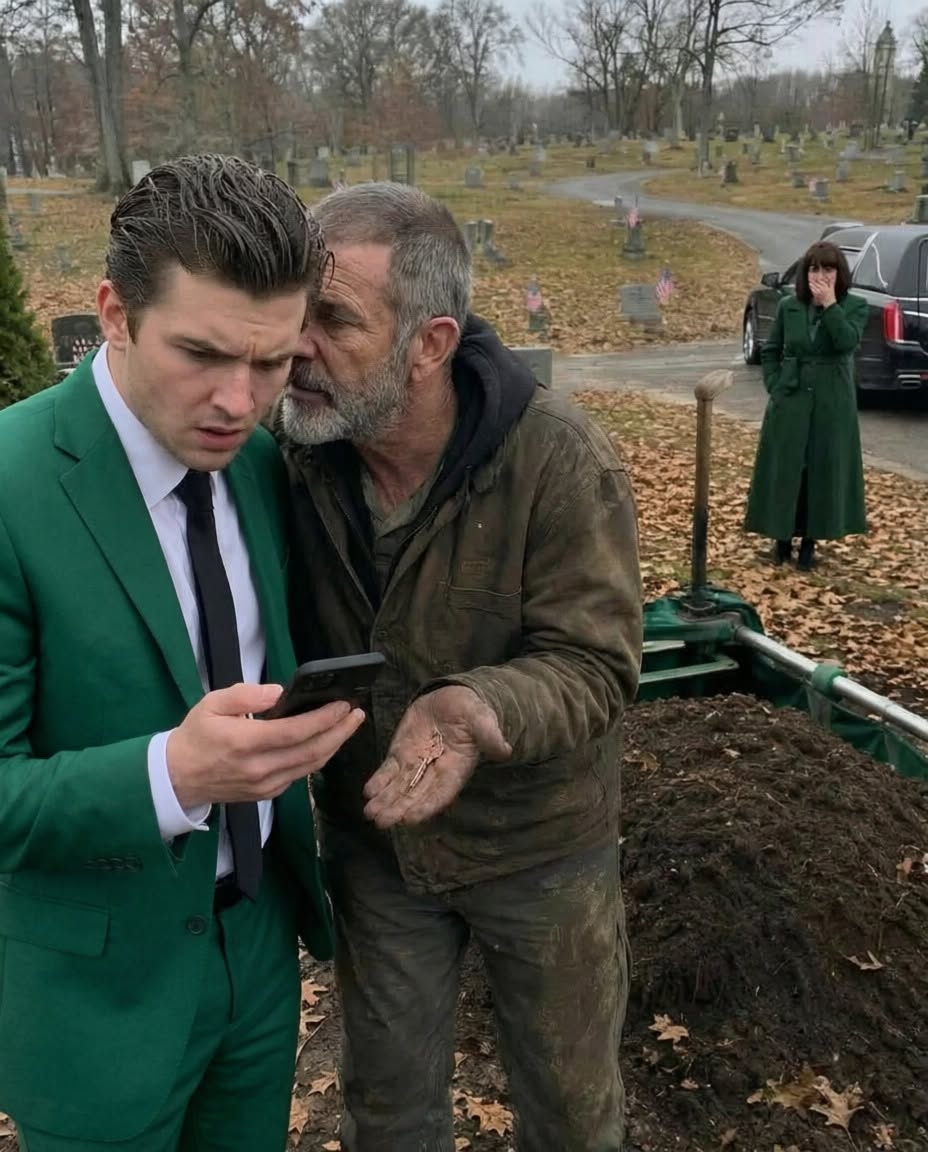
“At my father’s graveside, the gravedigger gripped my arm and whispered, “Sir, your father paid me to bury an empty coffin.” Before I could even speak, he pushed a brass key into my hand. “Don’t go home,” he warned. “No matter who calls, no matter what they say. Go to Unit 17 on Route 9. Right now.” Then my phone buzzed. A text from my mother appeared on the screen. Come home alone. My father had been buried less than five minutes earlier. Or so I believed.
The final hymn still seemed to hang in the freezing New Jersey air. Relatives and neighbors moved slowly across the cemetery grass, speaking in soft voices, promising food, touching my shoulder, offering the kind of words people use when they know nothing can be fixed.
My mother stood near the black funeral car with one hand over her mouth.
My wife, Celeste, kept our two children close.
And I stood there trying to be the son everyone expected me to be.
Strong.
Helpful.
Still standing.
My father, Raymond Mercer, was sixty-six. They said he had suffered a heart attack in his study and was gone before the ambulance arrived.
For three days, I had chosen flowers, signed documents, comforted my mother, and convinced myself grief was the only thing happening.
Then the gravedigger stopped me.
“Your father paid me,” he said.
I stared at him.
“Paid you for what?”
He looked over his shoulder before leaning closer.
“To bury an empty coffin.”
For a moment, my mind refused to accept the words.
“My father is dead,” I said. “I saw him.”
The man’s expression did not change.
“You saw what he wanted you to see.”
I almost stepped back.
Some sentences are so impossible that your mind rejects them before fear can even begin.
Then he pressed something cold into my palm.
A small brass key.
The number 17 was stamped on it.
“Don’t go home,” he repeated. “No matter who calls. No matter what they tell you. Go to Unit 17. Route 9 Storage. Your father left instructions.”
“My father died three days ago.”
That was when my phone buzzed.
I pulled it out automatically.
The message was from my mother.
Come home alone.
Three words.
No period.
No “honey.”
No explanation.
My mother never texted like that. She wrote long messages full of commas and called me sweetheart even when she only needed me to pick up milk.
But she was standing thirty yards away at her husband’s funeral, supposedly texting me like a stranger.
The gravedigger saw the screen.
His face lost color.
“Don’t,” he said. “Whatever you do, don’t go home yet.”
I looked at the grave.
Then at my mother.
Then at the key in my hand.
“What is happening?”
He reached into his coat and pulled out an old envelope.
My name was written across the front in my father’s handwriting.
Julian.
“He gave me this twenty years ago,” the gravedigger said. “Told me I would know when to give it to you.”
Twenty years.
My father had planned something before I was even old enough to understand why anyone would need a plan like this.
Then the gravedigger turned and walked away between the headstones like a man who had finally completed a promise he never wanted to keep.
I did not go home.
I sat in my car at the edge of the cemetery parking lot and opened the envelope with shaking hands.
Inside was a short letter from my father.
No comfort.
No explanation.
Only one instruction.
Go to Unit 17. Trust the woman waiting there. Do not go home until you understand why.
By the time I reached Route 9 Storage, dusk had settled over the highway. The facility sat behind a chain-link fence, past a gas station, a closed diner, and a row of low warehouses with faded signs.
A small American flag snapped sharply beside the office.
Security cameras watched the gate.
And beneath the awning stood a woman in a dark coat, waiting as if she already recognized my car.
Before I could ask who she was, she raised a badge.
Federal Bureau of Investigation.
My stomach dropped.
“Mr. Mercer,” she said, “your father told us you would come alone.”
I looked at the key.
Then at Unit 17.
The storage door was only twenty feet away, but suddenly that distance felt impossible.
“What’s inside?” I asked.
The agent’s face tightened.
“Enough to explain why your father needed an empty coffin.”
Then my phone began to ring.
My mother again.
The agent looked at the screen, then back at me.
“Do not answer that,” she said.
And behind her, inside Unit 17, something started to beep.
The story continues in the first comment

”