My younger brother texted me on a Saturday night and said, “Don’t come to the Sunday get-together.
My new wife says you’ll make the whole party stink.”
There are insults people hurl in anger, and then there are insults chosen carefully enough to leave a mark.
That one was chosen.
It arrived in the family group chat at 10:14 p.m.
No preamble.
No apology.
No effort to soften it into humor.
My brother Ethan wrote it the way you might cancel a service appointment.
Direct.
Efficient.
Dismissive.
I stared at my screen for so long that it dimmed in my hand.
At first I thought I had misunderstood.
Maybe he meant someone else.
Maybe there was some bizarre joke I had walked into late.
But then I read it again.
And again.
“Don’t come to the Sunday get-together.
My new wife says you’ll make the whole party stink.”
Stink.
That word lodged in my chest like something sour.
My first instinct was outrage.
My second was humiliation.
My third—worse than either—was the old reflex I hated most: the urge to fix it.
To smooth it over.
To ask what I had done wrong and how I could make it right.
That reflex had lived in me for years.
I was Clara Rowan, thirty-four years old, founder and CEO of a public relations firm with offices in two cities, a staff of forty-three people, and clients who trusted me to rescue million-dollar reputations.
But one text from my family, and suddenly I was fourteen again, standing in my parents’ kitchen trying to guess which version of myself would be least inconvenient.
Before I could answer Ethan, reaction bubbles appeared beneath his message.
A red heart from my mother.
A red heart from my father.
A red heart from my Aunt Denise.
Not one objection.
Not one, “That was rude.”
Not one private message asking if I was okay.
They approved.
That was the part that hollowed me out.
I could have almost forgiven a cruel message sent in the heat of the moment.
But approval from the whole family? That meant this wasn’t a mistake.
It was consensus.
My thumbs hovered over the keyboard.
A dozen responses flashed through my mind.
You let your wife talk about me like that?
After everything I’ve done for you?
You should be ashamed.
Instead, I typed one word.
“Understood.”
Then I set my phone face down on the desk.
I lived alone in a corner apartment overlooking downtown, all glass and pale wood and clean quiet.
Usually I loved that quiet.
That night it felt merciless.
The refrigerator hummed.
A siren wailed somewhere below.
The heating vent clicked on and off.
Across the room sat a framed photo from Ethan’s wedding six months earlier.
My parents stood on one side.
Ethan and his new wife Sabrina stood in the center.
Aunt Denise was there too, smiling like a woman pleased with the seating chart of life.
I wasn’t in the frame.
At the reception, my mother had waved off my disappointment with a laugh.
“Oh, Clara, the photographer was rushed.
Don’t make everything about yourself.”
So I hadn’t.
I had spent most of my life not making things about myself.
I was the dependable daughter.
The easy daughter.
The daughter who did not require
from downstairs.
They’re here.
I stood behind the glass wall of my office and watched the elevator open.
Ethan stepped out first, one hand holding Sabrina’s.
He wore the expression men wear when they believe a room will admire them.
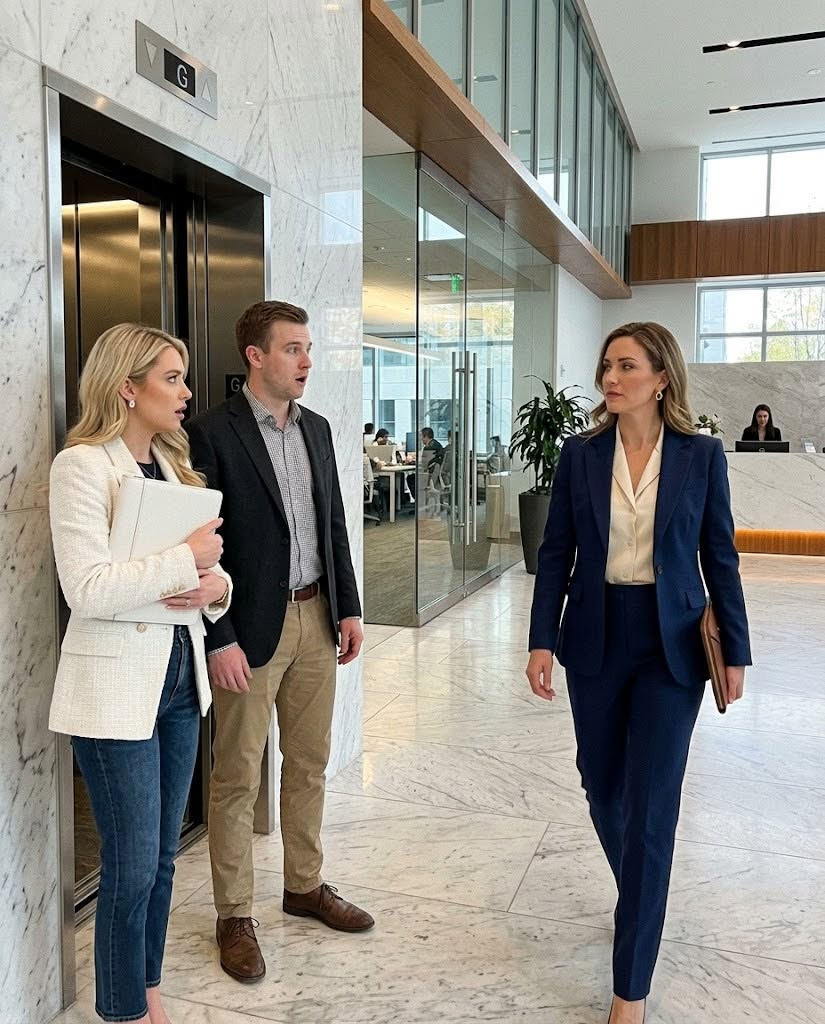
Sabrina looked expensive and immaculate—blonde hair polished into soft waves, diamond studs, white blazer, tan portfolio tucked against her chest.
She smiled at Tori.
Then she turned.
And saw me.
Her smile vanished so fast it was almost violent.
Ethan followed her gaze.
His whole body seemed to stop.
Jamie walked to my office door, opened it, and announced in her bright professional voice, “Miss Rowan, your 10:30 client meeting has arrived.”
I have lived through funding crises, media scandals, and one spectacular hostile takeover attempt.
Nothing has ever matched the pure stillness of watching my younger brother realize he had just humiliated the owner of his wife’s agency in writing.
I walked toward them slowly.
“Good morning,” I said.
Sabrina recovered first.
Women like her always do.
She arranged her face into something pleasant and uncertain.
“Clara.
Wow.
I… didn’t know.”
“No,” I said.
“You didn’t.”
Ethan tried to laugh.
“Why didn’t you ever tell us?”
I looked at him.
“You never asked what I did.
You only decided it wasn’t important.”
Jamie, sensing drama but loyal enough to pretend she sensed nothing, held the conference room door open.
Sabrina stepped closer to me and lowered her voice.
“About last night, I think there’s been a misunderstanding.”
“Really?” I asked.
“Yes.
It was a joke.”
“A joke about me making your party stink?”
Her mouth tightened.
Ethan cut in.
“She didn’t mean it like that.”
“Then how did she mean it?” I asked.
He said nothing.
I let the silence work.
Then I turned and walked into the conference room.
On the long walnut table sat three copies of the onboarding packet, one copy of the signed contract, and on top of Sabrina’s folder, clipped neatly in place, a printed screenshot of the family chat.
Her message.
Ethan’s message.
The red heart reactions from my parents and aunt.
My reply: Understood.
Sabrina stopped in the doorway.
“What is that?”
“Context,” I said.
Jamie closed the door behind us.
Nobody sat.
I took my place at the head of the table and folded my hands.
“Before we discuss deliverables, we need to discuss whether Rowan Strategies is willing to continue representing a client whose principal publicly insulted me in writing less than twelve hours before walking into my office.”
Ethan’s face flushed.
“Clara, come on.
Don’t do this.”
“Don’t do what?”
“Make this personal.”
I actually smiled then.
“Personal?” I repeated.
“Your wife called me something degrading in a family group chat.
You told me not to come to a family event because my existence would ‘stink up’ the room.
My parents endorsed it.
And now you’re asking me not to make it personal?”
Sabrina finally sat down as if her knees had weakened.
“I said I was joking.”
“No,” I said.
“You’re saying that now because you know what I own.”
That landed.
Her eyes flashed.
“I didn’t know this was your firm.”
“That’s true,” I said.
“And if you had known, would you have said it?”
She looked away.
Answer enough.
I slid the contract toward her.
“Section