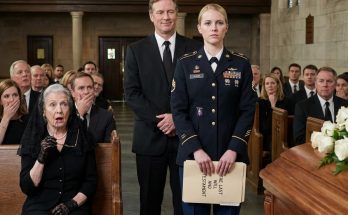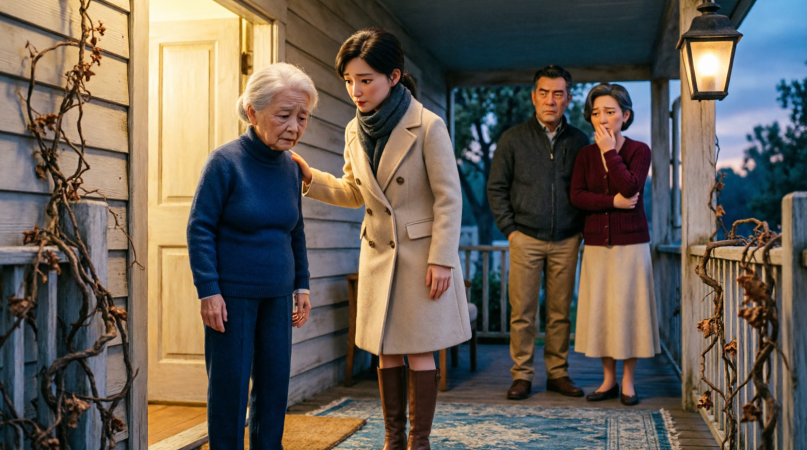
Serena’s hand froze halfway between the brass door knocker and her cream coat.
Wesley saw the folder first.
Not the porch light. Not my face. Not the cup of tea I had set carefully on the little table beside the door.
The folder.
It sat tucked under Lydia’s arm, thick enough to bend the corner of her navy blazer. My son’s name was printed across the tab in my handwriting, the same handwriting that had signed his school permission slips, college checks, car insurance forms, mortgage guarantees, and every rescue he had learned to call temporary.
WESLEY.
Serena’s eyes moved from the folder to Lydia’s face.
“Why is she here?” she asked.
Her voice was low and clean. No panic yet. Serena always reached for control before she reached for truth.
Lydia did not answer. She stood on my porch with rain beading on her shoulders, her gray-streaked hair pinned at the nape of her neck, one hand steady around the file.
Wesley swallowed.
“Mom,” he said, “this got out of hand.”
I looked at him.
At forty-eight, he still had Arthur’s eyes when he was frightened. That was the cruel part. A mother can look at a grown man and still see the child who once cried because his kite tore in the wind.
But that child had become a man who let his wife remove me from a dinner I helped make possible.
I stepped back from the doorway.
“Come in.”
Serena moved first, brushing past the threshold as if accepting an invitation she had been owed all along. Her perfume carried into the hall, sharp and expensive, mixing with the smell of lemon polish and rain-damp wool.
Wesley followed more slowly.
Lydia came last.
I closed the door.
The sound was soft, but Wesley flinched.
In the sitting room, Arthur’s photograph still watched from the mantel. The grandfather clock ticked beside the bookcase. Three wet coats shifted and settled in the quiet.
Serena did not sit.
“This is a family matter,” she said to Lydia.
Lydia placed the folder on my coffee table.
“It became a banking matter at 8:11 this morning.”
Wesley rubbed the back of his neck. “Mom, we were going to call you.”
“At 6:18 last night,” I said, “you did.”
His face tightened.
Serena turned toward him. “You sent the second text?”
He didn’t answer fast enough.
That was answer enough.
Her cream coat looked too bright against my old green chair. One rain droplet slid from her sleeve to the hardwood floor.
I picked up my teacup and set it on a coaster.
No shaking.
No raised voice.
No begging.
That alone seemed to unsettle them.
“Mom,” Wesley said, “Serena was upset. The coworkers came over last minute. It wasn’t personal.”
I nodded once.
“You weren’t invited. My wife doesn’t want you there,” I said.
His mouth opened, then closed.
Serena’s chin lifted. “It was one dinner.”
Lydia opened the folder.
Paper shifted against paper. Receipts. Printed authorizations. Bank summaries. Canceled drafts. Each page made a dry whisper, like leaves scraping concrete.
“It was not one dinner,” Lydia said.
Serena looked at her sharply. “You have no right to discuss our finances.”
“My finances,” I said.
The room stilled.
Outside, a car passed slowly through the wet street. Its tires hissed against the pavement.
Serena turned to me with the small smile she used in restaurants when a server made a mistake.
“Margaret, I understand you’re embarrassed.”
I almost laughed.
Not because it was funny.
Because embarrassment had kept me obedient for years.
Embarrassed to ask why I was never in family photos unless I was holding the camera.
Embarrassed to admit I paid for things no one thanked me for.
Embarrassed to feel hurt by little exclusions dressed up as scheduling conflicts.
Lydia pulled the first page free.
Wesley’s eyes followed it.
“Please,” he said.
That was the first honest sound he had made since entering my house.
Serena glanced at him. “Please what?”
He whispered, “Don’t.”
I sat down in Arthur’s chair.
The leather was cool under my palms.
“Read it,” I said.
Lydia adjusted her glasses.
“Mortgage assistance draft,” she began. “Monthly amount: $4,850. Originating account: Margaret Hale Living Trust. Beneficiary household: Wesley and Serena Hale. Active for thirty-one months.”
Serena blinked.
“That’s not—”
Lydia turned the page.
“Private school tuition support. Monthly amount: $2,800. Active for eighteen months.”
Wesley stared at the carpet.
Serena’s lips parted.
“Wesley told me that was from his bonus structure.”
I watched my son’s shoulders rise, then sink.
Lydia continued.
“Homeowners insurance. Two vehicles. Country club family membership. Emergency repairs listed under residential improvement. Business line tied to an entity called Hale Strategy Group.”
At that, Serena’s face changed.
Not guilt.
Alarm.
“What business line?” she asked.
Wesley pressed his fingers to his forehead.
“Serena,” he said quietly.
“What business line?”
Lydia looked at me for permission.
I gave a small nod.
She slid a page across the coffee table.
Serena snatched it up.
Her manicured thumb trembled against the corner.
The page showed $1,950 a month, withdrawn from my account for twenty-six months, marked as business telecommunications and client management software.
Serena read the company name once.
Then again.
“Hale Strategy Group,” she said.
Her voice had lost its polish.
Wesley looked toward the mantel, not at her.
I had never heard of that company until Lydia turned the screen toward me that morning. It had been one of the lines buried between utilities and membership fees, quiet and patient, waiting for daylight.
Serena lowered the page.
“You told me the firm paid for that.”
Wesley rubbed both hands over his face.
“I was going to fix it.”
“Fix what?”
He said nothing.
The house seemed to grow smaller around us. The clock ticked. Rain tapped the windows. Somewhere in the kitchen, the refrigerator hummed steadily, indifferent to the collapse taking place ten feet away.
Lydia removed another sheet.
“This is the notice generated today when access was revoked. Mr. Hale is no longer authorized to initiate transfers, create payment instructions, or use Margaret Hale’s trust account for any household or business-related charge.”
Serena stared at Wesley.
“You had access?”
His face reddened.
“For emergencies.”
“For years,” I said.
He turned to me. “You gave it to me.”
“I did.”
The words came out calm.
That mattered.
I had given it to him after Arthur died, when Wesley was grieving too, when he said the mortgage company needed a quick bridge and Serena was overwhelmed and the baby’s expenses had doubled.
I gave him access because I mistook trust for closeness.
Then I kept giving because stopping would have forced me to see what I had become to them.
A safety net with a pulse.
Serena folded the page slowly.
Her eyes moved over my sitting room for the first time, really seeing it. The worn rug. The framed photo of Arthur. The quilt over the arm of the sofa. The good porcelain cup beside my chair.
All the things she had dismissed as old.
All the things that had funded her new.
“Wesley,” she said, “how much?”
He shook his head.
Lydia answered because numbers do not protect anyone’s pride.
“In the past calendar year, $93,600.”
Serena took one step back.
Her heel struck the leg of the coffee table.
The folder shifted.
A few papers slid loose, spreading across the table like white cards in a losing hand.
“Mom,” Wesley said, and his voice cracked on that single word.
I waited.
For once, I did not rush to save him from discomfort.
He looked older than he had the night before. The skin beneath his eyes sagged slightly. His expensive sweater was damp at the collar. His phone kept buzzing in his hand.
Declined charge.
Declined charge.
Declined charge.
Each vibration sounded small and ugly in the room.
Serena’s eyes snapped to the phone.
“What is that?”
Wesley looked down.
He did not speak.
She took the phone from his hand.
I saw the screen glow against her face.
The color drained from her cheeks.
“Club dining account declined,” she read. “Preschool payment failed. Auto renewal failed. Mortgage draft returned pending review.”
Her breath came through her nose in sharp little pulls.
Then she looked at me.
Not like a daughter-in-law.
Not like a woman who had excluded an old widow from a dinner.
Like someone seeing the locked door behind the person she had pushed too far.
“You can’t do this,” she said.
I folded my hands in my lap.
“My name is on the accounts.”
“It affects the child.”
There it was.
The word she saved for leverage.
Child.
My granddaughter. The little girl who had texted me at 6:47 p.m. asking if I was still coming. The one who still pressed stickers onto my envelopes and called Arthur’s picture Grandpa Star.
My throat tightened.
But I did not move.
“I have already arranged a separate education account for her,” I said. “One neither of you can touch.”
Wesley lifted his head.
Serena went still.
Lydia placed one final document on top of the folder.
“This was completed at 9:32 this morning,” she said. “A custodial education trust. Direct school payments only. No parental withdrawal access.”
Serena stared at the paper.
For the first time since she entered my house, she had no immediate sentence ready.
The silence was not empty.
It was full of every dinner I had missed, every bill I had paid, every thank-you that had become an expectation.
Wesley stepped toward me.
“Mom, I’m sorry.”
His eyes were wet.
A younger version of me would have stood. Touched his face. Told him we would talk. Told him I understood. Told him Serena pressured him, life was hard, marriage was complicated, money made people afraid.
A younger version of me would have turned his apology into my responsibility.
I stayed seated.
“What are you sorry for?” I asked.
He blinked.
“For the text.”
I waited.
“For letting it happen.”
I waited again.
“For using the accounts.”
Serena made a sound under her breath.
He looked at her then back at me.
“For lying.”
That one landed.
Not beautifully.
Not enough to mend anything.
But it landed.
Serena straightened. “We should discuss this privately.”
“We are,” I said.
Her eyes cut toward Lydia.
“Without the banker.”
Lydia closed the folder with both hands.
“I’m here because Mrs. Hale requested a witness for the receipt of account revocation and notice of independent trust protection.”
Serena’s mouth tightened.
“A witness.”
“Yes,” Lydia said.
Her voice remained even.
That made Serena angrier than shouting would have.
Wesley sank onto the edge of the sofa without asking. His knees looked weak. His wet shoes left dark marks on the rug.
Arthur would have hated that rug being marked.
Then again, Arthur would have hated what his son had become far more.
Serena remained standing.
“You’re punishing us because of one awkward dinner,” she said.
I picked up the townhouse brochure from the side table. I had left it there on purpose.
The pages still showed the brick walkway, the staged lamps, the smiling kind of emptiness real estate photographers sell as home.
I opened to the page with the kitchen.
The one Serena had called perfect.
The one Wesley had said was for me too.
I placed it on top of the folder.
“I paid part of the down payment on a house where I was not welcome for dinner,” I said.
Serena’s gaze dropped to the glossy page.
For a moment, her face looked almost naked.
Not sorry.
Exposed.
Wesley covered his eyes with one hand.
“I didn’t think you’d actually stop everything,” he said.
That sentence told the whole truth.
Not that he loved me.
Not that he forgot.
Not that he was trapped.
He simply believed I would absorb the wound and keep paying.
My fingers tightened once around the armrest.
Then relaxed.
At 77, the body teaches you what the heart refuses. Tightness hurts. Release hurts less.
“I know,” I said.
Serena’s phone rang.
She looked down and silenced it.
It rang again immediately.
Then Wesley’s buzzed.
Then hers again.
Their life, built on automatic yes, had begun asking manual questions.
Serena glanced toward the front door.
“Wesley,” she said, “we need to go.”
But he did not stand.
He looked at me like a boy waiting outside the principal’s office, hoping his mother would come and make the consequences softer.
I had done that too many times.
Lydia gathered the loose pages back into order. Her hands were calm, professional, careful. She clipped the folder shut and passed me a receipt copy.
“The revocations are complete,” she said. “The trust protections are active. The business authorization has been flagged for review.”
Wesley’s head snapped up.
“Flagged?”
Lydia looked at him.
“Mrs. Hale did not recognize the business expenses. That required notation.”
Serena turned slowly toward Wesley.
The room sharpened.
There are moments when a marriage does not break loudly. No thrown glass. No screaming. Just one spouse realizing the other has been lying in a direction they never bothered to check.
“What review?” Serena asked.
Wesley stood.
“Not now.”
“Yes,” she said. “Now.”
I rose from Arthur’s chair.
Not quickly. My knees complained. My hand found the armrest first, then the air, then balance.
All three of them watched me.
I walked to the mantel and touched Arthur’s frame.
The silver was cool.
“You should leave,” I said.
Wesley took one step toward me. “Mom, please.”
I looked at my son.
His face blurred slightly at the edges, but I did not let the tears fall.
“You may call me when you are ready to speak without needing something.”
He stopped.
Serena pulled her coat closed, though the room was warm.
Lydia lifted the folder.
“No,” I said softly.
She paused.
I held out my hand.
She gave it to me.
The folder was heavy.
Heavier than paper should be.
Wesley looked at it as if it were alive.
I walked to the front door and opened it.
Cold damp air slipped into the hall. The porch light caught the rain in thin silver threads.
Serena stepped out first, fast now, her heels sharp against the boards.
Wesley lingered.
“Did you ever love me without the money?” he asked.
The question struck harder than I expected.
I held the folder against my chest.
“Yes,” I said. “That was the problem.”
His face folded.
For one second, I saw the little boy with the torn kite.
Then I saw the man who had written, You weren’t invited.
He stepped onto the porch.
I closed the door.
This time, he was on the other side of it.
The house settled around me.
No applause. No victory music. No clean happiness.
Just the clock, the rain, and my own breathing.
Lydia stood beside the sitting room archway, quiet as a witness in a church.
“Are you all right?” she asked.
I looked at the good teacup on the table. The tea had gone cold.
“I will be.”
Through the window, I saw Serena and Wesley standing beside their car. She was speaking fast. He kept looking back at the house.
Then Serena opened the passenger door and stopped.
Because another car had turned into my driveway.
A small blue sedan.
My granddaughter climbed out holding a backpack against her chest.
Behind her, her teacher stepped into the rain with one hand raised, uncertain.
I moved to the window.
My granddaughter looked past her parents, straight at my door.
Her small face was pale.
Then she lifted her phone.
A message arrived on my screen.
Grandma, Mom said you ruined everything. Can I come inside?
I opened the door before the second buzz.
This time, I did not ask anyone’s permission.
PART 3
“The Night Serena Called the Police… My Granddaughter Whispered Something That Changed Everything.”
The front door had barely closed behind my granddaughter when headlights flashed across the sitting room walls.
Blue and red.
Slow.
Rotating.
My granddaughter stiffened beside me.
Outside, Serena stepped out of the car first.
Not crying anymore.
Not shocked anymore.
Angry.
The dangerous kind of calm angry.
Rain slid down her hair as she pointed toward my house with sharp, furious movements.
Two police officers climbed from the cruiser.
Behind them, Wesley stood near the driveway with both hands on his head.
He looked sick.
My granddaughter grabbed my sweater sleeve.
“Grandma…”
Her voice trembled.
I crouched carefully in front of her.
“It’s all right, sweetheart.”
But she shook her head quickly.
“No,” she whispered. “Mommy gets scary when money disappears.”
That sentence hit harder than the police lights.
Outside, Serena’s voice cut through the rain.
“She took my daughter!”
Officer Daniels knocked firmly against the door.
I recognized him immediately.
His father had worked with Arthur thirty years earlier.
Life in small towns keeps receipts longer than banks do.
I opened the door before the second knock.
The cold air rushed inside.
Officer Daniels removed his hat slightly.
“Mrs. Hale.”
Behind him, Serena pointed toward the house again.
“She manipulated my child and refused to return her.”
My granddaughter stepped closer behind me.
Officer Daniels noticed immediately.
Children tell truth with their feet before their mouths ever speak.
“She texted me,” I said calmly. “Asking if she could come inside.”
Serena laughed once.
Sharp.
Fake.
“She’s eight years old.”
“And frightened,” I answered.
Wesley finally looked up.
His eyes found his daughter first.
Then me.
Then the folder still sitting on the coffee table behind my shoulder.
The folder had become a ghost in the room.
Officer Daniels cleared his throat carefully.
“Ma’am,” he said to Serena, “did the child arrive willingly?”
“She’s confused.”
“That’s not what I asked.”
Serena’s jaw tightened.
The rain kept falling softly around all of us.
Then my granddaughter did something none of us expected.
She stepped around me.
Tiny hands shaking.
Backpack still hanging from one shoulder.
And she looked directly at the police officer.
“My mommy said Grandma ruined our life because Grandma stopped giving us money.”
Silence.
Absolute silence.
Even Serena froze.
Children do not understand strategy.
That’s why truth escapes from them so cleanly.
“Sweetheart—” Serena started.
But the little girl kept going.
“She said Daddy messed everything up and now we might lose the big house.”
Wesley closed his eyes.
Officer Daniels remained still.
His partner quietly lowered the notepad in his hand.
My granddaughter’s lip trembled.
Then came the sentence that truly shattered the night.
“I didn’t come because Grandma kidnapped me.”
She looked up at me.
Tears sliding silently down her face.
“I came because I thought Grandma would still love me if we got poor.”
Serena’s face drained white.
Wesley made a broken sound in his throat.
And suddenly every expensive thing they owned looked smaller than the child standing barefoot in my doorway.
The porch light flickered once in the rain.
Officer Daniels spoke carefully now.
“Mrs. Hale,” he said to Serena, “this appears to be a family dispute, not an abduction.”
Serena snapped toward Wesley.
“Say something!”
But Wesley couldn’t.
Because for the first time in years, the truth was standing in front of him without invoices attached to it.
My granddaughter wiped her cheeks.
Then she reached into her backpack slowly.
“I forgot,” she whispered.
She pulled out a folded paper.
Wrinkled.
Pink.
Covered in stars.
She handed it to me.
I unfolded it carefully.
It was a school assignment.
“Draw Your Family Hero.”
Inside the crooked yellow frame she had drawn only one person.
Not her parents.
Not teachers.
Not friends.
Me.
And beneath the drawing, in uneven pencil letters, she had written:
“My grandma fixes things when everyone else breaks them.”
Wesley broke first.
Not loudly.
Just quietly enough to make it worse.
He sat down heavily on the wet porch step and covered his face with both hands.
Serena stared at him in disbelief.
Almost disgust.
As though weakness itself offended her.
Officer Daniels stepped backward toward the cruiser.
“We’ll document the call,” he said carefully. “But no further action is needed tonight.”
Serena turned sharply.
“You’re just leaving?”
The older officer paused.
Then his eyes moved toward Wesley sitting in the rain.
“Ma’am,” he said quietly, “I think your family has bigger problems than police.”
The cruiser lights shut off.
Darkness rushed back over the driveway.
Only the porch light remained.
Soft.
Yellow.
Lonely.
My granddaughter slipped her hand into mine.
Then Wesley lifted his head slowly from the porch step.
Rainwater clung to his face like tears he was too ashamed to admit.
“Mom,” he whispered, “there’s something else you don’t know.”
Behind him, Serena went completely still.
And for the first time that night…
She looked afraid.
# PART 4
### *“The Secret Wesley Hid From Everyone… Was Already Destroying Their Family Before the Dinner Ever Happened.”*
The rain had almost stopped.
Tiny drops still slid from the porch roof, tapping softly against the wooden railing.
Nobody moved.
Not me.
Not Serena.
Not even the officers pulling away from the curb.
Everything had frozen around Wesley’s final sentence.
> “Mom… there’s something else you don’t know.”
My granddaughter squeezed my hand tighter.
Serena’s face changed first.
Fear.
Real fear this time.
Not anger.
Not pride.
Fear.
“Wesley,” she said quietly.
Warning him.
But he stood slowly from the porch step anyway.
His sweater clung damply to his shoulders. His eyes looked hollow now, like a man too tired to keep holding walls together.
“I didn’t just use the trust account,” he said.
The night suddenly felt colder.
Behind me, the grandfather clock ticked steadily inside the house.
Every second sounded louder now.
Serena stepped toward him sharply.
“Stop talking.”
He laughed once.
Broken.
Humorless.
“You think silence is going to save this?”
“Wesley.”
“No,” he snapped suddenly.
That shocked all of us.
Especially Serena.
Because men like Wesley do not become weak overnight.
They become weak one surrender at a time.
And Serena had spent years teaching him surrender.
My granddaughter pressed closer against me.
I could feel her heartbeat through her small sleeve.
Wesley rubbed both hands over his face.
Then finally looked directly at me.
“The business wasn’t real.”
I stared at him.
“What?”
“Hale Strategy Group,” he whispered. “It wasn’t a consulting company.”
Serena shut her eyes.
Just for one second.
But it was enough.
Enough to confirm she already knew.
Wesley swallowed hard.
“It started as gambling.”
The word hit the porch like shattered glass.
Even the air seemed to stop.
My granddaughter looked upward in confusion.
“Daddy?”
His face collapsed at the sound of her voice.
Not dramatic.
Not cinematic.
Just exhausted shame finally finding daylight.
Serena turned away instantly.
Like she couldn’t bear being seen beside him anymore.
“I lost money after the layoffs three years ago,” Wesley continued. “At first it was small. Sports betting. Online cards. Then crypto trading. Then leverage accounts…”
His voice drifted thinner with every confession.
“I kept thinking I could win it back before anyone noticed.”
I suddenly remembered dozens of little moments.
Missed calls.
Mood swings.
Random emergencies.
His strange panic whenever bills arrived.
Arthur used to say:
> “A person drowning in secret always splashes at strange times.”
God, Arthur would have seen it immediately.
I didn’t.
Because mothers sometimes mistake protection for love.
And love for blindness.
Serena folded her arms tightly.
“You promised you fixed it.”
Wesley looked at her slowly.
“No,” he said. “I promised I’d hide it better.”
That landed hard.
Very hard.
Because suddenly the marriage looked different.
Not husband and wife.
Not partners.
Two people silently dragging a collapsing lie across expensive floors.
My granddaughter looked between them.
Confused.
Scared.
Too young to understand debt but old enough to recognize danger.
“Are we losing our house?” she whispered.
Nobody answered.
That was answer enough.
Then Wesley looked back at me.
“There’s more.”
Of course there was.
There always is.
People don’t destroy families with one lie.
They do it brick by brick.
“I borrowed against the house last year,” he admitted.
Serena spun toward him instantly.
“What?”
“I didn’t have a choice.”
“You said the refinancing was for taxes!”
“I was covering margin calls!”
Her face went white again.
“No…”
He nodded slowly.
“The house is almost gone.”
The porch suddenly became too small for the truth standing on it.
Inside the house, my tea still sat untouched on the table.
Cold now.
Like the version of my life I thought I understood.
Serena took a step backward.
Then another.
As if distance itself could undo what she was hearing.
“You said we were safe.”
Wesley laughed again.
That terrible broken laugh.
“I said whatever stopped you from leaving.”
That one cut her.
Deep.
I saw it immediately.
Not because she loved him.
Because she realized he had manipulated her too.
And that terrified her.
For years Serena believed she controlled the marriage.
Now she was discovering she had been standing on rotten floorboards the entire time.
My granddaughter suddenly began crying quietly.
Not loudly.
Not dramatically.
Just silent tears sliding down her cheeks while adults destroyed the world around her.
I bent immediately and pulled her close.
“That’s enough for tonight,” I said softly.
But Wesley shook his head.
“No,” he whispered. “She deserves the whole truth.”
Then his eyes lifted toward Arthur’s house behind me.
Toward the family photographs.
Toward the life he had slowly mortgaged piece by piece.
“The bank called yesterday morning,” he said. “Before the dinner.”
My stomach tightened.
“What bank?”
He looked sick.
“The house is entering pre-foreclosure.”
Serena covered her mouth.
A sound escaped her throat.
Tiny.
Animal.
Destroyed.
And suddenly…
The dinner invitation wasn’t about embarrassment anymore.
It wasn’t about coworkers.
Or social image.
Or inconvenience.
It was worse.
Much worse.
They had planned to smile through dinner while hiding the fact their entire life was collapsing financially.
And I realized something horrifying.
The reason Serena didn’t want me there…
…was because she was afraid I would notice.
The silence afterward felt endless.
Then my granddaughter whispered the saddest thing I had heard all night.
“Is this why Mommy cries in the bathroom now?”
Serena broke.
Completely.
Not elegantly.
Not beautifully.
She turned away from all of us and burst into tears right there on the dark wet driveway.
And Wesley just stood there.
Like a man finally watching the fire he started reach the roof.
# PART 5
### *“The Morning After Serena Broke Down… Someone Filed a Complaint Against Me With Child Services.”*
I barely slept.
Not because of the shouting.
Not because of Wesley’s gambling.
Not even because the family I spent decades protecting had cracked open in my driveway.
It was the little voice from the guest room down the hall.
Every few hours, my granddaughter whimpered in her sleep.
Sometimes she called for her mother.
Sometimes for me.
Once… quietly…
For Grandpa Arthur.
At 4:12 a.m., I stood outside her door listening to the soft sound of her breathing.
The hallway smelled faintly of lavender detergent and old wood polish.
Arthur used to say children sleep honestly.
Adults rehearse.
Children don’t.
I leaned against the wall and closed my eyes.
Then my phone vibrated.
Wesley.
I stared at the screen for a long time before answering.
His voice sounded wrecked.
“Mom.”
No excuse.
No manipulation.
Just one word carrying thirty years of damage.
“She’s gone,” he whispered.
I straightened immediately.
“What?”
“Serena.”
Cold spread through my chest.
“What do you mean gone?”
“She left around midnight. Took clothes. Jewelry. Some cash from the safe.”
His breathing shook badly now.
“She won’t answer my calls.”
I looked toward the guest room.
Toward the little girl sleeping under my roof.
“Does she know your daughter is here?”
Silence.
Then:
“I think that’s why she left.”
The words sat heavy between us.
I pressed fingers against my forehead.
“Wesley…”
“She said I ruined her life,” he whispered. “Then she said maybe you could pay for this mess too.”
There it was again.
Money.
Even now.
Like poison soaked into every conversation.
“Where are you?” I asked.
“In the house.”
His voice cracked.
“The bank put notices on the front door this morning.”
Morning.
God.
It wasn’t even sunrise yet.
I closed my eyes briefly.
Arthur used to warn me about rescuing too fast.
> “If you keep catching people before they hit consequences,” he once told me, “they never learn gravity.”
I finally understood what he meant.
“Stay there,” I said quietly. “We’ll talk later.”
But before I could hang up, Wesley whispered something that made my stomach tighten.
“Mom… Serena blamed you before she left.”
The line went silent.
I did not ask how.
Part of me already knew.
—
At 8:17 a.m., someone knocked on my front door.
Not Wesley.
Not Serena.
Two women stood outside.
One carried a clipboard.
The other wore a state identification badge clipped to her coat.
And suddenly…
I understood.
“Mrs. Margaret Hale?” the older woman asked gently.
My pulse slowed instead of rising.
Funny how betrayal eventually exhausts fear.
“Yes.”
“I’m Denise Carter with Child Protective Services.”
Behind me, I heard my granddaughter moving softly in the hallway.
The younger agent glanced toward the sound.
“We received an anonymous complaint regarding emotional instability and unsafe custodial conditions involving a minor child.”
Anonymous.
Of course.
I almost laughed.
Not because it was funny.
Because Serena had escalated exactly the way people do when they lose control:
First guilt.
Then anger.
Then destruction.
“May we come inside?” Denise asked.
I stepped aside calmly.
The agents entered carefully.
Their eyes moved over the house.
Family photographs.
Clean floors.
Bookshelves.
Warm kitchen light.
Nothing chaotic.
Nothing dangerous.
Just old.
Stable.
Loved.
That matters more than people realize.
My granddaughter appeared slowly at the hallway entrance rubbing one eye.
Her small voice stopped the room cold.
“Grandma?”
The younger agent immediately softened.
Children can sense who is safe long before adults finish paperwork.
Denise crouched slightly.
“Good morning, sweetheart.”
My granddaughter looked frightened.
Not of the agents.
Of losing another safe place.
I knelt beside her carefully.
“It’s okay,” I whispered.
But then Denise asked the question Serena probably hoped would destroy me.
“Can you tell us why you stayed with your grandmother last night?”
My granddaughter looked down at her socks.
Quiet.
Thinking.
Then she whispered:
“Because nobody was yelling here.”
The younger agent looked away instantly.
Denise’s expression changed too.
Not officially.
Humanly.
There’s a difference.
Children always reveal the true climate of a home in one sentence.
My granddaughter twisted her fingers together nervously.
“Did Mommy say Grandma is bad?”
No one answered immediately.
The silence itself became an answer.
Then she looked directly at Denise.
“Mommy says Grandma stopped loving us because of money.”
My throat tightened sharply.
But before I could speak—
My granddaughter added softly:
“But Grandma still made me pancakes.”
The younger agent blinked rapidly.
Denise slowly lowered her clipboard.
Outside, another car pulled into the driveway.
Dark blue Mercedes.
Fast.
Aggressive.
Serena.
The front door slammed before anyone could react.
Then her heels struck the porch hard.
Fast.
Angry.
She entered without knocking.
Hair disheveled.
Eyes swollen from crying.
But the moment she saw Child Services standing in my sitting room…
…she froze.
For one single second, nobody moved.
Then Denise stood calmly.
“Mrs. Hale?”
Serena recovered quickly.
Too quickly.
“Yes,” she snapped. “I made the report.”
My granddaughter shrank behind me immediately.
That hurt worse than anything else.
A child should never instinctively hide from her mother.
Denise glanced between all of us carefully.
“We’re conducting an assessment.”
Serena pointed directly at me.
“She manipulated my daughter against me.”
My granddaughter whispered against my sweater:
“That’s not true.”
Serena stopped breathing for half a second.
The room shifted again.
And then Denise asked the question that changed everything:
“Mrs. Hale… were there financial stressors or domestic conflicts in the home recently?”
Serena’s face drained instantly.
Because suddenly…
This wasn’t about me anymore.
It was about what investigators might uncover about them.
# PART 6
### *“When Child Services Started Asking Questions… Serena Realized Wesley Had Hidden Something Even Worse.”*
The room went silent after Denise’s question.
Not ordinary silence.
The dangerous kind.
The kind where everyone suddenly understands one wrong answer could change everything.
Serena crossed her arms tightly.
“There are no domestic issues.”
Too fast.
Too sharp.
Denise noticed.
People like Denise always notice.
The younger agent quietly wrote something on her pad.
My granddaughter remained pressed against my side.
Tiny fingers gripping my sleeve.
Serena saw it.
And that hurt her pride more than the investigation itself.
“You’ve turned her against me,” she snapped at me.
“No,” I answered softly. “Life did.”
That landed hard.
Serena opened her mouth—
Then stopped.
Because Wesley had just walked through the front door.
He looked terrible.
Same sweater.
Same damp hair.
Same exhausted eyes.
But now there was something else too.
Defeat.
Complete defeat.
His gaze froze when he saw Child Services.
Then moved to Serena.
Then to his daughter hiding beside me.
He understood everything immediately.
“You reported her?” he whispered.
Serena lifted her chin defensively.
“She kidnapped our child.”
“No,” he said quietly. “You panicked because the money disappeared.”
The younger agent stopped writing for a second.
That sentence mattered.
A lot.
Serena’s face twisted instantly.
“You don’t get to blame this on me!”
Wesley laughed bitterly.
“I already blamed Mom for years. Might as well try honesty once before everything burns down.”
My granddaughter looked confused by the anger bouncing around the room.
Denise stepped forward calmly.
“Mr. Hale,” she said, “we’re trying to assess the child’s environment.”
Wesley nodded slowly.
Then did something nobody expected.
He sat down.
Right there on the sofa.
Like his legs finally gave up carrying secrets.
And he said:
“She shouldn’t go home today.”
Serena turned toward him so sharply I thought she might strike him.
“What?”
His eyes remained fixed on the floor.
“The electricity was shut off this morning.”
Silence.
Absolute silence.
Even my granddaughter stopped breathing for a second.
Serena stared at him in horror.
“You told me it was delayed!”
“I lied.”
“You said the bank gave extension approval!”
“I lied about that too.”
Every confession peeled another layer off their marriage.
Until nothing stable remained underneath.
The younger CPS agent slowly lowered her notebook again.
This was no longer sounding like a vindictive grandmother situation.
This was beginning to sound like a collapsing household.
Serena looked around the room wildly now.
As though searching for a version of reality she could still control.
“You’re doing this on purpose,” she whispered to Wesley.
“No,” he said. “I did this years ago.”
That one hurt because it was true.
The grandfather clock ticked steadily beside the bookshelf.
Arthur always wound it every Sunday night.
Even dying didn’t stop that sound from governing the house.
Tick.
Tick.
Tick.
Truth arriving one second at a time.
Denise looked toward me carefully.
“Mrs. Hale… has your granddaughter stayed here before?”
“Many weekends.”
“And do you feel capable of temporary care if needed?”
Before I could answer—
Serena exploded.
“She is NOT taking my daughter!”
My granddaughter flinched violently.
That mattered too.
Children’s bodies testify faster than courts do.
Denise’s voice became firmer.
“Mrs. Hale, please lower your voice.”
Serena suddenly realized she was losing ground.
Fast.
So she switched tactics immediately.
Tears.
Soft voice.
Shaking hands.
“I’m overwhelmed,” she whispered. “We’re under financial pressure and Margaret used money to humiliate us.”
There it was.
The rewritten narrative.
Not lies exactly.
But selective truth sharpened into weapon form.
Denise remained neutral.
“Did Mrs. Hale ever threaten your child?”
“No.”
“Deny food?”
“No.”
“Use physical punishment?”
“No.”
“Then explain why your daughter appears safer here than with you.”
That question cut the room open.
Because nobody had a clean answer.
Especially not Serena.
My granddaughter suddenly tugged my sleeve gently.
“Grandma?”
“Yes, sweetheart?”
Her voice became very small.
“Can I still go to school tomorrow?”
The adults froze again.
Children don’t worry about lawsuits.
Or mortgages.
Or gambling debt.
They worry about losing routine.
Friends.
Lunchboxes.
Normal life.
I bent and kissed her forehead gently.
“Yes,” I whispered. “You’ll go to school.”
And that’s when Wesley finally broke completely.
Not emotionally.
Physically.
He leaned forward suddenly and buried his face in both hands.
“I can’t do this anymore.”
His shoulders shook.
Serena stared at him like he disgusted her now.
Not because he failed.
Because he failed publicly.
Then Wesley lifted his head slowly.
Eyes red.
Voice hollow.
“There’s another reason the accounts got flagged.”
The room tightened instantly.
Even Denise paused.
Serena looked terrified now.
“What did you do?”
Wesley swallowed hard.
Then looked directly at me.
“Mom… someone from the bank already contacted federal investigators.”
The air vanished from the room.
My heartbeat slowed.
Not faster.
Slower.
The way shock sometimes feels underwater.
“Investigators?” I repeated quietly.
Wesley nodded weakly.
“The business transfers crossed fraud thresholds.”
Serena stepped backward instantly.
“No.”
“I used your identity on two loan applications.”
My entire body went cold.
My granddaughter looked between us in confusion.
Denise’s expression changed immediately.
Professional now.
Serious.
The younger agent stopped writing altogether.
And Serena whispered the sentence that truly revealed who she was:
“You told me your mother knew.”
Wesley closed his eyes.
“I know.”
Then came the knock.
Three heavy knocks at the front door.
Not neighbors.
Not friends.
Authority.
Real authority.
Everyone looked toward the entrance.
And through the frosted glass beside the door…
…I saw two men in dark jackets holding folders.
# PART 7
### *“The Men at My Door Weren’t There for Me… They Were There Because Wesley Had Used My Name in a Way Even Serena Never Imagined.”*
The knocking came again.
Slow.
Heavy.
Official.
Nobody moved.
My granddaughter pressed against my side so tightly I could feel her trembling.
Wesley looked like he might faint.
And Serena…
Serena looked terrified for the very first time since I had known her.
Not embarrassed.
Not angry.
Terrified.
Denise from Child Services glanced toward the door carefully.
“Are you expecting someone?”
Wesley answered before I could.
“No.”
His voice sounded dead.
The knocking came a third time.
I walked to the door slowly.
At seventy-seven, your body learns something useful:
Panic wastes energy.
I opened the door.
Two men stood beneath the porch light wearing dark rain jackets over pressed shirts.
One older.
One younger.
Both carrying folders.
Bad news always arrives carrying folders.
The older man showed identification first.
“Mrs. Margaret Hale?”
“Yes.”
“I’m Special Investigator Grant Ellis from the Financial Crimes Division.”
Behind me, I heard Serena inhale sharply.
The investigator continued calmly.
“We need to speak with Wesley Hale regarding fraudulent lending activity and unauthorized financial representations connected to your trust accounts.”
Wesley sat perfectly still on the sofa.
Like prey hearing the hunter finally say its name aloud.
Grant stepped inside slowly after I nodded.
The younger investigator remained near the doorway.
Professional.
Observing everything.
Then Grant noticed Child Services standing in my sitting room.
Interesting surprise.
His eyes narrowed slightly.
“Well,” he murmured. “This family’s having quite a morning.”
Nobody laughed.
Serena suddenly stepped forward.
“There must be some misunderstanding.”
Grant looked directly at her.
“There usually is at first.”
That line landed hard.
Wesley stood shakily now.
His daughter looked up at him immediately.
“Daddy?”
God.
That single word nearly broke the room apart.
Wesley looked at her with the face of a man realizing consequences finally have witnesses.
“I’m sorry,” he whispered.
But the investigator opened the folder.
And then came the sentence that changed everything.
“Mr. Hale,” Grant said calmly, “did you or did you not submit two commercial recovery loan applications using your mother’s financial guarantees without direct authorization?”
Silence.
Wesley’s breathing became uneven.
Serena turned toward him slowly.
“No,” she whispered.
Not to the investigator.
To Wesley.
Like she already knew the answer but desperately needed reality to lie one final time.
Wesley couldn’t look at anyone now.
Especially not me.
“I was trying to buy time.”
Grant’s expression did not change.
“That is not an answer.”
Finally…
Wesley nodded.
Tiny movement.
Barely visible.
But enough.
Serena physically staggered backward.
“You forged her signature?”
“I thought I could recover the losses before—”
“You FORGED HER NAME?!”
My granddaughter jumped at the sound of Serena screaming.
I pulled her close instantly.
The younger investigator quietly noticed that too.
Everything was being noticed now.
Every reaction.
Every silence.
Every fear.
Grant opened another page inside the folder.
“The loans total approximately $420,000.”
The room tilted slightly around me.
Not because of the amount.
Because suddenly dozens of memories rearranged themselves in my head.
The rushed paperwork.
The “tax forms.”
The “temporary authorizations.”
The nights Wesley insisted I didn’t need to read everything because he’d “already handled it.”
Oh God.
Arthur warned me about this too.
Not specifically.
But generally.
> “Never let love make you intellectually lazy.”
I understood too late.
Serena looked physically sick now.
“You said your mother co-signed willingly.”
Wesley whispered something almost inaudible.
“What?”
He looked up finally.
Tears standing in his eyes.
“I told so many lies I stopped separating them.”
That sentence silenced everyone.
Even the investigators.
Because underneath fraud…
Underneath gambling…
Underneath greed…
…stood a man who had destroyed himself one compromise at a time.
Grant closed the folder carefully.
“Mr. Hale, we’re not placing you under arrest today.”
Serena nearly collapsed with relief.
But then he added:
“Yet.”
The word hung in the room like smoke.
My granddaughter looked up at me quietly.
“Is Daddy going to jail?”
Nobody answered fast enough.
Children always hear the truth hiding inside adult hesitation.
Wesley dropped into the chair again and covered his face.
And suddenly…
For the first time all night…
I stopped seeing him as my son.
Not emotionally.
Not fully.
But partially.
In that moment, I saw something else too:
A frightened man who had inherited Arthur’s charm…
…but none of Arthur’s discipline.
Grant turned toward me gently now.
“Mrs. Hale, based on preliminary findings, you may be classified as a financial victim in this case.”
Victim.
Strange word.
I didn’t feel like one.
Tired.
Heartbroken.
Humiliated.
But not weak.
Never weak.
Serena suddenly looked at me differently.
Not like an enemy.
Not even like family.
Like a lifeboat she had burned while still standing in the ocean.
Then Grant asked the question that shattered the last remaining piece of their marriage.
“Mrs. Hale,” he said to Serena, “how much did you know about the unauthorized applications?”
Serena froze completely.
And Wesley slowly lifted his head.
Terrified now.
Because for the first time since this nightmare began…
He realized he might not fall alone.
# PART 8
### *“When Serena Finally Told the Truth… Wesley Realized He Had Destroyed the Wrong Person.”*
The room held its breath.
Grant’s question still hung in the air.
> “How much did you know?”
Serena didn’t answer immediately.
And that alone was terrifying.
Because innocent people usually respond fast.
Only guilty people measure silence.
Wesley stared at her now.
Not lovingly.
Not angrily.
Fearfully.
As though he suddenly realized his wife had secrets too.
The rain outside had finally stopped.
But water still dripped steadily from the porch roof.
Tick.
Tick.
Tick.
Like the grandfather clock behind us.
Like time running out.
Serena slowly looked toward the investigators.
Then toward Child Services.
Then finally toward me.
And I saw something I had never seen on her face before.
Calculation failing.
For years Serena survived by controlling appearances:
* the perfect clothes
* the perfect parties
* the perfect marriage
* the perfect social image
But truth destroys people who survive through presentation.
Because truth doesn’t care about elegance.
Grant waited patiently.
“I knew about the gambling,” Serena whispered finally.
Wesley shut his eyes.
Not surprise.
Confirmation.
“But I did NOT know he forged signatures.”
Grant nodded slightly.
“Did you benefit financially from the loans?”
“That money went to the house!” she snapped suddenly. “The mortgage, school, debt, everything!”
The investigator stayed calm.
“That was not the question.”
Serena’s breathing became shallow.
Then Wesley said quietly:
“You knew about the second loan.”
Her head whipped toward him instantly.
“No.”
“You did.”
“No, Wesley.”
“You helped me move the money.”
My granddaughter looked confused again.
Scared again.
Too young for words like fraud and loans and investigations.
But old enough to recognize adults turning dangerous.
Serena stepped toward Wesley slowly.
“You are NOT putting this on me.”
He laughed bitterly.
“That’s funny coming from you.”
Something changed in Serena’s face then.
Something darker.
Years of resentment finally cracking open.
“You want the truth?” she snapped.
Nobody moved.
Even the investigators stayed silent.
Because sometimes people confess most honestly when they stop trying to look good.
Serena pointed directly at Wesley.
“I married a man who lied every single day.”
Wesley stared at her.
“You think I don’t know that?”
“No,” she said. “I think you don’t know WHY.”
That hit him hard.
Hard enough that he actually looked afraid.
Then Serena turned toward me.
And for the first time ever…
She stopped pretending.
“No matter what he did,” she said quietly, “you always saved him.”
The room shifted.
Because underneath the rage…
…was truth.
Painful truth.
I said nothing.
Serena laughed weakly.
“You know what Wesley used to say every time things collapsed?”
Wesley stood abruptly.
“Stop.”
But she ignored him.
“He’d say: ‘Mom will figure something out.’”
Every word landed like a stone.
“Lost money?”
Mom will fix it.
“Missed payments?”
Mom will help.
“Bad investment?”
Mom trusts me.
Tears stood in Serena’s eyes now.
Real tears this time.
Not manipulative ones.
Exhausted ones.
“You think I made him weak?” she whispered toward me. “You did.”
The sentence cut deep because part of it was true.
Not all.
But enough.
Wesley shook his head violently.
“Don’t do this.”
“No,” Serena snapped. “YOU don’t do this anymore.”
Then she finally said the thing she had clearly buried for years.
“The night before Arthur died… he warned me.”
My heartbeat stopped for one terrible second.
“What?”
Wesley looked stunned too.
Serena wiped tears angrily from her face.
“He told me Wesley had never truly heard the word no.”
The house suddenly felt haunted.
Arthur.
Even gone…
Still standing in the middle of this family.
I remembered that hospital room.
The machines.
The pale light.
Arthur asking everyone else to leave for a few minutes.
I had assumed he wanted private words with Serena about taking care of Wesley after he was gone.
God.
Maybe he had been apologizing instead.
Serena’s voice cracked now.
“He said, ‘If Margaret keeps rescuing him, one day Wesley will confuse love with entitlement.’”
Silence crushed the room.
My granddaughter looked up at me softly.
“Grandma?”
I could barely breathe.
Because suddenly I realized something horrifying:
Arthur had seen this ending years ago.
And I ignored every warning because protecting Wesley made me feel needed after Arthur died.
Grant closed his folder slowly.
Not interrupting.
Not rushing.
Human beings unravel in their own time.
Wesley looked completely shattered now.
“Dad said that?”
Serena nodded.
“He begged me to make you stand on your own eventually.”
Wesley sat down hard again.
Like the floor had disappeared underneath him.
And then my granddaughter whispered the most heartbreaking thing yet:
“Why does everybody keep talking like Grandpa knew bad things would happen?”
Nobody answered.
Because children aren’t supposed to inherit emotional wreckage from generations before them.
But they always do.
Grant finally spoke carefully.
“We’ll continue the financial investigation separately.”
Then his eyes moved toward Child Services.
“But honestly…”
He looked around the room slowly.
“…I think the bigger issue here isn’t money anymore.”
And he was right.
Because this family wasn’t collapsing from debt.
It was collapsing from years of love given incorrectly.
Then Wesley lifted his head slowly toward me.
Eyes destroyed.
Voice small.
“Mom…”
I looked at him quietly.
And he whispered:
“I think Dad was right about me.”
# PART 9
### *“After Wesley Admitted Arthur Was Right… I Finally Told My Son the Truth I Had Hidden for 40 Years.”*
Nobody spoke after Wesley’s whisper.
> “I think Dad was right about me.”
The room felt hollow.
Like all the air had been pulled out and replaced with old memories.
My granddaughter sat quietly beside me on the sofa now, holding the edge of my cardigan with tiny fingers.
Serena stood near the window staring into the wet driveway.
The investigators remained silent.
Even Child Services had stopped writing.
Because sometimes a family stops being a legal situation…
…and becomes a tragedy.
Wesley looked at me again.
Not demanding.
Not defensive.
Just broken.
And suddenly I saw him clearly.
Not the successful man he pretended to be.
Not the frightened little boy I kept rescuing.
Just a tired man drowning under years of avoidance.
Arthur used to say:
> “The hardest thing for a parent is deciding whether they’re raising a child… or delaying an adult.”
God.
He really did know.
I looked toward Arthur’s photograph above the mantel.
Then back at my son.
And for the first time in forty years…
…I stopped protecting him from the truth.
“You want to know what your father said to me before he died?”
Wesley froze.
Serena slowly turned from the window.
The whole room listened.
I folded my hands together carefully because suddenly they were shaking.
Not from fear.
From memory.
“He asked me a question,” I whispered.
Arthur’s hospital room came rushing back into my mind:
* pale blue walls
* heart monitor sounds
* rain against glass
* his hand weaker than I had ever felt it
I swallowed hard.
“He said…”
My voice cracked slightly.
> “‘Margaret… when I’m gone, will you finally let Wesley fail?’”
Wesley shut his eyes instantly.
Like the words physically hurt him.
But I continued.
Because stopping now would only create another lie.
“I got angry at him,” I admitted softly. “I told him a mother doesn’t abandon her child.”
My granddaughter looked up at me quietly.
Children always listen hardest when adults finally tell the truth.
I stared at the floor.
“And your father said something I hated him for at the time.”
Wesley’s breathing became uneven.
I could barely get the sentence out.
> “‘Saving someone from consequences is not the same thing as loving them.’”
Silence.
Absolute silence.
The grandfather clock ticked loudly beside us.
Tick.
Tick.
Tick.
Like Arthur himself refusing to let anyone escape the moment.
Wesley’s face folded inward.
Not dramatic crying.
Worse.
Quiet devastation.
“I tried so hard after he died,” I whispered. “But every time you struggled, I saw the little boy who missed his father.”
My throat tightened painfully now.
“So I kept helping.”
Mortgage.
Cars.
Tuition.
Bills.
Excuses.
I paid for all of it.
Not because Wesley deserved it.
Because grief made me terrified of losing what remained of Arthur.
And somewhere along the way…
…I stopped noticing I was feeding weakness instead of healing pain.
Serena slowly sat down for the first time all morning.
Not elegant now.
Not composed.
Just exhausted.
The younger CPS agent quietly wiped one eye.
Even Investigator Grant looked away respectfully.
Because underneath fraud and debt and manipulation…
…sat something painfully human:
A mother who loved incorrectly for too long.
Wesley stared at the floor.
Then whispered something so quietly I almost missed it.
“I don’t think I know how to be a man without someone rescuing me.”
That sentence shattered me more than the gambling.
More than the lies.
Because it was honest.
Finally honest.
And honesty sounds unbearably sad when it arrives too late.
My granddaughter climbed off the sofa suddenly.
Small feet padding softly across the rug.
She walked directly to Wesley.
Nobody stopped her.
She touched his arm carefully.
“Daddy?”
Wesley looked up slowly.
Tears covered his face openly now.
And my granddaughter asked:
“Did you forget how to be brave?”
God.
Children.
They reduce entire lifetimes into one impossible sentence.
Wesley broke completely then.
He pulled her into his arms and sobbed against her shoulder.
Not dignified.
Not controlled.
Years of failure pouring out all at once.
Serena looked away crying silently too.
Because maybe for the first time…
…she realized Wesley had been emotionally drowning long before she met him.
Grant finally closed his folder.
“We’ll contact legal counsel regarding next steps,” he said gently.
But even he sounded softer now.
Less investigator.
More witness.
Denise from Child Services stood slowly.
“Given the circumstances,” she said carefully, “temporary placement with Mrs. Hale appears appropriate while matters stabilize.”
Serena opened her mouth—
Then stopped.
Because deep down…
Even she knew it was true.
My granddaughter looked relieved for the first time all morning.
That alone said everything.
Then Wesley lifted his head slowly from his daughter’s shoulder.
Eyes swollen.
Voice hollow.
“Mom…”
I waited quietly.
And he whispered the sentence I had secretly waited years to hear:
> “Don’t save me this time.”
# PART 10
### *“The Day Wesley Refused to Be Saved… Serena Finally Revealed Why She Really Married Him.”*
Nobody moved after Wesley spoke.
> “Don’t save me this time.”
The words sat in the room like broken glass.
For forty years, my son had reached toward rescue the way drowning people reach toward air.
And now…
For the first time in his life…
…he was letting go.
I should have felt relief.
Instead, I felt grief.
Because sometimes growth arrives looking painfully similar to loss.
My granddaughter still sat curled against Wesley’s chest.
Tiny fingers clutching his sweater.
As if she feared he might disappear if she loosened her grip.
Serena watched them both silently from the armchair.
Something inside her had changed too.
The anger was still there.
But exhaustion had finally overtaken performance.
No makeup could fix this morning.
No expensive dinner.
No perfect social smile.
Truth had stripped everything down to bone.
Investigator Grant gathered his folders slowly.
“We’ll follow up within forty-eight hours,” he said.
Then his eyes settled on Wesley.
“I strongly suggest you retain counsel immediately.”
Wesley nodded weakly.
No argument.
No excuses.
Just acceptance.
That alone frightened me.
Because denial had always been his strongest survival skill.
Denise from Child Services approached me quietly.
“We’ll complete temporary placement paperwork today,” she explained gently. “Nothing permanent.”
My granddaughter looked up immediately.
“I can stay with Grandma?”
Denise smiled softly.
“Yes, sweetheart.”
My granddaughter buried her face against me in relief.
And Serena flinched.
Small movement.
But I saw it.
Because no matter how selfish Serena had become…
…some part of her still hated seeing her daughter choose emotional safety elsewhere.
Grant and the other investigator finally stepped toward the door.
But before leaving, Grant paused beside Wesley.
Then said quietly:
“You know what usually destroys people in cases like this?”
Wesley looked up slowly.
Grant’s voice stayed calm.
“Not debt.”
His eyes moved briefly toward me.
“It’s the moment they realize who kept loving them while they were becoming someone unrecognizable.”
Then he left.
The front door closed softly behind them.
And suddenly the house became unbearably quiet.
No investigators.
No police.
No official voices.
Just family.
Broken family.
Honestly broken now.
The grandfather clock ticked loudly again.
Tick.
Tick.
Tick.
Arthur’s ghost keeping time over all of us.
Serena stood slowly.
“I should pack some things for her,” she whispered.
My granddaughter stiffened immediately.
“I don’t want to go home.”
The sentence hit Serena like a slap.
Her face cracked instantly.
“You think I don’t love you?”
My granddaughter looked frightened now.
Confused.
Children should never have to answer questions like that.
I stepped in gently.
“She’s overwhelmed.”
But Serena shook her head.
“No,” she whispered. “I need to hear it.”
Dangerous sentence.
Adults often demand emotional reassurance from children when they’re falling apart themselves.
And children pay for it.
My granddaughter twisted her hands nervously.
Then finally whispered:
“You love me when things are good.”
The room shattered.
Serena physically recoiled.
As though the words had struck her in the chest.
And suddenly I understood something terrible:
Children always know the emotional weather inside a home.
Always.
Even when adults think they’re hiding it.
Serena sat down heavily again.
Eyes filling slowly.
Then she laughed once.
Soft.
Destroyed.
“You know the worst part?” she whispered.
Nobody answered.
Because everyone sensed confession coming.
Serena looked directly at me.
“I used to envy you.”
That surprised me.
Me?
Old widow Margaret with cold tea and quiet rooms?
She shook her head slowly.
“Wesley worshipped you.”
Wesley looked stunned.
Even now, after everything.
Serena wiped tears from her cheeks angrily.
“You want to know why I pushed him so hard for money? Status? Success?”
Her voice cracked.
“Because I grew up watching my mother beg my father for grocery money.”
Silence again.
Not dramatic silence.
Human silence.
Pain recognizing pain.
Serena stared toward the kitchen without really seeing it.
“I promised myself I would never live powerless again.”
Suddenly her obsession with appearances made sense:
* expensive clothes
* country club membership
* perfect house
* curated dinners
* social climbing
It wasn’t vanity alone.
It was fear wearing jewelry.
Wesley stared at her quietly.
“You never told me that.”
“You never asked.”
That landed hard too.
Because marriages don’t always die from hatred.
Sometimes they die from two frightened people performing strength for each other.
Serena laughed weakly again.
“And then I married a man who needed rescuing more than I did.”
Wesley lowered his eyes.
No defense left.
None.
Then Serena looked at me again.
And finally said the cruelest truth of all:
“You weren’t just helping him, Margaret.”
My chest tightened.
“You were replacing him.”
The sentence stunned the room.
Even me.
Serena’s voice trembled now.
“Every time life became hard, he turned toward you instead of becoming stronger himself.”
I wanted to argue.
Wanted to deny it.
But Arthur’s voice echoed again inside my memory:
> “One day Wesley will confuse love with entitlement.”
God.
Maybe all of us helped build this disaster together.
My granddaughter climbed into my lap quietly.
Small warm body.
Safe at last for one tiny moment.
Then Wesley looked at Serena carefully.
And asked the question that had probably haunted him for years:
“Did you ever actually love me?”
Serena stared at him for a very long time.
Then answered honestly.
“Yes.”
Tiny pause.
“But eventually I started loving stability more.”
Wesley closed his eyes.
Not angry.
Just devastated.
Because deep down…
He finally understood something horrifying:
The money hadn’t only destroyed his finances.
It had replaced the foundation of every relationship in his life.
And then—
His phone buzzed again.
He looked down.
The color drained from his face instantly.
“What?” I asked quietly.
Wesley swallowed hard.
Then whispered:
“The bank sold the house this morning.”
# PART 11
### *“The Morning Wesley Lost the House… My Granddaughter Found Something Hidden Inside Arthur’s Old Desk.”*
Nobody spoke after Wesley’s sentence.
> “The bank sold the house this morning.”
It felt unreal.
That house had been the center of their entire performance:
* dinner parties
* matching holiday photos
* expensive furniture
* polished smiles hiding unpaid bills
And now…
Gone.
Just like that.
My granddaughter looked between all of us carefully.
Children can feel when adults are standing near the edge of something life-changing.
“Do we have to move forever?” she whispered.
Wesley stared at his phone without blinking.
“I don’t know.”
That answer hurt more than lying would have.
Because uncertainty frightens children in ways adults forget.
Serena stood slowly and walked toward the window again.
Her reflection trembled faintly in the glass.
No mansion behind her now.
No perfect image.
Just a tired woman watching her life collapse street by street.
Then quietly…
Almost too quietly to hear…
She said:
“My mother was right.”
Wesley looked up.
“What?”
Serena laughed once under her breath.
Sad.
Embarrassed.
“She told me marrying someone for potential is just gambling in high heels.”
Nobody reacted.
Because honestly?
It was true.
And truth loses its dramatic power once everyone becomes exhausted enough.
My granddaughter shifted in my lap.
Then suddenly asked:
“Grandma… can I see Grandpa Arthur’s office?”
The room softened immediately.
Arthur’s office.
God.
Nobody had entered it much since he died.
Not because it was forbidden.
Because grief leaves fingerprints on certain rooms.
I looked toward the hallway slowly.
“You want to?”
She nodded.
“I like the globe.”
Arthur used to spin that globe while telling her stories about cities he never visited.
Tiny rituals survive death strangely well.
I stood carefully.
My knees complained again.
Everything complains at seventy-seven.
“Come on then.”
My granddaughter slipped her small hand into mine.
As we walked down the hallway, I could feel the others remaining frozen behind us in the sitting room.
Too emotionally bruised to move.
Arthur’s office smelled exactly the same:
* cedar wood
* old paper
* coffee
* aftershave lingering faintly in fabric
Time had paused inside this room.
Sunlight filtered weakly through the curtains onto Arthur’s desk.
My granddaughter immediately ran to the globe and spun it gently.
Tiny smile.
First smile all day.
I nearly cried just seeing it.
Then she stopped suddenly.
“Grandma?”
“Yes?”
“There’s paper stuck.”
I turned.
She was kneeling beside the bottom drawer of Arthur’s desk.
One small piece of folded yellow paper protruded awkwardly from the back corner.
Strange.
I frowned slightly.
Arthur hated disorganization.
I crouched slowly beside her and pulled the paper free.
Old envelope.
No stamp.
No address.
Just one word written across the front in Arthur’s handwriting.
MARGARET.
My breath caught instantly.
Behind us, Wesley’s voice appeared at the doorway.
“What is it?”
I looked up.
He and Serena stood there now too.
Broken people drawn toward the ghost of the man who once held this family together.
I stared at the envelope carefully.
Arthur’s handwriting.
Arthur’s pen pressure.
Arthur’s slanted letters.
Real.
Very real.
And suddenly my chest tightened painfully.
Because dead loved ones only speak twice:
* in memory
* or in things they left behind
Wesley stepped forward slowly.
“Dad wrote that?”
I nodded weakly.
My fingers trembled as I opened the envelope.
Inside sat three things:
* one folded letter
* one bank document
* one small brass key
The room went completely still.
Even my granddaughter sensed something important now.
I unfolded the letter first.
Arthur’s handwriting stared back at me immediately.
Steady.
Careful.
Prepared.
And at the top of the page, he had written:
> “If you are reading this, then Wesley finally mistook love for permission.”
Wesley physically staggered backward.
Serena covered her mouth instantly.
I could barely breathe.
Arthur knew.
Years ago…
He knew.
My hands shook harder as I continued reading silently.
Then suddenly stopped.
Because halfway through the letter…
Arthur mentioned another account.
Not the trust.
Not the mortgage.
Another one.
Hidden.
Protected.
My heart pounded now.
Wesley whispered:
“Mom… what does it say?”
I looked up slowly.
And for the first time since this nightmare began…
…I saw fear in Wesley that had nothing to do with money.
I swallowed hard.
Then read Arthur’s next sentence aloud:
> “I created one final account that Wesley can never access… unless he learns the difference between being loved and being rescued.”
# PART 12
### *“Arthur’s Hidden Account Came With One Condition… And Wesley Wasn’t Ready to Hear It.”*
Nobody moved.
The entire office felt frozen around Arthur’s letter.
Dust floated slowly through the pale morning light.
My granddaughter sat quietly beside the globe now, sensing something sacred had entered the room.
And in my trembling hands…
Arthur was speaking again.
Even after death.
Wesley stared at the paper like it might explode.
“Dad knew?” he whispered.
Not angry.
Not defensive.
Wounded.
Because children never expect their parents to quietly prepare for their failure.
I looked back down at the letter.
Arthur’s handwriting remained calm.
Steady.
The same way he spoke during storms.
I continued reading aloud.
> “Margaret, if things have reached this point, then Wesley has likely exhausted not only money… but character.”
Wesley shut his eyes instantly.
Each sentence was cutting him open.
Serena remained perfectly still beside the doorway.
Even she looked shaken now.
Because Arthur wasn’t speaking like a dead father.
He was speaking like a man who had watched this collapse happen slowly for years.
I swallowed hard and kept reading.
> “Do not mistake this account for rescue funds.”
The room tightened.
Arthur underlined the word rescue.
Twice.
> “This money exists only for two purposes:
> protecting our granddaughter…
> and testing whether our son can survive honesty.”
Silence.
Heavy silence.
The kind that settles into bones.
Wesley sat slowly in Arthur’s leather chair.
Arthur’s chair.
God.
The image nearly destroyed me.
Because suddenly Wesley looked less like a grown man and more like a lost child sitting in his father’s shadow.
My granddaughter tilted her head slightly.
“What’s honesty survival?”
Children ask questions adults spend lifetimes avoiding.
Nobody answered immediately.
Then Serena whispered quietly:
“It means telling the truth even when it hurts your life.”
That might have been the wisest thing she had said in years.
I unfolded the bank document next.
Private account summary.
Created eleven years earlier.
Balance protected under layered custodial restrictions.
My breath caught.
Arthur had hidden enough money to secure:
* our granddaughter’s education
* housing support
* emergency care
* future protection
For years.
Secretly.
Without telling even me.
Wesley stared at the numbers in disbelief.
“Oh my God…”
But then I saw the next page.
Conditions.
Arthur’s conditions.
My heartbeat slowed.
And suddenly…
I understood why he hid this from everyone.
I read carefully.
Then stopped breathing entirely.
Wesley noticed immediately.
“What?”
I looked up slowly.
“There’s a release condition.”
Serena stepped closer.
“What kind of condition?”
My hands trembled harder now.
Because Arthur hadn’t built a financial safeguard.
He had built a moral test.
And the condition was brutal.
I finally read it aloud.
> “No funds may be released to Wesley Hale unless all fraudulent activity, hidden debts, and financial deceptions are voluntarily confessed in full without negotiation, concealment, or blame transfer.”
The room went dead silent.
Arthur knew.
He knew Wesley’s greatest weakness wasn’t gambling.
It was avoidance.
Then I continued reading.
> “If Wesley chooses honesty before consequences force him into it, release may be considered.”
May.
Not will.
May.
Arthur even protected the account from emotional manipulation.
God.
That man really did think of everything.
Wesley looked physically ill now.
“Dad made me earn forgiveness?”
“No,” Serena whispered quietly.
We all looked at her.
And she said:
“He made you earn trust.”
That landed even harder.
Because forgiveness can be emotional.
Trust is behavioral.
Arthur understood the difference.
My granddaughter suddenly climbed into Wesley’s lap carefully.
Tiny arms wrapping around him.
And she whispered:
“I still love you, Daddy.”
Wesley broke again instantly.
Tears falling openly now.
“But I don’t think I like myself very much anymore.”
The sentence shattered the room.
Because for the first time…
His shame wasn’t about losing money.
It was about seeing himself clearly.
I looked back down at Arthur’s letter.
There was still more.
One final paragraph.
The shortest paragraph of all.
And somehow the most painful.
I read it softly.
> “Margaret… if you are reading this, then please remember:
> loving someone is not the same thing as preventing their suffering.”
My vision blurred immediately.
Arthur.
Even dead…
Still trying to save me too.
I lowered the paper slowly.
Nobody spoke.
Then suddenly—
Wesley stood.
Carefully moving his daughter aside first.
He wiped his face roughly.
And for the first time in this entire disaster…
There was something different in his eyes.
Not panic.
Not entitlement.
Decision.
He looked directly at me.
Then at Serena.
Then at Arthur’s letter in my hands.
And finally said:
> “I’m going to tell them everything.”
# PART 13
### *“The Day Wesley Chose Honesty… Serena Finally Told Him the Truth She Had Hidden for Years.”*
Nobody tried to stop him.
That was the strange part.
After years of lies…
excuses…
rescues…
cover stories…
…Wesley finally saying,
> “I’m going to tell them everything,”
felt almost holy.
Arthur’s office had become painfully quiet.
Even the grandfather clock in the hallway seemed farther away now.
Tick.
Tick.
Tick.
My granddaughter looked up at her father with wide eyes.
“You mean no more secrets?”
Wesley knelt in front of her slowly.
“No more secrets.”
His voice trembled badly.
Because promises sound terrifying when you’ve spent years breaking them.
Serena stood near the bookshelf with both arms wrapped around herself tightly.
Watching him.
Studying him.
Maybe wondering whether this version of Wesley was real.
Or simply another emotional collapse before avoidance returned.
I folded Arthur’s letter carefully and slid it back into the envelope.
My hands still shook.
Not from fear anymore.
From release.
Arthur had spent his final years quietly preparing for a disaster he hoped would never happen.
And somehow…
…he had still left room for redemption.
Wesley looked toward me again.
“Mom, I need the investigator’s number.”
I nodded slowly.
But before I could speak—
Serena said quietly:
“You should tell her first.”
Wesley frowned slightly.
“Tell who what?”
Serena’s eyes lowered to the floor.
And suddenly…
I felt the room tighten again.
Another secret.
God.
Families really do bury truth like landmines.
Wesley stood slowly.
“What are you talking about?”
Serena laughed softly under her breath.
Broken.
Embarrassed.
“The second loan.”
Wesley froze.
My chest tightened.
“You said you didn’t know,” he whispered.
“I didn’t know at first.”
The air changed instantly.
My granddaughter looked between them nervously now.
Serena wiped at her eyes angrily.
“You came to me crying after the bank rejected the refinancing.”
Wesley stared at her.
“You said if the account collapsed we’d lose everything.”
“You DID know?”
Her voice cracked sharply.
“I was trying to protect our daughter!”
“No,” Wesley whispered. “You helped me hide it.”
That one landed deep.
Because suddenly Serena’s moral ground cracked beneath her too.
She turned toward me.
Eyes full of shame now.
Not performance.
Real shame.
“He begged me not to tell you,” she whispered.
I closed my eyes briefly.
Of course he did.
And of course she agreed.
Because secrets create partnerships stronger than honesty sometimes.
Especially inside broken marriages.
Serena’s breathing became uneven.
“At first I thought it was temporary,” she admitted. “Then the debt kept growing.”
She looked toward Wesley.
“And eventually I became more afraid of losing the lifestyle than losing ourselves.”
There it was.
The true confession.
Not greed alone.
Fear of falling backward.
Fear of becoming powerless again.
Wesley looked sick now.
“You should’ve stopped me.”
Serena laughed bitterly.
“You would’ve hated me.”
“No,” he whispered.
Then looked around the room slowly.
“At least we wouldn’t be here.”
That sentence crushed her.
Because deep down…
She knew it was true.
My granddaughter suddenly asked the saddest question yet.
“Were you both pretending to be happy?”
Nobody answered immediately.
Children always cut directly through adult complexity.
Finally Serena whispered:
“Yes.”
My granddaughter looked down quietly.
Then said:
“That sounds lonely.”
God.
The room nearly shattered again.
Because she was right.
All those dinners.
All those parties.
All those smiling photographs.
Lonely people hiding inside expensive frames.
Wesley sat back down heavily in Arthur’s chair.
Then looked toward me carefully.
“I need to confess everything before they uncover more themselves.”
Arthur’s condition.
Voluntary honesty.
Not forced honesty.
I realized Wesley understood now.
For the first time in his life…
He could not buy his way out of consequences.
Could not charm his way through.
Could not wait for rescue.
He had to walk into truth willingly.
Serena suddenly spoke again.
Very quietly.
“There’s still one thing you don’t know.”
Wesley looked exhausted now.
“What else could possibly be left?”
Serena’s eyes filled immediately.
And suddenly…
She looked terrified.
Not angry.
Not defensive.
Terrified.
She pressed trembling fingers against her lips.
Then whispered:
> “The night before the dinner… I met with a divorce attorney.”
The room stopped breathing.
Wesley stared at her like he had been physically struck.
“You what?”
Tears slid down Serena’s face silently now.
“I thought if I left before everything collapsed… maybe I could still save myself and our daughter.”
Wesley looked completely destroyed.
Not because she wanted divorce.
Because she had planned escape while he was still drowning beside her.
Serena cried harder now.
“But then your mother cut off the accounts before I could leave.”
Silence.
Horrible silence.
And suddenly the dinner invitation made horrifying sense.
She didn’t want me there because the marriage was already dying.
The finances were collapsing.
And she was preparing an exit.
Wesley covered his mouth with shaking hands.
My granddaughter looked frightened again.
“Are Mommy and Daddy breaking up?”
Nobody could protect her from the truth anymore.
Not really.
Serena dropped into the armchair and sobbed openly.
And Wesley just stared at the floor.
Like a man realizing the life he thought he was saving…
…had already been leaving him quietly for months.
# PART 14
### *“After Serena Admitted She Planned to Leave… Wesley Found the One Thing Arthur Never Wanted Him to See.”*
Nobody spoke after the divorce confession.
The silence felt bruised.
Heavy.
My granddaughter sat curled quietly beside me now, clutching the sleeve of my cardigan like it anchored her to something stable.
Serena cried into both hands.
Not elegantly anymore.
Not strategically.
Just broken.
And Wesley…
God.
Wesley looked hollow.
Like every lie, every unpaid debt, every fake smile had finally collapsed inward at the exact same time.
Arthur’s office suddenly felt too small for all the truth sitting inside it.
The old globe.
The shelves.
The desk.
The leather chair.
Ghosts everywhere.
Wesley finally stood slowly.
Not angry.
That was the frightening part.
He looked past anger now.
Past denial.
Into something colder.
“How long?” he asked quietly.
Serena wiped at her face.
“What?”
“How long were you planning to leave?”
She swallowed hard.
“Since February.”
The room tilted.
February.
Months.
All those dinners.
Trips.
Family photos.
Pretending.
My granddaughter looked confused again.
“You wanted to leave Daddy?”
Serena’s face shattered instantly.
“No, baby—”
But children understand emotional distance before adults admit it aloud.
Wesley laughed softly under his breath.
That terrible empty laugh again.
“So while I was trying to save everything…”
Serena suddenly snapped.
“Save WHAT, Wesley?!”
The office jumped with the force of her voice.
“You weren’t saving us! You were gambling with our lives hoping your mother would never stop rescuing you!”
Wesley froze.
And Serena kept going now.
Years of resentment finally exploding open.
“You know what the worst part is?”
Tears streamed down her face again.
“I don’t even think you realized how selfish you became.”
That landed hard.
Because selfishness wrapped in panic still destroys people.
Serena pointed toward Arthur’s desk.
“You kept saying you were doing all this for family.”
Her voice cracked violently.
“But every lie was really about protecting yourself from shame.”
Wesley looked physically ill now.
And deep down…
He knew she was right.
My granddaughter suddenly whispered:
“Please stop yelling.”
Instantly the room softened again.
Serena covered her mouth in horror.
Wesley turned away quickly.
Adults always forget children measure safety by tone before words.
I gently pulled my granddaughter close.
“It’s okay, sweetheart.”
But she shook her head slightly.
“No it’s not.”
God.
Children always know.
Always.
Wesley walked toward the window slowly.
Rain clouds still hung low outside.
Gray.
Heavy.
Then he whispered something so quietly I almost missed it.
“I think I ruined everyone.”
The sentence floated through Arthur’s office like smoke.
And for the first time…
Nobody rushed to disagree.
Because healing cannot begin until truth is allowed to exist fully.
Serena sat trembling in the armchair.
“I didn’t want to become my mother,” she whispered.
We all looked at her.
She laughed weakly through tears.
“Staying with a man who keeps drowning while pretending he’s swimming.”
Wesley flinched visibly.
But again…
True things hurt differently.
Then suddenly—
My granddaughter pointed toward the bottom shelf of Arthur’s desk.
“Grandma…”
I followed her finger.
There was a small wooden box shoved behind old accounting books.
Dark walnut.
Locked.
My breath caught.
Arthur’s brass key.
The one from the envelope.
Wesley turned slowly.
The entire room seemed to tighten again.
Another secret.
Arthur really had prepared for this day.
I stepped carefully toward the shelf and lifted the box free.
Dust coated the edges.
Untouched for years.
The brass key trembled slightly in my hand as I inserted it into the lock.
Click.
The sound echoed softly through the office.
Inside the box sat:
* several documents
* old photographs
* one sealed envelope
* and a small cassette recorder
Wesley frowned slightly.
“What is that?”
But I already recognized it.
Arthur’s voice recorder.
He used it years ago to dictate notes when his arthritis became bad.
My chest tightened painfully.
There was a label attached in Arthur’s handwriting.
FOR WESLEY — ONLY WHEN HE FINALLY STOPS LYING.
Nobody breathed.
Wesley stared at the recorder like it frightened him.
Because suddenly this wasn’t just about money anymore.
It was about being seen completely by his dead father.
And that terrified him more than investigators ever could.
My granddaughter looked up innocently.
“Can we hear Grandpa?”
The room broke all over again.
Wesley slowly sat back down in Arthur’s chair.
Tears already standing in his eyes.
And whispered:
> “I don’t know if I deserve to.”
# PART 15
### *“When We Finally Played Arthur’s Recording… Wesley Heard the One Truth His Father Never Said Out Loud.”*
Nobody moved.
The recorder sat inside the wooden box like something alive.
Small.
Gray.
Ordinary.
And somehow more frightening than the investigators, the debt, or the collapsing marriage.
Because money exposes behavior.
But a parent’s final words expose identity.
My granddaughter leaned gently against my side.
“Did Grandpa make videos before phones existed?”
The innocence of the question nearly shattered me.
Wesley laughed softly through tears.
“Something like that.”
His voice sounded hollow now.
Worn thin from too many truths in one day.
Serena remained silent in the armchair.
No more arguing left inside her.
Just exhaustion.
I carefully lifted the cassette recorder from the box.
Arthur’s handwriting covered the tape label.
FOR MY SON.
God.
Even now he still wrote son first.
Not failure.
Not disappointment.
Son.
My fingers trembled as I turned it over.
The batteries were still inside.
Arthur always believed in preparedness.
I swallowed hard.
“Wesley…”
But he shook his head immediately.
“No.”
His breathing became uneven.
“I can’t.”
The words came out almost childlike.
And suddenly I realized something painful:
No matter how old we become…
…part of us always fears disappointing our parents.
Even dead ones.
My granddaughter looked at him quietly.
Then asked:
“Would Grandpa want you scared?”
That landed.
Hard.
Wesley closed his eyes briefly.
Then slowly held out his hand.
I gave him the recorder.
Arthur’s office felt impossibly still now.
Even the rain outside had stopped completely.
The entire world seemed to pause with us.
Wesley stared at the PLAY button for a long time.
Then finally pressed it.
Static crackled softly.
A hiss.
Silence.
Then—
Arthur’s voice.
Older.
Rougher.
But unmistakably Arthur.
My knees nearly gave out.
“Wesley,” the recording began.
The room shattered instantly.
Because grief waits silently until it hears a familiar voice again.
Wesley covered his mouth immediately.
Serena looked down at the floor crying quietly.
And my granddaughter whispered:
“That’s Grandpa…”
Arthur cleared his throat softly on the tape.
“If you’re hearing this, then one of two things happened.”
Tiny static crackled.
“Either you finally became honest…”
A pause.
“…or life finally forced honesty onto you.”
Wesley lowered his head.
Arthur knew him too well.
The recording continued.
“I spent years trying to decide whether protecting you was helping you.”
My chest tightened sharply.
Arthur’s voice softened.
“The hardest part of loving you, son, was watching how terrified you became of failure.”
Wesley’s shoulders shook silently now.
“You always thought mistakes meant you were weak,” Arthur said. “So you learned to hide them instead.”
God.
Every word was exact.
Perfectly exact.
The tape hissed softly again.
“Your mother loved you by removing pain.”
Tears blurred my vision instantly.
“And I loved you by trying to prepare you for it.”
Arthur paused a long time.
Then came the sentence that broke all of us.
> “Neither of us realized we were pulling you in opposite directions.”
Serena cried openly now.
Even I couldn’t breathe properly anymore.
Because suddenly this family disaster no longer looked like one villain destroying everyone.
It looked like generations of fear, love, weakness, and protection colliding slowly over decades.
Arthur continued.
“If you reached the point where this recording matters… then you’ve probably hurt people.”
Wesley whispered:
“Yes.”
Tiny.
Destroyed.
Like Arthur could somehow still hear him.
Then Arthur’s voice changed slightly.
Softer now.
Older.
More tired.
“But listen carefully.”
Static crackled again.
“One failure does not make you worthless.”
Wesley broke completely.
Not dramatic.
Not loud.
Just years of shame collapsing inward.
My granddaughter immediately hugged his arm tightly.
Arthur continued:
> “What destroys a man is not failure…
> it’s refusing responsibility after failure.”
Silence filled the office again after that line.
Heavy.
Sacred.
Arthur had spent his final words trying to separate shame from accountability.
Trying to save his son without rescuing him.
God.
He really had understood everything.
Then the tape clicked softly.
Arthur inhaled slowly one final time.
And said the words Wesley had probably needed his entire life:
> “You never had to become impressive for me to love you.”
The room shattered.
Wesley folded forward completely, sobbing into both hands.
Not because of the money.
Not because of the fraud.
Because suddenly he realized something horrifying:
He had spent his whole life trying to look successful…
…while never believing he was enough without success.
Even Serena cried harder now.
Because maybe she understood that feeling too.
My granddaughter looked confused by all the tears.
Then she whispered softly:
“Grandpa sounds kind.”
That nearly killed me.
Because yes.
He was.
Arthur’s voice returned one last time.
Weak now.
Fading.
“But if you’re hearing this after hurting your mother…”
A long pause.
“…then your first real act as a man must be learning how to stand without her carrying you.”
Click.
The tape ended.
Silence swallowed the office whole.
Nobody moved.
Nobody breathed properly.
And then Wesley slowly lifted his face from his hands.
Eyes swollen.
Destroyed.
Changed.
And he whispered the sentence that truly began the next chapter of the story:
> “I think this is the first honest day of my entire life.”
# PART 16
### *“The First Honest Day of Wesley’s Life Ended With Him Making the One Call He Had Avoided for Years.”*
Nobody spoke after the recording ended.
Arthur’s voice still seemed trapped inside the walls of the office.
Lingering.
Breathing.
Watching.
My granddaughter sat quietly beside Wesley now, her small hand resting against his arm like she was afraid he might disappear if she let go.
And Wesley…
He looked different.
Still devastated.
Still ashamed.
But different.
Because for the first time since this nightmare began…
…he was no longer trying to escape the truth.
Arthur had finally cornered him with love instead of control.
I carefully placed the recorder back inside the wooden box.
My hands trembled so badly I almost dropped it.
Forty-three years of marriage.
And somehow Arthur still knew exactly what to say after death.
Serena wiped her face silently.
Then looked toward Wesley carefully.
Not as enemies now.
Not even really as husband and wife.
Just two exhausted people standing in the wreckage of who they became together.
Wesley stared at the floor for a long time.
Then finally whispered:
“I blamed everyone except myself.”
Nobody interrupted.
Because confession sounds fragile when it’s real.
He laughed weakly under his breath.
“I blamed stress. Pressure. Marriage. Money. Dad dying. Mom helping too much.”
His eyes slowly lifted.
“But every bad choice still belonged to me.”
Arthur would’ve been proud of that sentence.
Not happy.
Proud.
There’s a difference.
My granddaughter tilted her head slightly.
“What happens now?”
God.
Children always ask the question adults fear most.
What happens now?
Not yesterday.
Not blame.
Not excuses.
Now.
Wesley inhaled shakily.
Then stood up slowly from Arthur’s chair.
And for the first time in years…
…he looked like a man preparing to carry something heavy himself.
“I fix what I can,” he whispered.
Serena stared at him carefully.
“And the things you can’t?”
Wesley looked toward Arthur’s desk.
Toward the recorder.
Toward the letter.
Then answered quietly:
“I stop lying about them.”
The room softened again.
Not healed.
Not even close.
But honest.
Finally honest.
Then Wesley pulled his phone from his pocket.
His hand shook violently.
I frowned slightly.
“Who are you calling?”
He swallowed hard.
“The investigator.”
Serena’s eyes widened instantly.
“Now?”
“Yes.”
“Wesley—”
“No more hiding.”
The sentence cut through the office cleanly.
Arthur’s condition.
Voluntary honesty.
Not forced honesty.
Wesley finally understood.
He pressed the number slowly.
The phone rang once.
Twice.
Then:
“Grant Ellis.”
Wesley nearly lost his nerve right there.
I saw it happen.
The old instinct:
* delay
* soften
* escape
* manipulate
But then his eyes drifted toward his daughter.
And something inside him steadied.
“This is Wesley Hale,” he said quietly.
Silence on the other end.
Then Grant answered carefully.
“Yes, Mr. Hale?”
Wesley closed his eyes.
And finally did the bravest thing he had ever done.
Not gambling.
Not business.
Not pretending success.
Truth.
“I need to amend my statement,” he whispered.
The office became completely still again.
Wesley’s voice shook harder now.
“There are debts and transactions you haven’t uncovered yet.”
Serena covered her mouth instantly.
Because even she didn’t know everything.
Grant’s voice sharpened slightly.
“What kind of transactions?”
Wesley leaned against Arthur’s desk like his body suddenly needed support.
Then came the sentence that changed everything again.
“I transferred money through an account overseas.”
My heart stopped.
Serena looked horrified.
“What?!”
Wesley kept talking now.
Fast.
Like years of buried panic had finally burst open.
“There were online lenders… crypto losses… hidden transfers… I moved money trying to stop the collapse.”
Grant became silent.
Very silent.
That frightened me more than yelling would have.
Then Grant asked carefully:
“How much are we discussing, Mr. Hale?”
Wesley’s face drained completely.
He whispered the number.
And Serena physically staggered backward into the bookshelf.
My granddaughter looked frightened again.
I felt the room tilt around me.
Because the amount was so much larger than any of us imagined.
Much larger.
Arthur’s office suddenly felt cold.
Too cold.
Grant finally spoke again.
“Mr. Hale… do not move any additional funds. Do not destroy records. I’m scheduling an immediate follow-up meeting.”
Wesley nodded weakly even though Grant couldn’t see him.
“I understand.”
The call ended.
Silence.
Horrible silence.
Then Serena whispered:
“How long?”
Wesley looked shattered now.
“Almost two years.”
She stared at him in disbelief.
“Two YEARS?”
He nodded slowly.
And suddenly Serena laughed.
Not kindly.
Not cruelly.
Just completely broken.
“My God,” she whispered.
Then tears filled her eyes again.
“None of us were actually living in that house anymore, were we?”
Nobody answered.
Because deep down…
We all knew she was right.
The house had stopped being a home long before the bank sold it.
It became a stage.
And everyone inside it had been performing survival.
My granddaughter climbed down from the sofa quietly.
Then walked toward Arthur’s desk.
She touched the old recorder gently.
And asked the one question nobody was ready for:
> “If Grandpa knew everybody was hurting… why didn’t he tell us sooner?”
# PART 17
### *“The Question My Granddaughter Asked About Arthur… Finally Revealed the Secret He Carried Until Death.”*
Nobody answered her.
Not because we didn’t want to.
Because adults spend years realizing children sometimes ask impossible questions accidentally.
> “If Grandpa knew everybody was hurting… why didn’t he tell us sooner?”
The office fell completely silent.
The old recorder sat on Arthur’s desk between us like a heartbeat that had stopped too late.
Wesley looked shattered.
Serena stared toward the floor.
And I…
God.
I suddenly realized something painful.
Arthur *had* tried.
We just didn’t listen in the ways that mattered.
I walked slowly toward the window.
Outside, the wet street shimmered under weak afternoon light.
Arthur used to stand in this exact spot every morning with his coffee.
Quiet.
Thinking.
Watching the world before everyone else woke up.
“He did try,” I whispered finally.
Everyone looked at me.
My granddaughter tilted her head.
“When?”
I smiled sadly.
“In small ways.”
Arthur never believed people changed through lectures.
He believed they changed through consequences.
But maybe…
Maybe he waited too long too.
I touched the curtain gently between my fingers.
“Your grandfather warned me many times after he retired.”
Wesley’s face tightened.
“What did he say?”
I laughed softly under my breath.
“He used to tell me our family had become financially allergic to discomfort.”
Even Serena blinked at that one.
Because it was true.
Every inconvenience had been avoided:
* debt covered
* mistakes softened
* consequences delayed
* appearances protected
Arthur saw the pattern long before the collapse.
I turned back toward them slowly.
“He wanted Wesley to fail safely while he was still young enough to recover.”
Wesley looked sick hearing that.
But again…
True things hurt differently.
My granddaughter climbed carefully into Arthur’s old chair.
Too small for it.
Tiny feet dangling above the floor.
Then she asked quietly:
“Did Grandpa know Daddy was sad?”
That question broke Wesley more than the investigation.
Because suddenly this wasn’t about fraud anymore.
It was about emotional inheritance.
I looked toward Arthur’s recorder again.
And then…
I noticed something strange.
Another folded note taped beneath the machine.
How had I missed it?
My pulse tightened.
I carefully peeled the note free.
Smaller handwriting this time.
Rushed.
Probably written near the end.
At the top it said:
FOR MARGARET — ONLY AFTER THE RECORDING.
My throat closed instantly.
Arthur again.
Still speaking.
Even now.
I unfolded the paper slowly.
And the very first sentence nearly stopped my heart.
> “Margaret, if Wesley finally listened to the recording… then there’s one last truth he deserves to know.”
Wesley stared at me.
“What truth?”
My hands trembled violently now.
Because suddenly…
I wasn’t sure I wanted to continue reading.
Arthur’s final private thoughts had always frightened me a little.
Not because he was cruel.
Because he was usually right.
I forced myself to continue.
> “Our son was never weak because you loved him too much.”
I froze.
The entire room froze with me.
Then I read the next line aloud.
> “He became weak because he spent his entire childhood believing love could disappear if he disappointed us.”
Silence.
Total silence.
Wesley looked stunned.
Serena covered her mouth again.
And suddenly memories came rushing back:
* Wesley panicking over report cards
* Arthur expecting discipline
* me overprotecting afterward
* our endless cycle of pressure and rescue
Oh God.
Arthur finally understood it before he died.
We accidentally raised a child terrified of failure instead of capable of surviving it.
I kept reading through tears now.
> “Every time Wesley failed, you comforted him.
> Every time I pushed him harder, he hid more from both of us.”
My knees nearly gave out.
Arthur wasn’t blaming me.
He was blaming himself too.
The note shook in my hands.
> “By the time he became a man, he no longer knew how to separate mistakes from worthlessness.”
Wesley sat perfectly still.
Like his entire identity was rearranging itself sentence by sentence.
My granddaughter looked confused.
“What’s worthless?”
Wesley answered before anyone else could.
His voice cracked badly.
“It means feeling like people won’t love you if you mess up.”
My granddaughter frowned immediately.
“That’s silly.”
God.
Children.
She looked directly at Wesley.
“I spill stuff all the time and Grandma still loves me.”
That sentence hit every adult in the room at once.
Because healing often sounds embarrassingly simple after years of emotional damage.
I continued reading Arthur’s final words.
> “If Wesley is finally telling the truth, do not rescue him from consequences…
> but do not let shame convince him he is beyond redemption either.”
My vision blurred completely.
Arthur.
Still trying to protect everyone at the same time.
Even after death.
Then came the final line.
Short.
Simple.
Devastating.
> “A child who fears losing love becomes an adult who fears honesty.”
Wesley broke again.
Not loudly.
Not dramatically.
Just silent tears running down the face of a man finally understanding himself too late.
And then…
His phone rang.
Unknown number.
Wesley stared at the screen for a long time.
Then answered weakly.
“Hello?”
His expression changed instantly.
Fear.
Real fear.
“What?”
The room tightened again.
Wesley slowly lowered the phone from his ear.
Face completely drained of color.
And whispered:
> “The overseas account wasn’t empty…”
# PART 18
### *“The Overseas Account Still Had Money In It… And Someone Else Had Been Using It.”*
Arthur’s office went cold.
Not physically.
Emotionally.
The kind of cold that enters a room when people realize the nightmare is not over yet.
Wesley still held the phone against his ear loosely.
Face pale.
Eyes unfocused.
My granddaughter looked up immediately.
“Daddy?”
He didn’t answer.
That frightened her more than yelling ever could.
I stepped toward him carefully.
“Wesley… who was that?”
His throat moved once before sound finally came out.
“The fraud department.”
Serena stood instantly.
“What now?”
Wesley stared at the floor.
“They traced activity on the overseas account this morning.”
The room tightened again.
“But you said the account was dead,” Serena whispered.
“I thought it was.”
Thought.
God.
That word had destroyed this family repeatedly.
I took the phone gently from his hand.
“Mr. Hale?” a man’s voice asked from the speaker.
“This is Margaret Hale.”
Tiny pause.
Then:
“Mrs. Hale, we identified two outgoing transfers from the overseas account within the last seventy-two hours.”
My heart slowed painfully.
“Transferred where?”
“We’re still tracing the destination.”
Wesley looked physically sick now.
“That’s impossible,” he whispered. “I froze the account months ago.”
The investigator’s voice sharpened slightly.
“Then someone else retained access.”
Silence exploded through the office.
Someone else.
Serena looked terrified now.
“What does that mean?”
But deep down…
I think all of us already knew.
Wesley had not built his lies alone.
The fraud officer continued carefully.
“There’s another issue.”
Of course there was.
“There were communications attached to the account.”
Wesley frowned weakly.
“What communications?”
The man hesitated slightly.
“Messages referencing repayment pressure.”
The room shifted.
Pressure.
Debt collectors?
Loan sharks?
No.
Something worse.
Wesley whispered:
“Oh God…”
Serena stepped closer immediately.
“What?”
But Wesley looked toward me instead.
Ashamed again.
Afraid again.
“There were private lenders.”
The office fell silent.
Not banks.
Private lenders.
Meaning:
* hidden contracts
* dangerous debt
* people outside legal systems
Arthur’s office suddenly no longer felt safe.
My granddaughter sensed it instantly too.
She quietly climbed down from the chair and moved closer to me again.
The investigator continued.
“One sender repeatedly mentioned collateral enforcement if repayment failed.”
Serena’s face drained completely.
“What kind of collateral?”
No answer came immediately.
That frightened me more than anything yet.
Then the man said carefully:
“We believe family assets may have been used as leverage.”
I stopped breathing.
Family assets.
Arthur’s house?
The trust?
No.
Worse.
Much worse.
Wesley suddenly covered his face.
And whispered:
“I never thought they’d contact the family.”
Serena grabbed his arm violently.
“What did you DO?!”
Wesley finally looked at her.
Tears standing in his eyes again.
“I borrowed from people online after the banks stopped approving loans.”
“How much?”
No answer.
That *was* the answer.
The investigator spoke again.
“Mrs. Hale, for safety reasons, we strongly advise you document all contacts and avoid sharing financial access with anyone connected to these accounts.”
Safety reasons.
The phrase echoed through Arthur’s office like a warning bell.
My granddaughter looked frightened now.
“Grandma… are bad people coming here?”
God.
I hated that question.
I crouched beside her immediately.
“No one is going to hurt you.”
And I meant it.
No matter what happened next.
Serena suddenly backed away from Wesley slowly.
Like she was finally seeing the true size of the collapse.
“You lied about debt.”
Tears filled her eyes again.
“You lied about the loans.”
Another step backward.
“You lied about the house.”
Then the final step.
“And now dangerous people are involved?”
Wesley looked destroyed.
“I was trying to fix it before anybody knew.”
“There IS no fixing this anymore!”
That scream echoed through Arthur’s office so sharply my granddaughter jumped.
Instant regret crossed Serena’s face.
But it was too late.
Children absorb fear like smoke.
Wesley stared at the old recorder on the desk.
Arthur’s final words still lingering inside the room:
> “A child who fears losing love becomes an adult who fears honesty.”
And suddenly…
I think Wesley finally understood something horrifying.
Every lie he told to avoid shame…
…created something far more dangerous than shame.
My phone vibrated suddenly in my pocket.
Unknown number.
I almost ignored it.
Almost.
Then a text appeared.
No greeting.
No name.
Just one sentence:
> “Tell Wesley the deadline expired yesterday.”
Ice spread through my chest.
And before I could hide the screen—
Wesley saw it.
His entire face collapsed instantly.
Because he recognized the number.
# PART 19
### *“The Text Message Wesley Recognized… Came From the One Person He Prayed Would Never Find Our Family.”*
The room stopped breathing.
Wesley stared at my phone like it contained a loaded weapon.
And maybe it did.
Because fear changes shape once it enters a family.
First it’s embarrassment.
Then debt.
Then lies.
And eventually…
People.
Dangerous people.
My granddaughter looked between all of us nervously.
“Daddy?”
Wesley slowly took the phone from my hand.
His fingers trembled violently.
The message glowed against his face:
> “Tell Wesley the deadline expired yesterday.”
Nothing else.
No signature.
No threat.
No explanation.
And somehow that made it worse.
Serena whispered:
“Who is that?”
Wesley didn’t answer immediately.
His silence stretched too long.
Then finally:
“His name is Viktor.”
Even the name sounded dangerous.
Short.
Cold.
Heavy.
Wesley swallowed hard.
“He handled recovery loans through encrypted lending groups.”
Recovery loans.
Such a harmless phrase for something so ugly.
Serena stared at him in disbelief.
“You borrowed money from criminals?”
“I didn’t know at first.”
That sentence almost made her laugh.
Not because it was funny.
Because every disaster in this family began with:
> “I didn’t know at first.”
Arthur’s office suddenly felt smaller.
My granddaughter climbed fully into my lap now.
Tiny body tense against mine.
Children always know when adults become truly afraid.
I looked directly at Wesley.
“How much do you owe?”
His face tightened immediately.
That meant the number was catastrophic.
“Wesley.”
He whispered it.
And Serena physically stumbled backward against the bookshelf.
“No.”
He nodded weakly.
“I kept borrowing to cover older losses.”
Ponzi panic.
Desperation stacking on desperation.
I suddenly understood why Arthur looked so worried during his last years.
Maybe he didn’t know details.
But he sensed the emotional pattern.
The avoidance.
The fear.
The endless performance.
Serena looked sick now.
“You used our family as collateral?”
Wesley shook his head quickly.
“No. Not officially.”
Not officially.
God.
That terrified me more.
Because unofficial threats obey no laws.
My phone buzzed again.
Another message.
This time with a photograph attached.
Wesley saw it first.
And the blood drained from his face instantly.
“What?” Serena demanded.
Wesley couldn’t speak.
I took the phone carefully.
The image showed:
* Arthur’s house
* my front porch
* taken recently
* from across the street
My entire body went cold.
Someone had been watching the house.
My granddaughter noticed my expression immediately.
“Grandma?”
I locked the screen quickly.
But it was too late.
Fear had already entered the room fully now.
Then came the third message.
> “Family involvement creates emotional complications. We prefer cooperation.”
Serena covered her mouth in horror.
“Oh my God.”
Wesley looked completely destroyed.
“I never told them where you lived.”
But again…
People drowning in lies never fully understand how much they’ve already exposed.
I stood slowly.
Something inside me had changed.
Fear, yes.
But underneath it…
Anger.
Cold anger.
Not because of the money anymore.
Because my granddaughter was now involved.
And that I would not tolerate.
Arthur used to say:
> “There’s a moment when fear becomes responsibility.”
I think this was that moment.
I looked directly at Wesley.
“Everything. Now.”
He blinked weakly.
“What?”
“No more partial truth.”
My voice came out harder than expected.
“Every name. Every account. Every message. Every lie.”
Even Serena looked startled hearing me speak like that.
But I was done trembling.
Done cushioning.
Done protecting grown adults from reality while children absorbed the damage.
Wesley sat heavily in Arthur’s chair again.
And finally…
Finally…
The entire story began coming out.
“There were three lenders,” he whispered.
He explained everything slowly:
* gambling losses
* crypto collapses
* hidden refinancing
* fake business invoices
* layered transfers
* offshore holding accounts
* anonymous payment channels
Each confession made Serena look more horrified.
Because even now…
She still hadn’t known the full truth.
Then Wesley said something that chilled me completely.
“I tried to stop six months ago.”
I frowned.
“What happened?”
Wesley looked toward the floor.
“They threatened exposure first.”
Pause.
“Then they started mentioning family details.”
My granddaughter tightened her arms around me immediately.
Wesley’s eyes filled again.
“I thought if I could just recover enough money before the deadlines…”
His voice cracked violently.
“…nobody would ever know.”
That was the tragedy of it.
Not greed anymore.
Panic.
Shame.
Fear growing into something monstrous.
Serena suddenly whispered:
“The dinner…”
Wesley nodded weakly.
“You weren’t supposed to come.”
I stared at him quietly.
“Because of your coworkers?”
He shook his head slowly.
Then finally told the truth about the dinner.
The real truth.
“There was going to be someone there watching me.”
The room froze solid.
“What?”
“One of Serena’s clients invited a guest investor.”
His breathing became uneven again.
“But I recognized him from the lender group.”
Ice spread through my chest.
Serena looked horrified.
“You think they were already tracking us?”
Wesley nodded slowly.
“I think they wanted me scared.”
Arthur’s office suddenly no longer felt like a family room.
It felt like the center of a storm finally reaching shore.
And then—
Someone knocked on the front door downstairs.
Three slow knocks.
Not police.
Not investigators.
Slow.
Patient.
Certain.
My granddaughter buried her face against me instantly.
And Wesley whispered in terror:
> “They found the house.”
# PART 20
### *“The Men Outside Arthur’s House Already Knew My Granddaughter’s Name.”*
Nobody moved.
The knocking came again.
Slow.
Controlled.
Not angry.
That made it worse.
Angry people lose control.
Calm people believe they already have it.
My granddaughter buried her face deeper against my chest.
I could feel her tiny heartbeat racing.
Wesley looked like all the blood had drained from his body.
And Serena…
God.
Serena finally understood this had moved beyond money.
Beyond divorce.
Beyond reputation.
Fear changed her face completely.
“Don’t open the door,” she whispered.
The knocking stopped.
Silence.
Then—
A phone buzzed.
Wesley’s.
He looked down slowly.
Unknown number again.
His hands shook so badly he almost dropped it.
Another message appeared.
> “We’re not here to frighten the child.
> We’re here because your son stopped answering.”
Ice spread through my stomach.
They knew about my granddaughter.
That meant surveillance.
Watching.
Tracking.
Arthur’s office suddenly felt impossibly exposed.
Wesley whispered:
“Oh God…”
Serena snapped toward him.
“What did you tell these people?”
“Nothing!”
“Then HOW do they know about her?!”
Because fear always needs someone to blame first.
Wesley covered his face again.
“I don’t know.”
But deep down…
He probably did.
People reveal pieces of themselves while desperate:
* addresses
* routines
* schools
* family names
Tiny details become maps in the wrong hands.
Another knock echoed downstairs.
Still patient.
Still calm.
My granddaughter whimpered softly.
And something inside me hardened instantly.
No more fear.
Not now.
Arthur once told me:
> “When children become afraid, adults lose the luxury of falling apart.”
I stood carefully.
Serena grabbed my arm immediately.
“Margaret, no.”
I looked at her calmly.
“Someone has to handle this.”
Wesley rose too quickly from the chair.
“No, Mom.”
But I turned toward him sharply.
“No more hiding behind other people.”
The sentence landed hard.
Very hard.
Because suddenly Wesley understood:
for years, other people walked into fires while he stood behind them trying to survive consequences.
Not this time.
I handed my granddaughter gently to Serena.
The child clung to me at first.
“Grandma…”
I kissed her forehead softly.
“It’s okay.”
Then I looked directly at Wesley.
“You answer the door.”
Fear crossed his face instantly.
Pure fear.
Not of violence.
Of accountability.
Arthur’s words still haunted the room:
> “Your first real act as a man must be learning how to stand without her carrying you.”
Wesley knew it too.
He swallowed hard.
Then slowly nodded.
We moved downstairs together.
Every step creaked louder than normal.
The grandfather clock ticked heavily in the hallway.
Tick.
Tick.
Tick.
Like the house itself was holding its breath.
At the bottom of the stairs, Wesley froze beside the front door.
His hand hovered over the lock.
And for one terrible second…
…I thought he might run.
The old instinct.
Escape.
Delay.
Avoid.
But then upstairs, my granddaughter called softly:
“Daddy?”
Everything changed in his face.
Not courage exactly.
Responsibility.
Finally responsibility.
He opened the door.
Two men stood beneath the porch light.
Dark coats.
Rain-speckled shoes.
No weapons visible.
No raised voices.
The older one looked directly at Wesley.
“Mr. Hale.”
Not a question.
Recognition.
Wesley’s throat moved once.
“Yes.”
The man glanced briefly past him into the house.
Then his eyes landed on me.
Cold.
Observant.
Not cruel.
That somehow frightened me more.
“You stopped responding,” the man said calmly.
Wesley tried to steady his voice.
“I’m working on repayment.”
The younger man almost smiled at that.
Almost.
“No,” he said softly.
“You were pretending repayment.”
Silence.
The older man stepped slightly closer.
“We gave you extensions.”
Another step.
“We gave warnings.”
Another.
“You disappeared.”
Wesley looked trapped now.
Like a man finally realizing panic had run out of road.
Serena appeared halfway down the staircase clutching my granddaughter protectively.
The older man noticed immediately.
His expression changed slightly.
Human.
Just for a second.
Then he sighed.
“You involved family. That complicates things.”
My granddaughter whispered against Serena’s shoulder:
“Mommy…”
God.
I hated this.
Hated strangers bringing fear into Arthur’s home.
Wesley finally whispered:
“What do you want?”
The older man looked at him steadily.
“The truth.”
That stunned all of us.
Not money.
Not threats.
Truth.
The man pulled a folded document from his coat.
Then handed it to Wesley.
Wesley unfolded it slowly.
And the color vanished from his face completely.
“What?” Serena demanded.
But Wesley couldn’t speak.
I took the paper gently from his shaking hands.
It was a transaction summary.
Dozens of transfers.
Large transfers.
But one line had been circled in red ink.
An outgoing payment made three months earlier.
Recipient name:
SERENA HALE.
The entire house went silent.
And Serena whispered:
> “No…”
# PART 21
### *“The Transfer Sent to Serena’s Account Proved Someone in the Family Had Been Lying Even Longer Than Wesley.”*
Serena stared at the paper in my hands like it might disappear if she refused to breathe.
> RECIPIENT: SERENA HALE
Circled in red.
Large transfer.
Three months earlier.
The younger man on the porch watched her carefully now.
Not accusing.
Studying.
Wesley looked completely lost.
“What is this?”
Serena shook her head immediately.
“I never got that money.”
But her voice came too fast.
Too sharp.
The older man noticed too.
“You received the transfer,” he said calmly.
“No.”
He tilted his head slightly.
“The account belongs to you.”
“I said I never SAW the money.”
Silence.
That changed everything.
Not saw.
Meaning:
the transfer happened.
My stomach tightened.
Wesley stared at her in disbelief.
“You knew about this?”
Serena backed away slightly.
“I thought it was from the refinancing.”
“You told me you never knew about offshore transfers!”
“I DIDN’T KNOW WHERE IT CAME FROM!”
The younger man finally spoke.
“Forty thousand dollars usually makes an impression.”
Forty thousand.
My granddaughter looked confused again.
Too much fear.
Too many numbers.
Too many adults breaking apart.
Serena pressed both hands against her forehead.
“Oh my God…”
Wesley stepped toward her slowly.
“What did you do with it?”
She looked up instantly.
And for the first time since I met her…
I saw genuine shame without pride protecting it.
“It paid the school balance,” she whispered.
Wesley froze.
“The mortgage.”
Another whisper.
“The electricity.”
Her breathing became uneven now.
“And the credit cards.”
The room shifted violently.
Because suddenly…
Serena hadn’t been preparing escape for months.
She had been secretly trying to stop the collapse too.
Just differently.
Wesley looked stunned.
“You never told me.”
Serena laughed weakly through tears.
“You never told ME anything either!”
That landed hard.
The older man on the porch sighed softly.
“This is why financial panic destroys families,” he murmured.
Nobody answered him.
Because he was right.
Secrets multiply separately until nobody understands who is protecting whom anymore.
My granddaughter suddenly whispered:
“Were Mommy and Daddy both scared?”
Serena looked at her daughter.
Really looked at her.
Then slowly nodded.
“Yes.”
Tiny pause.
“Very scared.”
And suddenly…
I think Serena finally understood something terrible:
children do not remember balance sheets.
They remember emotional weather.
Wesley sat down heavily on the staircase.
Completely exhausted now.
“So you stayed.”
Serena frowned weakly.
“What?”
“You said you were planning to leave.”
His eyes filled again.
“But you used the money to keep the house alive instead.”
Serena wiped tears angrily from her face.
“I didn’t know what else to do!”
The sentence echoed through the hallway.
Not greed.
Not manipulation.
Panic.
Everybody drowning differently.
The older man looked toward Wesley again.
“You understand repayment is no longer the main concern.”
Wesley nodded weakly.
“I know.”
“You involved layered transfers connected to monitored accounts.”
That phrase chilled me.
Monitored.
The younger man added quietly:
“Which means other people are now paying attention too.”
Other people.
Not lenders.
Bigger.
Worse.
My pulse slowed painfully.
Arthur’s house suddenly no longer felt like the center of a family crisis.
It felt like collateral damage in something larger.
Then the older man’s eyes moved toward me.
Toward my granddaughter.
Toward the family photographs in the hallway.
And his expression softened slightly.
“You should not have brought this to their doorstep.”
Wesley looked like he might collapse.
“I know.”
“No,” the man replied quietly.
“I don’t think you fully do yet.”
Silence.
Then the older man reached slowly into his coat pocket again.
Wesley visibly tensed.
But instead of threats…
He pulled out a small folded photograph.
Old.
Bent at the corners.
He handed it toward Wesley.
Wesley took it carefully.
Then froze instantly.
“What is that?” I asked softly.
Wesley’s face drained completely.
“It’s me.”
I stepped closer.
The photo showed Wesley sitting outside a casino entrance two years earlier.
Head in his hands.
Completely alone.
And standing across the street…
Watching him…
Was Arthur.
My entire body went cold.
Wesley stared at the picture in horror.
“Dad knew…”
The older man nodded once.
“Your father contacted people quietly trying to settle part of your debt before he died.”
The room shattered again.
Serena covered her mouth.
My granddaughter looked confused.
And I…
God.
Arthur carried this alone.
All this time.
The older man looked directly at Wesley.
“Your father begged us not to destroy you.”
Tears rolled down Wesley’s face instantly.
“He said shame already had enough control over his son.”
Arthur.
Even then…
Still trying to save him.
But then the older man said the sentence that changed everything again:
> “Unfortunately, your father died before we discovered who originally pulled you into the network.”
The hallway went silent.
Wesley frowned weakly.
“What network?”
The older man’s eyes darkened.
Then he looked toward Serena.
And asked quietly:
> “Mrs. Hale… have you ever heard the name Daniel Mercer?”
# PART 22
### *“The Name ‘Daniel Mercer’ Wasn’t Just Dangerous… It Was Connected to Serena’s Life Before Wesley Ever Met Her.”*
The hallway went completely still.
Even the rain outside seemed to pause again.
> “Mrs. Hale… have you ever heard the name Daniel Mercer?”
Serena’s face lost all color instantly.
That was answer enough.
Wesley saw it too.
And suddenly…
Fear changed shape.
Not fear *for* Serena.
Fear *of what she wasn’t saying.*
“Serena,” he whispered.
She didn’t answer.
The older man on the porch studied her carefully now.
Like he had been waiting for that reaction.
My granddaughter looked between everyone nervously.
“Who’s Daniel?”
Nobody answered her.
Because adults were suddenly realizing the story had started long before Wesley’s gambling.
Serena slowly sat down on the staircase.
Like her knees could no longer hold secrets upright.
Wesley stared at her.
“You KNOW him?”
Her breathing became uneven.
Then finally—
Very quietly—
“Yes.”
The entire house seemed to shift.
My stomach tightened instantly.
The younger man exchanged a glance with the older one.
Not surprise.
Confirmation.
Wesley looked completely blindsided.
“How?”
Serena laughed weakly under her breath.
Not happy.
Ashamed.
“Before I met you…”
She stopped.
Tried again.
“Years ago, when I first moved to the city, I worked for a luxury hospitality group.”
Arthur’s clock ticked loudly behind us.
Tick.
Tick.
Tick.
Serena looked toward the floor.
“Daniel Mercer invested in several nightlife properties.”
Nightlife properties.
That sounded cleaner than what it really meant.
The older man spoke calmly.
“Mercer specialized in identifying financially desperate people.”
My chest went cold.
Serena closed her eyes briefly.
“He liked people who wanted to look successful before they actually were.”
God.
That line explained almost everything.
The designer clothes.
The expensive dinners.
The obsession with image.
Wesley whispered:
“You never told me this.”
Serena looked up sharply.
“Would you have listened?”
Silence.
Because honestly?
Probably not.
She wiped tears from her face roughly.
“When I met Wesley… he reminded me of those men.”
Wesley flinched.
“What men?”
“The ones Daniel liked.”
The older man nodded slowly.
“Men terrified of appearing ordinary.”
Arthur.
Arthur saw it too.
My granddaughter climbed down from Serena’s lap carefully and walked toward me again.
Children always move toward emotional safety instinctively.
Serena noticed.
And I think that hurt her more than any accusation tonight.
Wesley stared at his wife in disbelief.
“You think I became this because of him?”
“No,” Serena whispered.
Then finally looked directly at him.
“I think he recognized what was already inside you.”
That landed brutally hard.
The older man stepped inside the house fully now.
Not threatening.
Serious.
“Mercer recruits emotionally vulnerable debtors,” he explained carefully. “He starts small. Easy wins. Friendly advice. Investment opportunities.”
Wesley’s face slowly crumpled.
Because now he recognized the pattern.
The younger man added:
“By the time victims realize the system is predatory… they’re already trapped by shame.”
Shame.
Always shame.
Arthur’s final note echoed through my head:
> “A child who fears losing love becomes an adult who fears honesty.”
Oh God.
Mercer hadn’t created Wesley’s weakness.
He exploited it.
Serena suddenly whispered something horrifying.
“The night before the dinner…”
Everyone looked at her.
Her hands shook violently now.
“I saw Daniel.”
The room exploded.
“What?!” Wesley shouted.
My granddaughter jumped immediately.
Serena covered her face.
“He approached me after the fundraiser.”
The fundraiser.
The same event connected to the dinner disaster.
Her breathing became ragged.
“He told me Wesley was ‘running out of time.’”
The older man cursed softly under his breath.
Not loudly.
But enough.
Because now even he looked worried.
Wesley looked sick.
“You saw him and didn’t tell me?”
“I was scared!”
“You let him near our family?!”
“You brought him INTO our lives!”
That one silenced everything.
Because again…
It was true.
Wesley staggered backward against the wall.
And suddenly the entire story became horrifyingly clear:
* Wesley feared failure
* Mercer exploited shame
* Serena feared poverty
* I feared losing my son
* Arthur feared what we were becoming
And every fear fed the next disaster.
My granddaughter tugged my sleeve softly.
“Grandma…”
I bent toward her immediately.
“Is Daniel a bad man?”
I looked at Wesley.
At Serena.
At Arthur’s old house trembling with generations of damage.
Then answered carefully:
“Yes.”
Tiny pause.
“But bad people become powerful when good people stay afraid too long.”
The older man nodded slowly at that.
Then his phone buzzed.
He checked the screen once.
And his entire expression changed.
“What?” Wesley whispered.
The man looked up slowly.
Grim now.
Very grim.
Then said the sentence that pushed the story into its final arc:
> “Daniel Mercer knows Arthur Hale is dead…
> and he believes the hidden account belongs to Wesley now.”
# PART 22
### *“The Name ‘Daniel Mercer’ Wasn’t Just Dangerous… It Was Connected to Serena’s Life Before Wesley Ever Met Her.”*
The hallway went completely still.
Even the rain outside seemed to pause again.
> “Mrs. Hale… have you ever heard the name Daniel Mercer?”
Serena’s face lost all color instantly.
That was answer enough.
Wesley saw it too.
And suddenly…
Fear changed shape.
Not fear *for* Serena.
Fear *of what she wasn’t saying.*
“Serena,” he whispered.
She didn’t answer.
The older man on the porch studied her carefully now.
Like he had been waiting for that reaction.
My granddaughter looked between everyone nervously.
“Who’s Daniel?”
Nobody answered her.
Because adults were suddenly realizing the story had started long before Wesley’s gambling.
Serena slowly sat down on the staircase.
Like her knees could no longer hold secrets upright.
Wesley stared at her.
“You KNOW him?”
Her breathing became uneven.
Then finally—
Very quietly—
“Yes.”
The entire house seemed to shift.
My stomach tightened instantly.
The younger man exchanged a glance with the older one.
Not surprise.
Confirmation.
Wesley looked completely blindsided.
“How?”
Serena laughed weakly under her breath.
Not happy.
Ashamed.
“Before I met you…”
She stopped.
Tried again.
“Years ago, when I first moved to the city, I worked for a luxury hospitality group.”
Arthur’s clock ticked loudly behind us.
Tick.
Tick.
Tick.
Serena looked toward the floor.
“Daniel Mercer invested in several nightlife properties.”
Nightlife properties.
That sounded cleaner than what it really meant.
The older man spoke calmly.
“Mercer specialized in identifying financially desperate people.”
My chest went cold.
Serena closed her eyes briefly.
“He liked people who wanted to look successful before they actually were.”
God.
That line explained almost everything.
The designer clothes.
The expensive dinners.
The obsession with image.
Wesley whispered:
“You never told me this.”
Serena looked up sharply.
“Would you have listened?”
Silence.
Because honestly?
Probably not.
She wiped tears from her face roughly.
“When I met Wesley… he reminded me of those men.”
Wesley flinched.
“What men?”
“The ones Daniel liked.”
The older man nodded slowly.
“Men terrified of appearing ordinary.”
Arthur.
Arthur saw it too.
My granddaughter climbed down from Serena’s lap carefully and walked toward me again.
Children always move toward emotional safety instinctively.
Serena noticed.
And I think that hurt her more than any accusation tonight.
Wesley stared at his wife in disbelief.
“You think I became this because of him?”
“No,” Serena whispered.
Then finally looked directly at him.
“I think he recognized what was already inside you.”
That landed brutally hard.
The older man stepped inside the house fully now.
Not threatening.
Serious.
“Mercer recruits emotionally vulnerable debtors,” he explained carefully. “He starts small. Easy wins. Friendly advice. Investment opportunities.”
Wesley’s face slowly crumpled.
Because now he recognized the pattern.
The younger man added:
“By the time victims realize the system is predatory… they’re already trapped by shame.”
Shame.
Always shame.
Arthur’s final note echoed through my head:
> “A child who fears losing love becomes an adult who fears honesty.”
Oh God.
Mercer hadn’t created Wesley’s weakness.
He exploited it.
Serena suddenly whispered something horrifying.
“The night before the dinner…”
Everyone looked at her.
Her hands shook violently now.
“I saw Daniel.”
The room exploded.
“What?!” Wesley shouted.
My granddaughter jumped immediately.
Serena covered her face.
“He approached me after the fundraiser.”
The fundraiser.
The same event connected to the dinner disaster.
Her breathing became ragged.
“He told me Wesley was ‘running out of time.’”
The older man cursed softly under his breath.
Not loudly.
But enough.
Because now even he looked worried.
Wesley looked sick.
“You saw him and didn’t tell me?”
“I was scared!”
“You let him near our family?!”
“You brought him INTO our lives!”
That one silenced everything.
Because again…
It was true.
Wesley staggered backward against the wall.
And suddenly the entire story became horrifyingly clear:
* Wesley feared failure
* Mercer exploited shame
* Serena feared poverty
* I feared losing my son
* Arthur feared what we were becoming
And every fear fed the next disaster.
My granddaughter tugged my sleeve softly.
“Grandma…”
I bent toward her immediately.
“Is Daniel a bad man?”
I looked at Wesley.
At Serena.
At Arthur’s old house trembling with generations of damage.
Then answered carefully:
“Yes.”
Tiny pause.
“But bad people become powerful when good people stay afraid too long.”
The older man nodded slowly at that.
Then his phone buzzed.
He checked the screen once.
And his entire expression changed.
“What?” Wesley whispered.
The man looked up slowly.
Grim now.
Very grim.
Then said the sentence that pushed the story into its final arc:
> “Daniel Mercer knows Arthur Hale is dead…
> and he believes the hidden account belongs to Wesley now.”
# PART 24
### *“Arthur’s Final Meeting With Daniel Mercer Revealed the One Thing Wesley Never Understood About His Father.”*
The photograph shook in Wesley’s hands.
Arthur sitting across from Daniel Mercer.
Alive.
Tired.
Still fighting for his son quietly while the son himself kept lying.
The older recovery agent looked toward me carefully.
“Your husband offered Mercer repayment personally.”
My chest tightened painfully.
“With what?”
Silence.
Then:
“Himself.”
The room froze.
Arthur had tried to carry Wesley’s shame for him.
Again.
Just differently.
Wesley collapsed into Arthur’s chair sobbing openly.
And upstairs, the grandfather clock continued ticking like judgment itself.
—
# PART 25
### *“The Night Wesley Finally Faced Daniel Mercer… He Walked In Without His Mother Beside Him.”*
Mercer requested a meeting.
One condition:
Wesley came alone.
For the first time in his life…
I did not stop him.
Arthur’s words echoed inside me:
> “Do not rescue him from consequences.”
Before leaving, Wesley knelt beside his daughter.
“If I come back different,” he whispered, “I still love you.”
She touched his face softly.
“Grandpa said brave means telling truth.”
God.
Arthur’s lessons had reached the next generation already.
Wesley walked out the front door alone.
And this time…
Nobody carried him.
—
# PART 26
### *“Daniel Mercer Finally Told Wesley Why He Chose Him.”*
The meeting happened in an empty restaurant after midnight.
Mercer smiled the moment Wesley entered.
Calm.
Elegant.
Terrifying.
“You know why I picked you?” Mercer asked.
Wesley said nothing.
Mercer poured whiskey slowly.
“Because men who need approval will destroy themselves before disappointing people.”
Every word struck like Arthur’s voice twisted darker.
Mercer leaned forward.
“You were never addicted to gambling.”
Tiny smile.
“You were addicted to becoming someone nobody could reject.”
And Wesley finally understood:
Mercer didn’t trap him with money.
He trapped him with shame.
—
# PART 27
### *“The Secret Arthur Left Behind Forced Wesley to Make an Impossible Choice.”*
Arthur’s hidden account could protect:
* Margaret
* the granddaughter
* legal recovery
But only if Wesley signed permanent surrender documents.
No access.
No inheritance.
No future claim.
Arthur’s final protection against rescue.
Wesley stared at the paperwork for hours.
Then finally signed.
No argument.
No manipulation.
Just acceptance.
And for the first time…
Margaret saw her son choose responsibility over entitlement.
—
# PART 28
### *“Serena Finally Told Margaret the Truth About the Dinner.”*
Late that night, Serena sat beside Margaret in the kitchen.
Cold tea between them.
Quiet house.
Quiet grief.
“I wasn’t embarrassed of you,” Serena whispered.
Margaret looked up slowly.
Serena cried softly.
“I was embarrassed Daniel Mercer would see what kind of mother-in-law still helped us survive.”
Tiny pause.
“And I hated myself for needing you too.”
That truth hurt deeper than insults ever could.
Because Serena hadn’t rejected Margaret out of cruelty alone.
She rejected the mirror showing how dependent they became.
—
# PART 29
### *“Wesley Returned Home Looking More Like Arthur Than Margaret Had Ever Seen Before.”*
When Wesley returned the next morning…
He looked older.
But steadier.
No panic.
No performance.
Just tired honesty.
He handed Margaret his phone.
All passwords.
All accounts.
All records.
“No more hidden doors,” he said quietly.
Then he looked at his daughter.
And instead of promising perfection…
He promised presence.
“I may lose money,” he whispered.
“I may lose the house.
I may even lose people.”
His voice cracked.
“But I will never lie to you again.”
His daughter hugged him tightly.
And Margaret finally cried without trying to hide it.
—
# PART 30
### *“The Investigators Closed In on Mercer… But Arthur’s Final Letter Changed Everything.”*
Inside Arthur’s final sealed envelope was one last message:
> “Mercer survives because people fear exposure more than corruption.”
Arthur had quietly documented:
* meetings
* account numbers
* private names
* shell companies
For years.
The investigators realized Arthur had been building evidence before his death.
Not for revenge.
For Wesley’s escape.
Arthur knew one day the truth would have to destroy the lie completely.
And he prepared for it.
Even dying didn’t stop him protecting his family.
—
# PART 31
### *“The Day the House Finally Sold… Margaret Learned What Her Granddaughter Would Remember Forever.”*
Moving trucks lined the driveway.
The big house emptied room by room.
No luxury left.
No performance left.
Just people.
Serena stood beside Wesley quietly.
Not healed.
But honest.
And the granddaughter sat beside Margaret on the porch swing watching the sunset.
“Grandma?”
“Yes, sweetheart?”
“Are we poor now?”
Margaret smiled softly through tears.
“No.”
The child frowned.
“But we lost everything.”
Margaret kissed her forehead gently.
“No, baby.”
She looked toward Wesley helping carry boxes without hiding behind anyone anymore.
“We just finally found out what actually mattered.”
The little girl thought about that for a long time.
Then whispered:
“I think Grandpa already knew.”
Margaret looked toward the evening sky.
And smiled through tears.
“Yes.”
He did.
—
# PART 32 — FINAL
### *“One Year Later… Wesley Opened Arthur’s Recorder One Last Time.”*
The little apartment was small.
Simple.
Honest.
Wesley worked regular hours now.
No fake investments.
No secret accounts.
No luxury image.
Serena worked too.
Some days they argued.
Some days they healed.
Some days they simply survived.
But the lies were gone.
And that changed everything.
Margaret visited every Sunday.
Just like Arthur once did.
One evening, after his daughter fell asleep on the couch, Wesley opened Arthur’s old recorder one final time.
There was one last unlabeled tape inside.
He pressed PLAY.
Static crackled softly.
Then Arthur’s tired voice filled the apartment.
> “If you’re hearing this…
> then maybe you finally understand something.”
Wesley closed his eyes immediately.
Arthur continued:
> “A good life is not built by avoiding failure.
> It’s built by surviving truth.”
Tears rolled silently down Wesley’s face.
In the background, his daughter stirred softly in her sleep.
Arthur’s voice weakened near the end.
> “And son…
> if you ever become a father afraid your child might stop loving you after mistakes…”
Tiny pause.
Then the final sentence:
> “Love them honestly anyway.”
Click.
Tape end.
Silence filled the apartment softly.
Wesley sat there crying quietly.
Not from shame anymore.
Not from fear.
From freedom.
Then his daughter sleepily climbed into his lap.
“Daddy?”
“Yes, sweetheart?”
She wrapped tiny arms around his neck.
And whispered the final line of the story:
> “Grandpa was right.
> Truth feels safer.”