In the small town of Maple Creek, Vermont, everyone knew Lincoln Elementary School. It wasn’t large or flashy, but it possessed something no brand-new campus could ever buy: hallways covered in children’s artwork, classrooms scented with dry-erase markers and fresh crayons, and a playground where generations of kids had learned to read, stumble, get back up, and dream.
That evening, the school’s newly renovated auditorium glowed as though it had finally come back to life. Strings of white lights stretched across the ceiling. Round tables were covered with blue paper cloths. Balloons floated above every chair, and a local jazz trio played timeless love songs the children barely recognized, though more than a few parents smiled nostalgically at every melody.
It was the annual Father-Daughter Dance.
William Carter sat quietly in the last row, his charcoal suit perfectly pressed, his hands resting calmly on his knees. At sixty-two, he was one of the wealthiest men in the state and one of its most private philanthropists. Through his family foundation, he had paid for the auditorium’s restoration without requesting a plaque, giving a speech, or allowing his name to appear anywhere in the building.
He simply wanted the room to bring joy again.
And he was already thinking about leaving.
He hadn’t danced in nearly ten years.
Not since his seven-year-old daughter, Emily, died from leukemia.
Since then, William had mastered the art of surviving without truly living. He wrote generous checks, funded scholarships, attended brief charity events, and returned each evening to a mansion so quiet that every empty room seemed to ask the same unanswered question.
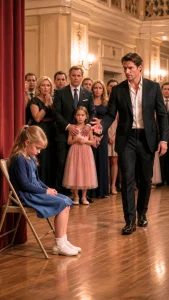
Near the stage, half-hidden behind a crimson curtain, stood Sophie Bennett.
She was eight years old, wearing a pale blue dress that had become a little too short and a pair of white shoes that pinched her feet. Her dark hair was tied back with a simple elastic band, and wrapped around her wrist was a blue paper bracelet handed out at the entrance.
She twisted it nervously between her fingers while staring toward the front doors.
Her aunt, Karen, had promised she’d arrive at seven.
It was already seven-thirty.
Third-grade teacher Ms. Rachel Morgan noticed almost immediately that Sophie wasn’t waiting the way excited children usually wait.
She was waiting the way children do after they’ve learned not to expect very much.
Rachel recognized that silence.
It wasn’t shyness.

It was self-protection.
When the music shifted into a slow dance, girls walked onto the floor beside fathers, grandfathers, uncles, and older brothers. One little girl stood on her father’s shoes while they laughed together. Another rested her head against her grandfather’s chest.
Sophie quietly slipped her phone into her dress pocket and lowered her eyes.
Nearby, a young boy whispered—not cruelly, but with the unfiltered honesty children sometimes have.
“She doesn’t have anyone to dance with.”
Sophie didn’t burst into tears.
She didn’t make a scene.
She simply pressed her lips together, as though something inside her had broken carefully enough not to make a sound.
Then she whispered,
“No one wants to dance with me.”
Rachel froze.
So did William.
He had no idea why, amid the music, conversations, and laughter, those five words reached him so clearly.
He looked toward the little girl standing beside the curtain.
He noticed the shoes that were too tight.
He noticed how straight she stood—far too straight for an eight-year-old.
Most of all, he saw a sadness so disciplined that it frightened him.
Rachel started walking toward Sophie.
William stood first.
From the inside pocket of his jacket, he removed the extra admission ticket the volunteers had handed him at the entrance.
Without drawing attention to himself, without acknowledging the curious eyes following him, he crossed the auditorium.
He stopped in front of Sophie, bent slightly so they were eye level, and spoke softly.
“I have an extra ticket… and no one to share it with.”
He smiled gently.
“Would you honor me with this dance?”
Sophie looked up.
Her eyes weren’t filled with childish excitement.
They belonged to someone carefully deciding whether an adult could be trusted.
She studied the ticket.
Then his face.
Finally, with great caution…
She nodded.
When they stepped onto the dance floor together, the auditorium fell completely silent.
William Carter—the billionaire who never smiled for newspaper cameras, the anonymous donor who avoided attention—was dancing with the little girl everyone had just watched standing alone beside the curtain.
Sophie counted quietly beneath her breath.
“One… two… three…
One… two… three…”
William never corrected her.
Never hurried her.
Instead, he adjusted every step to match hers.
His hand rested lightly against her shoulder.
The other gently held hers, as though it were something precious that had already been broken once.
When the song ended, Sophie looked up.
“Thank you.”
“No,” William answered softly.
“Thank you.”
For just a second…
She almost smiled.
Barely.
But William noticed.
Afterward they shared hot apple cider while Ms. Rachel lingered nearby, pretending not to watch.
Sophie accepted the paper cup with both hands.
Later, believing no one was paying attention, she quietly slipped a wrapped cookie into her backpack.
William saw.
But he deliberately looked away.
By nine o’clock, nearly everyone had gone home.
Karen never arrived.
Rachel called three times.
No answer.
Finally, she decided to drive Sophie home herself.
William offered to follow behind, simply to make sure everything was all right.
Rachel didn’t object.
Karen’s small house sat on a narrow residential street beneath a flickering porch light.
Before Sophie could knock, the front door opened.
Karen stood there with folded arms.
She didn’t yell.
That somehow made it worse.
Her voice was calm.
Cold.
“Well, look at you.”
“You made everyone stare at you like you’re some poor little victim.”
Sophie’s shoulders immediately shrank inward.
The door closed.
From inside his car, William noticed something else.
An official envelope stuck halfway out of the mailbox.
Across the front, he could clearly read:
Vermont Department for Children and Families
And beneath it…
Sophie Bennett.
He said nothing.
He drove home.
But that night…
He never slept.
During the following week, Rachel began noticing details she’d overlooked before.
Every Monday Sophie arrived exhausted.
She ate lunch unusually fast.
Then quietly tucked half of it into her backpack.
Before asking for anything, she always apologized first.
“Sorry… may I use the restroom?”
“Sorry… may I borrow another pencil?”
“Sorry… I didn’t mean to take so long.”
On Wednesday, Rachel found her in the nurse’s office.
School nurse Mrs. Linda Harris was treating a blister on Sophie’s heel.
The white dance shoes had rubbed her feet raw until they bled.
Rachel documented everything.
That afternoon, she contacted William Carter’s foundation to ask whether the emergency school clothing fund was still active.
The next morning, a plain white box arrived.
Inside was a brand-new pair of navy-blue sneakers with Velcro straps.
Sophie stared at them as though they belonged to someone else.
“I can’t accept these,” she whispered.
Rachel smiled gently.
“Why not?”
Sophie lowered her voice.
“New things make adults angry.”
Rachel felt her chest tighten.
Piece by piece, the truth began revealing itself.
Karen collected Sophie’s monthly survivor benefits along with money from a trust fund Sophie’s late mother, Rebecca Bennett, had established for her care.
Yet Sophie came to school without lunch.
Without medical appointments.
Without new glasses she desperately needed.
Without shoes that fit.
Her grief counseling had quietly stopped months earlier.
So had her dental checkups.
Rachel filed an official report.
Within days, social worker Angela Brooks visited the school.
Angela was calm, observant, and meticulous.
She listened.
Asked questions.
Reviewed records.
Took notes.
Rather than interviewing Sophie in an office, Angela chose somewhere that wouldn’t frighten her.
They met at a small family diner called Hope Café, where the booths were wooden, the coffee smelled of cinnamon, and no one asked unnecessary questions.
William arrived first.
Rachel had mentioned Sophie liked chicken soup whenever she felt nervous.
So he ordered a large bowl.
No gifts.
No stuffed animals.
Just soup.
Sophie sat across from him, backpack still resting on her lap.
Tied around one strap…
Was the blue bracelet from the dance.
“Hi,” she said quietly.
“Hello.”
William smiled.
“They gave me far too much soup.”
“Would you help me finish it?”
She nodded.
They talked about school.
Math.
Books.
Sophie admitted that sometimes letters seemed to move across the page whenever she became too tired.
William confessed he’d always loved numbers himself.
Then he reached into his jacket pocket.
Carefully unfolded the extra dance ticket.
And placed it on the table.
Sophie’s eyes widened.
“You still have it.”
“It didn’t seem right to throw it away.”
She never touched it.
But something in her expression softened.
For the first time…
She didn’t seem prepared to run.
Then she quietly asked,
“Do grown-ups only act nice when people are watching?”
William didn’t argue.
He simply answered,
“That’s been true in your experience.”
She blinked.
No adult had ever responded that way before.
“Did you have a daughter?”
William swallowed.
“I did.”
“Her name was Emily.”
Sophie stirred her soup.
“Did you stop loving her?”
His voice caught.
“I never stopped.”
“She got sick.”
Sophie looked into the bowl.
“My mom died too.”
“I know.”
“I’m so sorry.”
Beneath the table, Sophie squeezed the blue bracelet tightly.
“I never stopped loving her either.”
Just then…
The restaurant door swung open.
Karen entered.
Her jaw was tight.
Her eyes locked immediately onto William.
“I was told she was here.”
She looked at him as though he’d stolen something precious.
“We’re leaving.”
Before standing, Sophie automatically whispered,
“Sorry.”
From another booth, Angela watched every second.
She said nothing.
Not yet.
But she wrote another note.
Ten days later, a meeting was held at the county child welfare office.
Angela presented her findings.
Rachel submitted school reports.
Nurse Linda included photographs of Sophie’s blisters, ill-fitting shoes, and records showing chronic hunger.
There was also a photograph taken during a home visit.
Sophie’s backpack lay open.
Inside were saved crackers, loose change in a plastic bag…
And the blue bracelet from the dance.
Karen tried defending herself.
“I’m a single woman raising a child who isn’t even mine.”
“I’m doing the best I can.”
Angela met her gaze calmly.
“We aren’t evaluating one difficult day.”
“We’re evaluating a pattern.”
The county attorney explained that an emergency protective placement could be requested.
From the back of the room, William finally spoke.
“I’d like to be considered as her temporary guardian.”
“I’ll complete every background check.”
“Every home inspection.”
“Every parenting class.”
“I’m not asking to skip the process.”
“I’m asking to follow it properly.”
Karen laughed bitterly.
“Of course.”
“The billionaire wants to play hero.”
William never answered.
Three days later—before the protective order could be finalized—Karen signed Sophie out of school early.
She claimed there was a family emergency.
Instead, she drove toward Burlington, where her boyfriend lived.
“You’ll be more useful there,” Karen muttered behind the wheel.
“And don’t think anyone keeps a little girl around unless the money comes with her.”
Sophie remained silent.
At a gas station, Karen went inside to pay.
Sophie quietly opened the passenger door.
Grabbed her backpack.
And walked away.
She didn’t run.
She simply kept walking until she reached a nearby bus stop.
She counted the coins she’d been saving.
Asked the driver whether any bus returned to Maple Creek.
The driver noticed her trembling hands.
He let her ride in the front seat.
At the end of the route, another driver helped her transfer onto a second bus.
She arrived back in town just after dark.
At 9:47 p.m., Rachel found Sophie sitting inside her own parked car behind the school.
Months earlier, Rachel had shown Sophie where she kept a spare key—just in case the little girl ever needed somewhere safe to wait.
Sophie remembered.
The moment Rachel opened the door, Sophie blurted out,
“I didn’t break anything.”
Rachel knelt beside her.
“I know, sweetheart.”
“I know you didn’t.”
That same evening, Angela finalized the emergency protective order.
William Carter was approved as Sophie’s temporary guardian under state supervision.
When Angela explained that Sophie could stay with him until the court reached a final decision, the little girl looked across the parking lot.
William stood several yards away.
He didn’t approach.
He didn’t try convincing her.
He simply waited.
“Does he decide?” Sophie asked.
Angela smiled gently.
“You do too.”
“You can say no.”
Sophie looked down at her backpack.
Then back at William.
“Okay.”
William’s home felt enormous.
And painfully quiet.
That first night, Sophie chose the small guest room beside the kitchen.
She insisted on leaving the hallway light on.
William showed her where the cereal was.
“You never have to ask.”
“You can eat whenever you’re hungry.”
She didn’t answer.
The next morning, he found her breakfast bowl washed, dried, and carefully placed in the dish rack.
She was already dressed.
Backpack on her lap.
Ready to leave…
If she had to.
Weeks passed.
Then months.
Sophie began therapy.
Some days she attended willingly.
Other days she refused to get out of the car.
William slowly learned that supporting someone sometimes meant not forcing them.
He learned to leave the hallway lamp on without mentioning it.
He learned not to check her backpack even though he knew she still hid food inside.
He learned to apologize whenever he said something awkward.
One afternoon…
He finally unlocked Emily’s old music room.
He didn’t invite Sophie inside.
He simply left the door open.
A small piano stood against the wall.
Children’s drawings remained exactly where Emily had left them.
A framed photograph showed his daughter smiling brightly.
Several days later, Sophie peeked inside.
“Was this hers?”
“Yes.”
“May I look?”
William nodded.
That night Sophie woke from a nightmare.
She wandered downstairs and found William clumsily sewing fabric together.
It was her blue dance dress.
Now too small.
He was turning it into a pillow.
On the kitchen table lay the broken pieces of the blue paper bracelet, which had finally torn after months of wearing it.
“I thought…”
He hesitated.
“Maybe we could keep it safe inside.”
“If you’d like.”
Sophie didn’t answer.
She simply sat beside him.
William carefully placed the broken bracelet inside the pillow before stitching the final seam closed.
When he finished…
Sophie hugged it tightly against her chest.
“Now it can’t disappear.”
One year later, Lincoln Elementary’s auditorium filled once again for the Father-Daughter Dance.
But this time there was a new tradition.
Created by Ms. Rachel.
No child would ever stand alone.
If a parent or relative couldn’t attend, a teacher, neighbor, grandparent, volunteer, or trusted family friend would already be waiting.
No one would ever be left beside the curtain again.
Instead of paper wristbands, every guest received a small blue ribbon pin.
Sophie—now wearing shoes that actually fit—fastened hers carefully to the neckline of her dress.
Then she walked with William to a small table near the stage.
They placed the pillow made from her old blue dress there.
Beside it stood two framed photographs.
One of her mother, Rebecca, smiling beneath the summer sun.
The other of Emily sitting proudly at her little piano.
“There.”
Sophie smiled.
“Everything’s ready.”
William nodded.
“Everything’s ready.”
As the music began, Sophie looked up at him.
“Last year…”
“You promised me a dance.”
William chuckled softly.
“We already danced.”
She shook her head.
“That one was borrowed.”
“It doesn’t count.”
For the first time in years…
William Carter smiled without holding anything back.
He held out his hand.
Sophie took it completely.
Not with hesitant fingertips.
Not ready to pull away.
Not preparing to run.
Together they stepped onto the dance floor.
This time…
She didn’t count the steps.
She didn’t glance toward the door.
Halfway through the song, she rested her head gently against William’s arm.
Neither of them spoke.
They didn’t need to.
Around them, children danced with grandparents, teachers, neighbors, uncles, family friends, and volunteers.
An entire town quietly proving that sometimes…
A family begins the moment someone decides to stay.
When the music ended, Sophie looked up.
“Same day next year?”
William glanced at her new shoes.
The blue ribbon pinned proudly to her dress.
The little girl who no longer waited beside any curtain.
“Same day next year,” he said.
And for the first time in many years…
William Carter didn’t return to an empty house.
He returned to a backpack resting beside the front door.
A hallway light left glowing.
And a little girl who was slowly learning that being loved wasn’t something you had to earn.
It was simply…
Home.