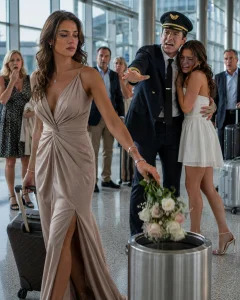
Emily Whitmore had spent five years imagining that moment.
She bought a bouquet of sunflowers from a small flower stand in Georgetown, styled her hair the way Andrew liked it, and arrived at Reagan National Airport two hours early.
Andrew Carter had left as a military doctor on an overseas mission, promising that when he came home, they would finally marry.
“Wait for me, Em. When I come back, we’ll start our life for real.”
She believed him.
For five years, Emily looked after Andrew’s parents, endured Mrs. Harrington’s insults, and helped save Carter Development from collapse.
Mrs. Harrington never believed Emily was good enough.
“A woman that controlling always ends up alone,” she would say. “Learn to be softer, sweetheart. Men don’t like women who know more than they do.”
Emily would smile politely.
Then she would return to fixing contracts, negotiating with banks, and stopping investors from abandoning the company.
No one knew that Whitmore Capital had quietly funded every rescue deal.
No one knew who Emily really was.
When the arrival doors opened, her heart nearly burst.
Andrew stepped out of the crowd, thinner than before, exhausted, with a green duffel bag over one shoulder.
The moment he saw her, he froze.
Emily took one step forward.
Then a woman in a cream dress ran toward him.
“Andrew!”
She threw herself into his arms.
Emily recognized her.
Natalie Brooks.

Andrew’s childhood friend. The woman from all those old photos. The one he always called “like a sister.”
Emily waited for him to pull away.
He didn’t.
Instead, Andrew wrapped one arm around Natalie’s waist and rubbed her back with a tenderness that had no place between “siblings.”
One sunflower slipped from Emily’s bouquet and fell to the airport floor.
Andrew finally looked at her.
“Em, let me explain.”
Emily looked at his hand still resting on Natalie’s waist.
She didn’t scream.
She didn’t cry.
She walked to the nearest trash can, dropped the bouquet inside, and pulled out her phone.
“Mr. Bennett,” she said, “withdraw Carter Development’s guarantee for the Arlington project today.”
Andrew went pale.
“What are you doing?”
Emily continued.
“Cancel the bridge financing for the Georgetown development too. I don’t want a single dollar connected to Whitmore backing them anymore.”
“Miss Emily,” Mr. Bennett said carefully, “that could leave the Carters without liquidity in less than forty-eight hours.”
Emily looked at Natalie still clinging to the man she had sacrificed five years for.
“Then let them discover what the woman they treated like an assistant was actually worth.”
She hung up.
Andrew stepped toward her, but Emily raised one hand.
“If you missed her that much, stay with her. I finally understand my place.”
That night, a black car drove Emily to a mansion in Beacon Hill, a home she had not entered in five years.
Her grandfather, Arthur Whitmore, was waiting beneath the lights of the grand foyer.
“Well,” he said, “look who finally remembered she still has a family.”
Emily swallowed hard.
“Grandpa… I need to come back.”
The old man studied her quietly.
“As the girl who left for love… or as the woman who finally opened her eyes?”
Emily placed Andrew’s promise ring on the table.
“As a Whitmore.”
The next morning, Carter Development received six notices from its banks.
By noon, the company was facing payments it could not cover.
“This is Emily’s doing,” Mrs. Harrington snapped. “That girl is throwing a tantrum because Andrew hugged a friend.”
Mr. Carter slammed his fist on the desk.
“A tantrum doesn’t freeze hundreds of millions of dollars. What haven’t you told me?”
Andrew said nothing.
For years, whenever his father said another crisis had been solved, Andrew assumed Emily had helped with paperwork, calls, or minor contacts.
He never realized she was the contact.
Across the city, Emily stood on the forty-second floor of a newly purchased tower.
A new name already hung in the lobby.
Whitmore Capital.
Her family had given her the name.
She had built the fortune.
“We now own 4.8% of Carter Development,” reported Olivia Reed, her chief financial officer. “Another 0.2%, and the acquisition becomes public.”
Emily signed the order.
“Buy it.”
“That will cause panic.”
“No,” Emily said. “The panic was already there. We’re just turning on the lights.”
That afternoon, Emily arrived at the Carter family home.
Mrs. Harrington opened the door with a strained smile.