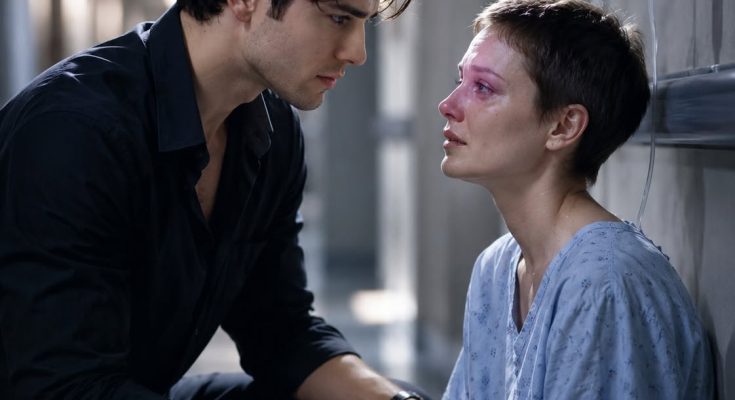
For several seconds, Maya said nothing.
The hallway around us kept moving.
Nurses passed with trays of medicine. A doctor walked by while reading a file. Somewhere farther down the corridor, a child was crying. The fluorescent lights hummed above our heads with a cold, lifeless sound.
But in that moment, the whole hospital seemed to disappear.
There was only Maya.
Her hand lay inside mine like something fragile I was afraid to hold too tightly.
She slowly pulled her fingers away.
“Arjun,” she whispered, “you shouldn’t be here.”
The words struck harder than I expected.
“I came to visit Rohit,” I said. “I didn’t know you were here.”
Her lips trembled slightly, but she forced a faint smile.
“Then you should go see him.”
“Maya.”
She closed her eyes.
That one gesture broke something inside me. I had seen her tired before. I had seen her sad, silent, disappointed, distant. But I had never seen her defeated.
Not like this.
“What happened?” I asked again, quieter this time.
She looked toward the window at the end of the corridor. Rain had begun tapping against the glass, soft and uneven.
“I got sick,” she said.
I waited.
She swallowed, then added, “A few weeks after I left.”
My heart began to pound.
“What kind of sick?”
She didn’t answer.
A nurse approached before I could ask again. She was young, with kind eyes and a clipboard pressed against her chest.
“Mrs. Sharma,” she said gently, “the doctor is ready to speak with you.”
Maya stiffened.
I looked at the nurse.
“Mrs. Sharma?” I repeated.
Maya lowered her eyes.
Even after the divorce, she had kept my surname.
The nurse glanced between us, uncertain.
“I’m coming,” Maya said softly.
She tried to stand.
Her body swayed.
I caught her by the arm before she could fall.
“Maya!”
“I’m fine,” she whispered, embarrassed. “Please.”
But she wasn’t fine. Her knees were weak, her breath uneven. I could feel how little strength she had left.
The nurse stepped forward, concerned. “She should use the wheelchair.”
“I don’t need it,” Maya said quickly.
I looked at her.
That stubbornness—quiet, gentle, unshakable—was so painfully familiar that for a second I almost saw the woman who used to stand in our kitchen at midnight, insisting she was not tired while making tea for both of us.
“Maya,” I said, “sit.”
She looked at me as if she wanted to argue.
Then her body betrayed her.
She sank back into the chair.
I turned to the nurse. “Bring the wheelchair.”
“Arjun, don’t,” Maya whispered.
But I didn’t listen.
A minute later, I was pushing her down the corridor toward the doctor’s office. She sat in silence, her thin fingers folded in her lap.
The sight felt unreal.
Two months ago, she had walked out of our apartment carrying a small suitcase and a quiet heart.
Now I was pushing her through a hospital hallway like a stranger who had arrived too late to be called family.
Outside the doctor’s room, Maya finally spoke.
“You don’t have to come in.”
“Yes,” I said, “I do.”
She turned her face slightly. “You’re not my husband anymore.”
The sentence was soft.
But it cut deeper than anger ever could.
I gripped the wheelchair handles.
“No,” I said. “But I’m not nothing either.”
She didn’t reply.
The doctor was a middle-aged woman with silver-threaded hair and tired, intelligent eyes. Her nameplate read: Dr. Eszter Varga, Hematology.
Hematology.
Blood.
The word settled heavily in my stomach.
Dr. Varga looked at Maya, then at me.
“This is?”
Maya hesitated.
Before she could answer, I said, “I’m Arjun. Her…” My voice failed for half a second. “Her ex-husband.”
The doctor’s expression shifted slightly, but she remained professional.
“Maya, would you like him to stay?”
Maya looked down at her hands.
A long silence passed.
Then she nodded.
Dr. Varga opened the folder on her desk.
I watched her face, searching for hope before she said anything. But doctors learn to hide truth behind calm voices.
“Maya,” she began, “your latest results confirm what we suspected.”
My throat tightened.
Maya did not move.
“The leukemia has progressed faster than we hoped.”
The word entered the room like a blade.
Leukemia.
For a moment, I didn’t understand it.
Or maybe I understood it too well and my mind refused to accept it.
I stared at Maya.
She kept her head lowered.
“How long?” she asked.
Her voice was strangely calm.
Dr. Varga exhaled slowly. “Without treatment, not long. With aggressive treatment, there is still a chance. But we need to begin immediately. Chemotherapy, then we evaluate for a bone marrow transplant.”
I gripped the side of the chair.
“Why didn’t anyone tell me?” I asked.
The doctor looked at me with quiet surprise.
Maya shut her eyes.
“Because I didn’t want anyone to tell you,” she said.
I turned to her.
“What?”
She finally looked at me. Her eyes were red, but dry.
“You had already left, Arjun. I didn’t want to drag you back into my life because I was sick.”
“Drag me back?” My voice cracked. “Maya, you have leukemia.”
“I know what I have.”
“And you were sitting alone in a hospital corridor.”
“I have managed until now.”
“No, you haven’t.”
Her face tightened.
For the first time since I had found her, a flash of emotion crossed her expression.
“Please don’t speak as if you know what these weeks have been like for me.”
I stopped.
The anger vanished instantly, leaving only shame.
Dr. Varga quietly closed the folder.
“There is something else,” she said.
Both of us looked at her.
“Maya’s blood counts are extremely unstable. She needs admission today. Not next week. Not after arrangements are made. Today.”
Maya’s fingers clenched.
“I can’t stay.”
“You must,” the doctor said firmly.
“I have things at home.”
“What things?” I asked.
She looked away.
I knew that look.
Maya was hiding something.
Dr. Varga leaned forward. “Maya, this is no longer optional.”
“I understand.”
“No,” the doctor said gently, “I don’t think you do. You fainted this morning. Your platelet count is dangerously low. You’re at risk of internal bleeding. You should not be alone.”
The room blurred slightly.
I turned to Maya.
“You fainted?”
“It was nothing.”
“Stop saying that.”
Her lips pressed together.
Dr. Varga looked at me. “Does she have family in Budapest?”
I answered before Maya could.
“No.”
“Anyone staying with her?”
“No,” I said, my voice hollow.
Maya whispered, “I told you I’ve been fine.”
I looked at her pale face, her trembling hands, the hospital gown hanging loosely from her shoulders.
“You haven’t been fine for a long time,” I said.
The words left my mouth before I could stop them.
And suddenly, I wasn’t talking only about the illness.
Maya understood.
Her eyes lowered again.
After the consultation, the nurse brought admission papers. Maya signed them slowly, as if each stroke of the pen cost her strength. I stood beside her, useless and shaken.
Then I remembered Rohit.
I called him from the corridor.
“Bro, where are you?” he asked weakly. “I thought you were coming.”
“I’m at the hospital,” I said. “Something happened.”
“What happened?”
I looked through the glass panel at Maya sitting inside the admissions room.
“It’s Maya.”
There was silence on the line.
“What about Maya?”
“She’s sick. Very sick.”
Rohit didn’t ask foolish questions. He simply said, “Go to her. I’m okay.”
I ended the call and returned.
Maya was now standing beside the nurse, refusing the wheelchair again.
This time I didn’t argue.
I simply walked beside her, close enough to catch her if she fell.
She noticed.
“Don’t do this,” she whispered.
“Do what?”
“Act like nothing happened between us.”
I gave a bitter, helpless smile.
“I’m not acting like nothing happened. I’m acting like something still matters.”
She looked at me then.
For one brief second, her face softened.
Then she turned away.
They placed her in a small room near the end of the ward. One bed, one window, one chair, one narrow cupboard. The bedsheet was white, almost painfully clean. The air smelled of disinfectant and rain.
Maya sat on the edge of the bed, looking smaller than I remembered.
The nurse checked her blood pressure, adjusted the IV line, and left.
The door clicked shut.
We were alone.
Neither of us spoke.
So much had lived between us. Love. Grief. Resentment. Silence. Two unborn children whose names we never gave. Five years of morning tea and evening arguments. A divorce signed with shaking hands. And now this hospital room, where all of it had followed us.
Finally, I said, “Why didn’t you call me?”
She smiled faintly, without happiness.
“Would you have answered?”
The question stunned me.
“Of course.”
“Really?”
I opened my mouth.
No words came.
Because I remembered.
The week after the divorce, she had called once.
Only once.
I had stared at the screen until it stopped ringing.
I had told myself answering would reopen wounds.
I had told myself space was necessary.
I had told myself many things.
Maya watched the realization settle on my face.
“I wasn’t calling about the illness then,” she said softly. “I didn’t know yet. I only wanted to ask if you had taken your allergy medicine. You always forgot during spring.”
My eyes burned.
“Maya…”
“It’s all right,” she said. “After that, I understood.”
“No.” I shook my head. “No, you didn’t understand. I was being a coward.”
She looked tired suddenly, as if even pain exhausted her.
“Arjun, please don’t turn this into guilt. I don’t have the strength to comfort you.”
That silenced me.
She lay back against the pillow, closing her eyes.
I stood beside the bed, not knowing whether to stay or leave.
After a while, she whispered, “There’s a key in my bag.”
I looked at her.
“To my apartment,” she said. “I need some clothes. My medical documents. And…” She paused. “There’s a brown envelope in the drawer beside the bed. Bring that too.”
“What’s in it?”
Her eyes stayed closed.
“Just bring it.”
Something in her tone warned me not to ask.
I took the key from her bag.
Before leaving, I looked back from the door.
Maya seemed almost asleep.
But just as I stepped out, she said, “Arjun.”
I stopped.
“Don’t look through the envelope.”
My hand tightened around the key.
“I won’t.”
She opened her eyes.
For the first time, I saw fear there.
Not of death.
Of me discovering something.
“I mean it,” she whispered.
I nodded.
Then I left.
Maya’s apartment was on the third floor of an old building not far from the clinic. The stairwell smelled of damp concrete and old cooking oil. Her name was written on the mailbox in small, neat letters.
Maya Sharma.
My surname again.
I stood there for a moment, staring at it.
Then I climbed the stairs.
The apartment was tiny.
One room. A narrow kitchen. A bathroom barely large enough to turn around in. A bed against the wall. A small wooden table by the window. A single mug beside the sink.
No decoration, except for one framed photograph on the bedside table.
Our wedding picture.
I couldn’t move.
We looked so young in it. Maya in red and gold, smiling shyly. Me beside her, proud and nervous. My hand around hers. Our eyes full of a future we thought we could protect.
I picked up the frame.
There was dust on the glass, except for one clean line across Maya’s face, as if someone had touched it often.
My throat closed.
I set it down carefully.
Her clothes were folded in a small suitcase under the bed. I packed a few soft shawls, pajamas, slippers. In the cupboard, I found files of medical reports arranged by date. Maya had always been organized, even in suffering.
Then I opened the bedside drawer.
The brown envelope was there.
Thick.
Unsealed.
I stared at it.
Her warning came back.
Don’t look through the envelope.
I picked it up.
It felt heavier than paper should.
I placed it in the bag.
Then something else caught my eye.
A small white box pushed to the back of the drawer.
My breath stopped.
It was a baby keepsake box.
The kind sold in stores for first socks, hospital bracelets, ultrasound photos.
I knew because Maya had bought it three years ago.
Before the first miscarriage.
She had hidden it after we lost the baby. I thought she had thrown it away.
Slowly, I opened it.
Inside were two folded hospital bracelets.
Two ultrasound images.
And a third one.
A newer one.
My hands began to tremble.
The date printed at the corner was five weeks after our divorce.
I stared at the tiny blur on the image.
No.
No.
My mind rejected it before my heart could understand.
There was a note beneath it.
Maya’s handwriting.
I wanted to tell him. I tried once. He didn’t answer.
The room tilted.
I sat on the edge of the bed, unable to breathe.
Maya had been pregnant.
After the divorce.
After I left.
After I ignored her call.
I don’t know how long I sat there before I noticed another folded paper beneath the note.
It was from the hospital.
I read it once.
Then again.
Then a third time, because the words refused to stay still.
Spontaneous miscarriage. Complicated by severe anemia. Further hematological investigation recommended.
The page slipped from my hand.
So that was how they found it.
The illness.
The third child we never knew.
The third loss she had endured alone.
I covered my face with both hands, but no sound came out.
Grief can be loud.
But sometimes it is so deep that it becomes silent.
When I returned to the hospital, the sky had grown dark.
Maya was awake.
She looked at the bag in my hand, then at my face.
She knew immediately.
“You looked,” she said.
I stepped inside slowly.
“I didn’t open the envelope.”
Her expression changed.
Then she understood.
“The drawer,” she whispered.
I placed the bag down.
For a long moment, neither of us spoke.
Then I took the ultrasound image from my pocket and held it in my shaking hand.
“Why didn’t you tell me?”
Her face crumpled.
Only for a second.
Then she turned away.
“I tried.”
Those two words destroyed me.
“I know,” I said.
“No,” she whispered. “You don’t know.”
I sat beside her bed.
“Then tell me.”
She stared at the window. Rainwater ran down the glass in thin, crooked lines.
“I found out after I moved out,” she said. “I was late. I thought it was stress. Then I took a test.”
Her voice was flat, but her fingers twisted the sheet.
“I wanted to tell you. I called you. You didn’t answer.”
“I was wrong.”
“I waited for you to call back.”
I closed my eyes.
“You never did,” she said.
Each word landed quietly.
That made it worse.
“I thought maybe it was better that way,” she continued. “We had already lost two babies. You were exhausted. I was exhausted. I thought… maybe if this pregnancy survived the first few weeks, then I would tell you.”
“Maya…”
“But then I started bleeding.”
Her voice broke.
She swallowed hard and forced herself to continue.
“I went to the emergency room alone. I told myself not to cry because if I started, I wouldn’t stop. And when the doctor said the baby was gone, I nodded like I understood. Like it was a normal sentence.”
She pressed her lips together.
“I came home the next morning and slept on the floor because I didn’t have strength to reach the bed.”
I couldn’t speak.
“I thought that was the worst thing,” she said. “Then the blood tests came back.”
Leukemia.
The word hung between us again.
I bent forward, elbows on knees, hands clasped so tightly my knuckles hurt.
“I left you alone,” I whispered.
Maya looked at me.
“Arjun.”
“No. Don’t make it smaller. Don’t soften it. I left you alone.”
She was quiet for a long time.
Then she said something I did not expect.
“Yes.”
I looked up.
Her eyes were wet now.
“Yes,” she repeated. “You did.”
The truth entered me like cold water.
I had wanted forgiveness before confession. Comfort before accountability. Some gentle sentence from her that would make me less monstrous in my own eyes.
But Maya gave me the truth.
And I deserved it.
“I am so sorry,” I said.
She looked away.
“I know.”
“Can you ever forgive me?”
Her answer came after a long silence.
“I don’t know.”
The honesty hurt.
But it was better than kindness.
A nurse came in then to start medication. Maya wiped her eyes quickly, embarrassed. I stepped back and watched as the nurse checked the IV line, adjusted the drip, and spoke in a cheerful voice that belonged to a world where people got better simply because medicine existed.
When she left, Maya looked exhausted.
“You should go home,” she said.
“I’m staying.”
“No.”
“Yes.”
“Arjun, we’re divorced.”
“I know.”
“You don’t owe me this.”
I looked at her.
“That’s not why I’m staying.”
She studied me, searching for something false.
Maybe she found plenty.
Maybe she found nothing.
Finally, she turned her face toward the wall.
“Do whatever you want.”
So I stayed.
That night, I slept in the chair beside her bed.
Or tried to.
Hospitals do not allow real sleep. Machines beep. Shoes squeak in hallways. Nurses enter and leave. Pain moves quietly from room to room.
Around three in the morning, Maya began shivering.
I woke instantly.
Her forehead was burning.
I called the nurse. Within minutes, the room filled with movement. Thermometer. Blood pressure. IV antibiotics. Questions. Instructions. Words I could barely follow.
Maya drifted in and out of consciousness.
Once, her eyes opened and found mine.
“Don’t tell my mother,” she whispered.
I leaned closer. “What?”
“Please.”
Her mother lived in Pune and had a weak heart. Maya had always protected her from pain, even pain that was not hers to hide.
“We’ll talk about it later,” I said.
“No,” she murmured. “Promise.”
“Maya…”
Her fingers weakly caught my wrist.
“Promise.”
I had broken enough promises in my life.
So I lied.
“I promise.”
She relaxed.
By morning, the fever had lowered. Dr. Varga explained that infections were dangerous now. Maya’s immune system was collapsing. Treatment had to begin immediately.
I signed forms where I could. Paid deposits. Called my office and asked for leave. Went to the cafeteria and bought tea Maya barely drank.
I moved through the day like a man trying to repair a house already on fire.
In the afternoon, while Maya slept, I finally opened the brown envelope.
I told myself she had only forbidden me before I knew everything.
That was another lie.
Inside were documents.
A life insurance policy.
Medical bills.
A handwritten letter addressed to me.
My name on the front.
Arjun.
My hands went cold.
For several minutes, I couldn’t open it.
Then I did.
Her handwriting was steady at first.
Arjun,
If you are reading this, it probably means I was not brave enough to give it to you myself.
I stopped breathing.
I don’t know what you will feel when you learn everything. Maybe anger. Maybe guilt. Maybe nothing. I hope it is not guilt. I have carried enough of that for both of us.
I was pregnant when I called you. I wanted to tell you, but when you didn’t answer, I thought life had answered for you.
My eyes blurred.
After I lost the baby, I became sick. The doctors say treatment is possible, but expensive, painful, uncertain. I am tired, Arjun. Not only from illness. From losing pieces of myself again and again.
Please do not think I hate you. I never managed to hate you. That was part of my problem.
A sound escaped me then.
Something between a breath and a sob.
There is one thing I need to tell you. I did not sign the divorce papers because I stopped loving you. I signed because I thought you would breathe easier without me.
I looked toward the bed.
Maya slept with one hand near her face, her eyelashes dark against her pale cheeks.
I watched you become smaller beside my sadness. I watched you avoid coming home. I watched you smile less. I thought maybe I had become a room with no windows, and you were suffocating inside it.
So when you said divorce, I let you go.
The letter shook in my hands.
But I kept your name. Not because I was foolish. Because for five years, it was mine too.
I pressed my fist against my mouth.
If something happens to me, please send my ashes to my mother. Tell her I was peaceful. Tell her I was not alone, even if that is not true.
The last line was different.
The handwriting weaker.
And please forgive yourself one day. I am trying to do the same.
I folded the letter slowly.
Then I sat there in the hospital chair, surrounded by white walls and antiseptic air, and understood that regret was not a feeling.
It was a place.
And I had just arrived there.
Over the next week, Maya began chemotherapy.
The first day, she was quiet. The second, she vomited until there was nothing left. The third, she cried silently while pretending she wasn’t. On the fourth day, she told me to stop watching her like she was already dead.
So I tried to behave normally.
I brought her books she didn’t read. Played old songs she claimed were irritating but never told me to turn off. Helped her walk slowly down the corridor when the doctors insisted she move a little.
Sometimes we spoke.
Mostly we sat in silence.
But the silence had changed.
It was no longer the silence of two people drifting apart.
It was the silence of two people standing beside wreckage, unsure what could still be saved.
One evening, she asked, “Did you tell your parents?”
“No.”
“Why?”
“They’ll make it about themselves.”
For the first time, she smiled.
A real smile.
Small, but real.
“They always did,” she said.
I laughed softly.
Then we both fell quiet, remembering family dinners where my mother praised Maya’s cooking while reminding her that motherhood would make her “complete,” and my father asked me loudly when I planned to give him a grandson.
I had never defended Maya enough.
That memory sat between us too.
“I’m sorry,” I said.
She looked at me, tired amusement in her eyes.
“For which part?”
“All of it.”
“That’s a very large apology.”
“I know.”
She turned toward the window.
After a while, she said, “I used to hate evenings.”
“Why?”
“Because I would hear footsteps in the hallway and hope they were yours. Then you would text that you were working late.”
I stared down at my hands.
“Sometimes I really was working.”
“And sometimes?”
I didn’t answer.
She nodded, as if she had known.
“I used to cook anyway,” she said. “Then I would put the food away. The next morning, I’d tell you I wasn’t hungry, but really I had eaten dinner standing alone in the kitchen after midnight.”
“Maya, stop.”
“Why?”
“Because it hurts.”
She looked at me then, not cruelly.
“It hurt then too.”
I accepted the sentence.
There was nothing else to do.
A few days later, Dr. Varga called me into her office.
Maya was sleeping after a blood transfusion.
The doctor looked serious.
“We need to discuss transplant options.”
“I’ll do it,” I said immediately.
She folded her hands. “It isn’t that simple. We have to test compatibility.”
“Then test me.”
“We will. But spouses are not usually the strongest match unless there is a rare compatibility. Siblings are better.”
“She has no siblings.”
“Then we search the registry.”
“How long does that take?”
“It depends.”
I hated that answer.
Everything depended.
On blood. On time. On money. On luck.
“Test me,” I repeated.
Dr. Varga nodded.
They drew my blood that afternoon.
When I returned to Maya’s room, she already knew.
“You shouldn’t have done that,” she said.
“It’s just a test.”
“It’s not your responsibility.”
I sat beside her.
“Do you remember our wedding vows?”
She looked away.
“Don’t.”
“You said them first because I forgot my line.”
Despite herself, she almost smiled.
“You were sweating so much.”
“I was nervous.”
“You looked like you wanted to run.”
“I didn’t.”
She looked at me.
I held her gaze.
“I didn’t then,” I said. “I did later. That was my mistake.”
Her expression softened, then closed again.
“Arjun, don’t confuse fear with love.”
“I’m not.”
“I don’t want you here because you’re guilty.”
“I know.”
“And I don’t want to become your chance to feel noble.”
The words struck hard because they were fair.
“I’m not noble,” I said. “I’m just late.”
She stared at me for a long time.
Then she whispered, “You were always late.”
I nodded.
“Yes.”
That evening, I went back to my apartment for clean clothes.
The place looked exactly as I had left it. A half-empty glass on the table. Laundry on a chair. Takeout boxes in the bin. A life arranged for one person and still somehow too empty.
I showered, changed, and sat on the edge of the bed.
Then my phone rang.
Unknown number.
I almost ignored it.
But something made me answer.
“Hello?”
A man’s voice spoke.
“Mr. Arjun Sharma?”
“Yes.”
“My name is Daniel Kovács. I’m calling from the legal office of Farkas and Partners. We represent Ms. Maya Sharma in a private matter.”
My spine stiffened.
“What matter?”
There was a pause.
“I’m afraid I can’t discuss details over the phone. But Ms. Sharma listed you as the person to contact if she became medically incapacitated.”
I stood slowly.
“What are you talking about?”
“She has an appointment scheduled tomorrow regarding guardianship documentation.”
“Guardianship?”
“Yes,” he said carefully. “For the child.”
The room went silent.
I stopped breathing.
“What child?”
Another pause.
This one longer.
“Mr. Sharma,” the lawyer said, his voice suddenly cautious, “I think you should speak with Ms. Sharma directly.”
My hand tightened around the phone.
“What child?” I repeated.
“I’m sorry. I cannot say more.”
The call ended.
For a full minute, I stood there with the phone still pressed to my ear.
Then I grabbed my jacket and ran.
By the time I reached the hospital, it was almost midnight. The ward lights were dim. A nurse tried to stop me, but I barely heard her.
Maya was awake.
She was sitting upright in bed, staring at something in her hands.
A photograph.
When she saw my face, all color drained from hers.
“Arjun?”
I closed the door behind me.
“Who is the child?”
Her fingers tightened around the photograph.
The silence gave me the answer before she did.
“Maya,” I said, voice shaking, “who is the child?”
She looked terrified.
Not guilty.
Terrified.
“Please,” she whispered. “Not here.”
I stepped closer.
“A lawyer called me. He said you listed me for guardianship. For a child.”
Her eyes filled with tears.
I had seen Maya cry quietly before.
But this was different.
This was the look of someone whose last wall had collapsed.
“Arjun,” she said, “I was going to tell you.”
My heart hammered so violently I felt sick.
“Tell me now.”
She looked down at the photograph in her hand.
Then slowly, she held it out.
I took it.
The picture showed a little girl.
Maybe four years old.
Big dark eyes.
Soft curls.
A small red sweater.
She was smiling at the camera with a dimple in her left cheek.
The same dimple Maya had.
The same dimple our second unborn baby might have had.
I stared at the photograph as the room tilted around me.
“Her name is Anika,” Maya whispered.
I looked up.
My voice came out broken.
“Whose daughter is she?”
Maya’s tears spilled over.
She answered so softly I almost didn’t hear her.
“She’s ours.”
The photograph slipped from my fingers and landed on the hospital floor.
For a moment, neither of us moved.
Then somewhere in the corridor, a monitor began beeping in another room.
Life continuing.
Indifferent.
I stared at Maya.
“That’s not possible.”
She closed her eyes.
“I know what you think.”
“No.” I shook my head. “No, Maya. We never had a child. We lost—”
“I thought we lost her.”
The words stopped me.
Maya opened her eyes again. They were filled with a pain so old it seemed carved into her.
“The second miscarriage,” she whispered. “It wasn’t what they told us.”
I could not understand.
Or maybe I refused to.
“What does that mean?”
Her breath trembled.
“That night, when I was taken for emergency care, I was unconscious for hours. You remember?”
Of course I remembered.
I remembered blood on the bathroom floor.
Her hand slipping from mine in the ambulance.
The doctor telling me later that the pregnancy was gone.
I remembered signing forms I didn’t read because my hands were shaking.
I remembered Maya waking up and asking one question:
“Is the baby alive?”
And I remembered saying no because that was what they had told me.
Maya wiped her face with the back of her hand.
“A few months after I moved out, I started getting letters.”
“What letters?”
“From a woman named Ilona. A nurse. She worked at the private clinic where they transferred me that night because the main ward was full.”
My mouth went dry.
“She said there had been a mistake.”
“A mistake?”
Maya’s voice cracked.
“She said the baby didn’t die that night.”
I stepped backward.
“No.”
“She was born alive, extremely premature. They told you she was gone before they stabilized her.”
“That’s impossible.”
“I thought so too.”
I could barely hear her over the blood rushing in my ears.
Maya continued, each word shaking.
“Ilona said there were records hidden. A transfer. An adoption process. Something illegal. She said she had kept quiet for years because she was afraid. Then she found me through old paperwork.”
I gripped the chair beside the bed.
“Why didn’t you tell me?”
“I didn’t believe it at first!” she cried softly. “I thought it was a scam. Then she sent proof. Hospital records. A blood test. A photograph.”
Anika.
The little girl on the floor between us.
I bent down slowly and picked up the photograph.
My fingers trembled against her smiling face.
“She’s alive?” I whispered.
Maya nodded, crying openly now.
“She’s alive.”
“Where?”
“With the family that took her. Here in Hungary.”
I looked at Maya.
“Adopted?”
“Not legally. Not fully. That’s why the lawyer called. Ilona was gathering documents. She said if something happened to me, someone had to continue the case.”
The room spun.
Our daughter.
Alive.
Four years old.
Hidden from us while our marriage collapsed under the weight of a death that may never have happened.
“Who did this?” I asked.
Maya looked at the door as if afraid someone might hear.
Then she whispered a name.
“Dr. Bálint Farkas.”
I froze.
Farkas.
The legal office name.
Farkas and Partners.
A coincidence?
No.
Maya saw the recognition on my face.
“The lawyer who called you,” she said, “Daniel Kovács?”
I nodded slowly.
Her voice dropped to almost nothing.
“He works for the same family.”
A coldness spread through me.
“Then why would you trust him?”
“I didn’t,” she whispered. “I contacted him because I wanted to see what he knew. But after that…”
She reached under her pillow with shaking hands and pulled out a folded paper.
“I got this yesterday.”
I unfolded it.
There were only five words typed on the page.
Stop searching, or she disappears.
My blood turned to ice.
Before I could speak, the hospital lights flickered once.
Then the door opened.
A nurse I had never seen before stepped inside.
She smiled politely.
“Mrs. Sharma,” she said, “it’s time for your injection.”
Maya’s face went white.
I looked at the nurse’s hands.
There was no chart.
No medicine tray.
Only a syringe.
And behind her, in the darkened corridor, stood a man in a gray coat watching us through the glass.
Maya grabbed my wrist.
“Arjun,” she whispered.
The nurse locked the door behind her.
And smiled wider.
PART 3 — THE SYRINGE IN THE DARK
The nurse’s smile did not reach her eyes.
She stood with her back against the locked door, the syringe held loosely between two gloved fingers, as if it were nothing more dangerous than a pen. But the room suddenly felt smaller, colder, suffocating.
Maya’s fingers dug into my wrist.
“Arjun,” she whispered, barely breathing.
I stepped in front of her bed.
The nurse tilted her head. “Please move aside, sir. The patient needs her injection.”
“Show me the chart,” I said.
Her smile sharpened.
“It is routine.”
“Then show me the chart.”
Outside the glass panel, the man in the gray coat remained still. His face was half-hidden by the corridor’s dim light, but his posture carried the calm of someone used to being obeyed.
The nurse sighed softly. “You are making this difficult.”
I reached for the emergency call button beside Maya’s bed.
The nurse moved fast.
Too fast.
She lunged toward me with the syringe raised.
I grabbed her wrist before the needle touched my arm. Pain shot through my shoulder as we struggled. Maya gasped and tried to push herself up, but her body betrayed her. The IV tube tugged sharply against her hand.
“Help!” I shouted.
The nurse twisted hard, her nails scraping my skin. The syringe fell, clattering beneath the bed.
In the same second, the man in the gray coat vanished from the corridor.
Footsteps thundered outside. A real nurse appeared at the door, confused when it would not open.
“Open the door!” I yelled.
The woman tried to pull free, but I slammed her wrist against the bedside rail. She cried out. Maya reached weakly for the fallen syringe and kicked it farther away with trembling effort.
A security guard arrived outside.
The lock clicked.
The door opened.
The woman shoved me backward and tried to run, but the guard caught her before she reached the hall.
“What is happening?” the real nurse cried.
“She tried to inject my wife,” I said.
The word came out before I could stop it.
My wife.
Maya heard it. Even through terror, even through fever, her eyes lifted to mine.
The guard forced the woman against the wall. “Who are you?”
She said nothing.
The real nurse checked her badge and went pale. “This badge is fake.”
Dr. Varga arrived minutes later, wearing a coat over her night clothes, her face sharp with alarm.
“What was in the syringe?” I demanded.
The syringe was sealed in a plastic evidence bag. Dr. Varga examined it without touching the needle.
“I don’t know yet,” she said. “But it did not come from this ward.”
Maya’s breathing became uneven.
“Anika,” she whispered.
I turned to her.
Her eyes were wide with panic. “They know we talked. They know.”
I wanted to tell her she was safe.
But the locked door, the fake nurse, and the empty hallway where the man had stood all told me the same thing.
No one was safe.
By morning, the woman had disappeared.
Not from the hallway.
From custody.
The hospital security office claimed police had taken her. The police claimed no one had been transferred. The fake nurse had walked out through a service exit with two men in plain clothes, and all CCTV footage from that corridor had mysteriously failed.
Dr. Varga listened to the report in silence.
Then she closed Maya’s door and lowered her voice.
“You both need to leave this hospital.”
I stared at her. “She’s on chemotherapy.”
“I know.”
“She can barely walk.”
“I know that too.”
“Then how can you say leave?”
Dr. Varga’s expression tightened. “Because someone entered a protected ward with a forged badge and attempted to inject her with an unknown substance. If they can do that here, they can do worse.”
Maya looked at her. “You believe me now.”
The doctor’s eyes softened.
“I believed you before,” she said quietly. “But now I know others are afraid of what you found.”
I looked between them. “What exactly did she find?”
Maya closed her eyes.
Dr. Varga hesitated.
Then she said, “Maya asked me last week to review old medical records from the night of her second miscarriage.”
My heart clenched.
“She suspected the documents had been altered,” Dr. Varga continued. “There were inconsistencies. Missing neonatal notes. A transfer code that should never have been attached to a deceased fetus.”
I swallowed hard. “Meaning?”
“Meaning,” Dr. Varga said, “there is a possibility your child was born alive.”
Maya’s face crumpled.
I sat down before my knees could fail.
For years, our grief had been a grave without a body. Now someone had opened the earth beneath it and revealed footprints leading away.
“Where is Ilona?” I asked Maya.
“She stopped answering two days ago.”
“Address?”
“I don’t have one. Only emails. She always said meeting was too dangerous.”
Dr. Varga looked at me. “Then start with the lawyer.”
“Daniel Kovács?”
She nodded. “If he contacted you, he wanted something.”
Maya shook her head. “Or someone told him to.”
I pulled out my phone and called the number back.
It rang once.
Twice.
Then a recorded message played.
The number you have dialed does not exist.
I called again.
Same message.
Maya let out a broken laugh. “See?”
But I was no longer only afraid.
Something colder had begun moving through me.
For years, I had run from pain. I had avoided grief, silence, guilt, and responsibility. I had left Maya alone because sadness made me uncomfortable.
But now someone had taken our child.
Someone had watched my wife suffer.
Someone had built a lie out of blood and paperwork and expected us to remain broken inside it.
I stood.
“Pack only what matters.”
Maya looked at me. “Where will we go?”
“To Rohit.”
Her eyes widened. “Your friend just had surgery.”
“And he owns the most paranoid security company in Budapest.”
For the first time since midnight, a flicker of hope crossed her face.
Small.
Fragile.
But real.
PART 4 — THE CHILD WHO SHOULD HAVE DIED
Rohit did not ask why I arrived at his apartment with my sick ex-wife wrapped in a hospital blanket.
He opened the door, stared at Maya’s pale face, then at my bleeding wrist, then at the hospital bag in my hand.
Finally, he said, “You look terrible.”
Maya whispered, “Nice to see you too.”
Rohit stepped aside. “Good. Sarcasm means you’re alive.”
His apartment was on the top floor of a modern building near the Danube, full of cameras, locks, screens, and wires. He had built his security business after leaving cybersecurity work, and though I had teased him for years about living like a spy, that morning I was grateful for every camera.
He gave Maya his bedroom.
When she slept, Rohit pulled me into the living room.
“Tell me everything.”
So I did.
I told him about leukemia. The third pregnancy. The lost baby. The photograph. Anika. Dr. Bálint Farkas. The fake nurse. The threatening note.
Rohit listened without interrupting.
When I finished, he sat back and said, “This is bigger than one doctor.”
“I know.”
“No, you don’t.” He opened his laptop. “A premature baby declared dead, hidden records, illegal placement, a connected family, a lawyer baiting you, and an attempted hospital murder? That is not a mistake. That is a system.”
The word chilled me.
System.
Not one monster in a room.
A machine.
Rohit scanned the photograph of Anika and enhanced the background.
“She’s in a garden,” he muttered. “Could be anywhere.”
I leaned closer. Behind Anika was a white stone fountain and a low wall covered with yellow roses.
Maya’s voice came from the doorway.
“Not anywhere.”
We turned.
She stood holding the wall for support, trembling in Rohit’s oversized sweater.
“Maya, you should be lying down,” I said.
“I know that fountain.” Her eyes stayed fixed on the laptop. “I saw it in one of Ilona’s files.”
She walked slowly to the table. Rohit helped her sit.
“In the documents,” she said, “there was a property name. I didn’t understand at first. Kőrózsa House.”
Rohit typed quickly.
A few seconds later, a webpage appeared.
A private estate outside Budapest.
White stone fountain.
Yellow roses.
Owned by the Farkas Foundation for Children and Families.
Maya covered her mouth.
Rohit whispered, “Oh God.”
The website looked perfect. Too perfect.
Smiling children. Charity dinners. Medical outreach programs. Adoption support. Photos of well-dressed donors holding champagne glasses beneath chandeliers.
At the bottom of the page was a board of directors.
Dr. Bálint Farkas.
Beside him stood a woman with silver hair and pearls.
Katalin Farkas, Founder.
And beside her, younger, elegant, smiling with a polished cruelty I recognized from nowhere and everywhere.
Daniel Kovács, Legal Advisor.
Maya touched the screen with shaking fingers. “That’s him.”
“Who?” I asked.
“The man in the corridor.”
Rohit zoomed in.
Daniel Kovács.
The lawyer who had called me.
The man in the gray coat.
A strange calm filled the room.
Not peace.
The kind of calm that comes when fear finally gets a face.
Rohit began digging.
Within an hour, he found old articles. Donations. Hospital partnerships. International adoption networks. Court cases that vanished before trial. Rumors buried in Hungarian forums about women being told their premature babies had died.
One phrase appeared again and again.
Angyal Program.
Angel Program.
Maya stared at the words.
“I saw that code,” she whispered.
Rohit clicked through cached pages. “It looks like a neonatal charity initiative. Officially, it funded emergency care for premature infants.”
“And unofficially?” I asked.
Rohit’s jaw tightened. “Maybe it moved babies.”
My stomach turned.
Maya made a small sound, like pain had escaped her body without permission.
I knelt beside her chair.
“We don’t know yet.”
She looked at me with hollow eyes. “How many mothers, Arjun?”
I had no answer.
The laptop pinged.
Rohit frowned.
“What?” I asked.
“Someone just tried to access my network.”
The room went silent.
He typed rapidly.
“They followed you.”
I moved toward the window.
Rohit grabbed my arm. “Don’t.”
On one security feed, a black car idled across the street.
In the back seat sat Daniel Kovács.
He was looking directly at the camera.
Then my phone rang.
Unknown number.
Rohit nodded for me to answer and placed the call on speaker.
Daniel’s voice was smooth.
“Mr. Sharma. You are becoming inconvenient.”
Maya went rigid.
I said nothing.
“You are emotional. I understand. A sick woman. A photograph. An old tragedy. But emotion makes people careless.”
“Where is my daughter?” I asked.
A pause.
Then he laughed softly.
“That word is dangerous.”
“Where is she?”
“You should be more concerned about Maya. Her treatment is delicate. Interruptions could be fatal.”
My blood burned.
“If you touch her—”
“You cannot protect both of them,” Daniel said.
Maya closed her eyes.
Then he added, “Come alone tonight. Elizabeth Bridge. Midnight. Bring the documents Maya received from Ilona. In exchange, I will let you see the child.”
Rohit shook his head violently.
Daniel continued, “Police will make this worse. Friends will make this worse. Cameras will make this worse.”
His voice dropped.
“And Mr. Sharma? Tell Maya something for me.”
I gripped the phone.
“She should have died quietly.”
The call ended.
For a moment, no one moved.
Then Maya whispered, “I’m going with you.”
“No.”
“She’s my daughter too.”
“You can barely stand.”
Her eyes flashed. “I stood alone through worse.”
That silenced me.
Rohit leaned back, thinking.
“You both are not going anywhere alone,” he said. “But we might let him think you are.”
Maya looked at him. “What do you mean?”
Rohit’s eyes moved to the screen, where Daniel’s car still waited.
“I mean we stop running.”
PART 5 — THE BRIDGE AT MIDNIGHT
Budapest at midnight looked like a city made of gold and ghosts.
The Danube moved beneath Elizabeth Bridge, black and silent, carrying reflections of lamps, towers, and old stone buildings that had watched centuries of people lie, love, betray, and disappear.
I stood near the center of the bridge with Maya’s brown envelope under my arm.
Alone.
At least, that was how it looked.
A tiny camera was hidden in my coat button. A microphone rested beneath my collar. Rohit watched from a van two streets away. Dr. Varga, against every rule of her profession, had connected us with a journalist she trusted. And that journalist had sent copies of everything we had to three different editors with one instruction:
If we vanish, publish.
The wind cut through my jacket.
At exactly midnight, Daniel Kovács appeared.
He walked toward me without hurry, gray coat moving around him like smoke.
“You came,” he said.
“Where is Anika?”
He smiled. “So impatient.”
“Where is my daughter?”
“Careful. Biology and legality are not the same thing.”
I took one step toward him. “You stole her.”
Daniel’s expression remained calm. “I stole nothing. I preserved value that would otherwise have been wasted.”
For a second, I did not understand.
Then I did.
My hands curled into fists.
“She was a child.”
“She was a severely premature infant born to unstable immigrants with no money, no influence, and no guarantee of survival.” His tone was almost bored. “The foundation gave her life.”
“You told us she died.”
“I told you what you needed to believe.”
A sound left my throat.
He watched me with interest. “There are families who can provide better futures than grief-stricken clerks and broken wives.”
I wanted to kill him.
The desire was sudden and pure.
But Rohit’s voice whispered through the earpiece.
“Keep him talking.”
I forced myself to breathe.
“How many?”
Daniel tilted his head.
“How many children?”
His smile faded slightly.
“That is not your concern.”
“It will be.”
He laughed. “You think truth wins because people cry loudly enough? Truth wins when it has money, lawyers, and signatures. We have all three.”
“And Ilona?”
For the first time, something moved in his eyes.
“Ilona became sentimental.”
“What did you do to her?”
He stepped closer.
“Give me the envelope.”
“No.”
“Then Anika remains where she is. Or perhaps she goes somewhere you will never find.”
I felt the bridge sway beneath me, though maybe it was only my body.
“Let me see her.”
Daniel studied me.
Then he removed a phone from his pocket and showed me a live video.
A little girl slept in a pink bed, one hand tucked beneath her cheek.
Anika.
My daughter.
Alive.
My breath shattered.
She looked smaller asleep. Softer. Her curls spread across the pillow. A stuffed elephant rested beside her.
I lifted a trembling hand toward the screen.
Daniel pulled it back.
“Proof of life,” he said. “Now the envelope.”
I stared at him.
“You don’t even know what’s inside it, do you?” I said.
Daniel’s smile vanished.
That was the gamble.
Maya had never received everything from Ilona. The envelope contained medical bills, insurance papers, and Maya’s letter. Not the proof Daniel feared.
His eyes narrowed. “Give it to me.”
“You’re scared.”
“I am practical.”
“No,” I said. “You’re scared Ilona gave Maya something that can destroy you.”
Daniel’s jaw tightened.
And that told me everything.
He did not know where the real evidence was.
Then a voice spoke behind him.
“She didn’t give it to Maya.”
Daniel froze.
Maya stepped from the shadows at the end of the bridge.
Wrapped in a long coat, pale as moonlight, standing with one hand against the railing.
My heart stopped.
“Maya,” I breathed.
She ignored me and looked straight at Daniel.
“She gave it to Anika.”
Daniel’s face changed.
For the first time, fear showed.
Not much.
But enough.
“What did you say?” he asked.
Maya’s voice trembled, but it did not break.
“Ilona hid the proof with the child you thought no one would ever question.”
Daniel moved toward her.
I stepped between them.
At that exact moment, two black cars rolled onto the bridge.
Doors opened.
Men stepped out.
Rohit swore in my earpiece.
“Arjun, move. Now.”
But Daniel smiled again.
“You should have come alone.”
Then headlights flooded the bridge from the opposite direction.
Another vehicle stopped.
A woman stepped out.
Silver hair.
Pearls.
Katalin Farkas.
Daniel turned sharply. “What are you doing here?”
She looked at him with cold disgust.
“Cleaning up your arrogance.”
Something in her voice made even Daniel go still.
Katalin walked toward us, her face unreadable.
Maya grabbed my sleeve.
Katalin stopped a few feet away and looked at Maya.
For a long moment, she said nothing.
Then she whispered, “You have her eyes.”
Maya recoiled.
“What?”
Katalin’s expression cracked.
Only slightly.
But enough to reveal grief beneath the jewels.
“I did not know,” she said.
Daniel snapped, “Mother—”
“Silence.”
The word sliced through the air.
Mother.
Daniel Kovács was not merely a legal advisor.
He was a Farkas.
Katalin turned to me. “The child is safe.”
“Where?” I demanded.
“With me.”
Maya swayed.
I caught her.
Katalin’s eyes fell to Maya’s hospital bracelet. Something like guilt moved across her face.
“You are ill.”
Maya laughed bitterly. “Your family has been very attentive.”
Katalin closed her eyes.
Daniel stepped forward. “Do not listen to them. They have no standing.”
Katalin looked at him.
“You used my foundation.”
Daniel’s face hardened. “I expanded your work.”
“You sold children.”
“I placed them.”
“You falsified deaths.”
“I solved problems desperate families could not solve themselves.”
Maya whispered, “You took my baby.”
Daniel turned on her. “Your baby would have died without us.”
Katalin slapped him.
The sound cracked across the bridge.
Even the men beside the cars froze.
Katalin’s hand trembled.
“She lived,” Katalin said. “And because she lived, you decided she belonged to you.”
Daniel wiped blood from the corner of his mouth.
His calm vanished.
“You knew enough,” he hissed. “Do not pretend innocence now.”
Katalin went pale.
That one sentence shifted the ground beneath us.
Maya stared at her.
“What did you know?”
Katalin looked away.
The silence answered.
Maya’s knees almost gave out.
I held her upright.
“What did you know?” Maya repeated, voice breaking.
Katalin’s face aged ten years in one breath.
“I knew there were irregular adoptions,” she whispered. “I believed they involved abandoned infants. Mothers who signed. Families who could not care for them. I believed the papers.”
“Because you wanted to,” Maya said.
Katalin flinched.
Then Daniel laughed softly.
“You see? Everyone believes what helps them sleep.”
Sirens sounded in the distance.
Daniel looked toward Pest, then back at us.
Rohit’s voice came through my earpiece.
“Police are coming. Real police. Journalist too.”
Daniel heard the sirens and understood.
His eyes went flat.
“No one gets her now,” he said.
He turned and ran.
One of his men pulled a gun.
Katalin shouted.
The bridge exploded into chaos.
I pushed Maya behind a pillar as a shot cracked through the night. People screamed. Tires shrieked. Rohit’s van mounted the curb at the bridge entrance, horn blaring like a wounded animal.
Daniel jumped into one of the black cars.
It sped away before police reached us.
But as it disappeared into the city, my phone buzzed.
A message from an unknown number.
A photo.
Anika’s empty bed.
Below it, one sentence:
Now she disappears.
PART 6 — THE HOUSE OF YELLOW ROSES
Maya did not scream.
She stared at the photo until her body went completely still.
Then she said, “Take me to her.”
Dr. Varga would have forbidden it. Rohit did forbid it. The police officer on the bridge insisted Maya return to the hospital immediately.
But mothers do not negotiate with empty beds.
Maya looked at me and said only one word.
“Please.”
So we went.
Katalin gave the address.
Not the public estate. Not Kőrózsa House.
A smaller property near Lake Balaton, hidden behind vineyards and private roads. Daniel had purchased it under a shell company. Katalin had learned of it only weeks earlier and suspected he used it to hide records.
Now we suspected he was using it to hide our daughter.
The drive felt endless.
Maya sat beside me in the back seat of Rohit’s van, her head against the window, one hand gripping Anika’s photograph. Fever burned in her skin. Every few minutes, she closed her eyes as if fighting darkness.
“You should be in a hospital,” I said.
“She was in my body,” Maya whispered. “Then she was in my grief. Now she is somewhere afraid. Don’t ask me to lie still.”
I had no answer.
Around dawn, we reached the vineyard road.
Fog lay low over the fields. Yellow roses climbed the stone wall around the property, wet with morning dew.
Rohit stopped the van behind a line of trees.
Katalin had followed in another car with the journalist and two police officers she claimed she trusted. I did not trust anyone anymore, but I trusted the desperation in her face.
The house beyond the wall was beautiful.
White walls. Green shutters. A garden swing. A child’s bicycle lying near the steps.
Maya saw it and made a sound.
“Anika.”
Rohit checked his tablet. “There are cameras, but the network is sloppy. I can loop them for maybe five minutes.”
“Do it,” I said.
The police officer raised a hand. “We wait for backup.”
Maya stepped past him.
I followed.
“No,” the officer snapped.
Katalin spoke quietly behind us. “Let them go.”
He turned. “Madam—”
“Let them go.”
There was authority in her voice old enough to make men obey before thinking.
Rohit opened the side gate electronically.
Five minutes.
That was all.
We crossed the garden.
The swing moved slightly in the wind.
Inside, the house smelled of lavender and dust. A child’s drawing lay on the hallway table. It showed three stick figures under a sun.
One small.
Two tall.
Above them, in uneven letters, someone had written:
Mama? Papa?
Maya covered her mouth.
I felt something collapse inside me.
“She knew,” Maya whispered. “Someone told her.”
A noise came from upstairs.
A small sob.
Maya ran.
I had never seen her move like that in illness. Not fast exactly, but with a force beyond strength.
At the top of the stairs, a door stood half-open.
Inside was a nursery.
Pink curtains. White shelves. Stuffed animals arranged too neatly.
And in the corner, behind a rocking chair, a little girl huddled with the stuffed elephant from the video.
Anika.
Her eyes were huge.
Terrified.
Maya stopped at the doorway as if approaching a wild bird.
“Anika?” she whispered.
The child stared at her.
I could not breathe.
Her face was Maya’s and mine and neither of ours. A miracle built from years of sorrow.
Maya slowly lowered herself to the floor despite the pain it caused her.
“I’m Maya,” she said softly. “I’m not here to hurt you.”
Anika clutched the elephant.
“Where is Aunt Ilona?”
Maya’s eyes widened.
Ilona.
“She was here?” I asked gently.
Anika looked at me and shrank back.
Maya lifted a weak hand. “It’s okay. This is Arjun.”
The child studied me.
Then she whispered, “Papa?”
The word hit me so hard I had to grip the doorframe.
Maya began crying silently.
Anika looked frightened by the tears.
“I’m sorry,” Maya whispered quickly. “I’m sorry. I’m not sad because of you.”
The little girl’s lower lip trembled.
“Aunt Ilona said my real mama was sick. She said I had to be brave.”
Maya crawled forward another inch.
“You are very brave.”
Anika looked at her hospital bracelet.
“Are you going to die?”
The room went silent.
Maya closed her eyes once.
Then opened them.
“I’m trying very hard not to.”
The answer was so honest, so gentle, that Anika loosened her grip on the elephant.
Then footsteps sounded below.
Rohit’s voice crackled through my earpiece.
“Daniel is here. Get out.”
I moved into the room. “Maya.”
She reached for Anika.
“Come with us, sweetheart.”
Anika hesitated.
A door slammed downstairs.
Daniel’s voice echoed through the house.
“Anika!”
The child flinched violently.
Maya’s face changed.
All softness vanished.
“Come now,” she said.
Anika ran into her arms.
Maya held her as if her bones might break but her soul would not.
I lifted Anika gently from Maya because Maya could not carry her. The child clung to my neck, trembling.
I had imagined meeting my daughter in impossible ways.
In dreams.
In grief.
In another life where we had never lost her.
But never like this.
Never while running down a staircase as the man who stole her shouted below.
Daniel appeared at the bottom of the stairs.
His hair was disheveled, his coat open, his face stripped of elegance.
“Put her down.”
I held Anika tighter.
Maya stood beside me, barely upright.
Daniel smiled at Anika. “Sweetheart, come here. These people are confused.”
Anika buried her face in my shoulder.
Daniel’s eyes darkened.
“She belongs to the foundation.”
Maya’s voice was quiet.
“She belongs to herself.”
Daniel laughed. “You are dying. He is nobody. You think a court will give her to you?”
I descended one step.
Then another.
“Move.”
Daniel took out a gun.
Anika whimpered.
Maya stepped in front of us.
My heart stopped.
“Maya, no.”
But she did not move away.
She looked Daniel in the eyes.
“You already killed my motherhood once,” she said. “You don’t get a second time.”
Daniel’s hand shook.
For one terrible second, I thought he would shoot.
Then a voice came from behind him.
“Bálint would be ashamed.”
Katalin stood in the doorway.
Daniel spun. “Do not say his name.”
“He began this by saving children,” Katalin said. “You turned it into a market.”
Daniel’s face twisted. “He was weak. He saved infants and handed them back to people who could not feed them, love them, or pay. I gave them futures.”
“You gave yourself power.”
“I gave you a legacy!”
Katalin stepped closer.
“You gave me ghosts.”
Police lights flashed outside.
Daniel looked from her to us.
Then he grabbed Katalin.
The gun pressed against her ribs.
“Everyone back.”
The officers at the door froze.
Daniel dragged Katalin toward the rear hall.
Before anyone could move, he fired into the ceiling.
Anika screamed.
Maya collapsed.
I caught her with one arm while holding Anika with the other.
Daniel escaped through the back.
Katalin fell to the floor, gasping.
Blood spread across her white blouse.
Not from the shot.
From a knife.
Daniel had stabbed his own mother.
PART 7 — THE MATCH NO ONE EXPECTED
Katalin survived the ambulance ride.
Barely.
Maya almost did not.
The shock, fever, and exertion pushed her body past its limit. By the time we returned to Semmelweis under police protection, she was unconscious.
Anika sat beside me in the waiting room, wrapped in a blanket, clutching her elephant.
She did not cry anymore.
That frightened me more than tears.
Rohit sat across from us with dried blood on his sleeve and a bruised jaw from tackling one of Daniel’s men outside the vineyard house.
Police moved through the hallway. Reporters gathered outside the hospital. The story had broken before noon.
Angel Program Scandal.
Stolen Infants.
Farkas Foundation Under Investigation.
Families began calling police stations across Hungary. Mothers who had been told their babies died. Fathers who had signed forms in languages they did not understand. Nurses who had stayed silent too long.
A system was cracking.
But in that waiting room, none of it mattered.
Only Maya mattered.
Dr. Varga came out after three hours.
Her face told me enough.
I stood.
“She is alive,” she said quickly.
My knees weakened.
“But her condition is critical. Infection markers are rising. Her marrow function is failing faster than before. The transplant cannot wait much longer.”
“The registry?”
“No match yet.”
“Test me again.”
“We did. You are not compatible enough.”
The words crushed me.
Anika looked up.
“Is Mama sleeping?”
Dr. Varga knelt in front of her. “Yes, sweetheart.”
“Can I see her?”
The doctor hesitated.
Then nodded.
Maya looked smaller than ever in the ICU bed.
Machines surrounded her like a mechanical forest. Tubes ran into her arms. Her lips were pale. Her short hair lay against the pillow.
Anika approached slowly.
I expected fear.
Instead, she climbed carefully onto the chair beside the bed and placed her elephant near Maya’s hand.
“For bravery,” she whispered.
Maya did not wake.
Anika looked at Dr. Varga. “My blood is like Mama’s?”
Everyone froze.
Dr. Varga’s eyes sharpened. “What did you say?”
Anika shrugged shyly. “Aunt Ilona said I was special. She said bad people took me because my blood was important.”
Rohit whispered, “Oh no.”
Dr. Varga stood slowly.
“Katalin mentioned records,” she said. “Daniel may not have only been placing children. He may have been tracking genetic markers.”
I stared at her.
“What does that mean?”
“It means Anika may have been kept close because she was medically valuable.”
Maya had leukemia.
Bone marrow transplant.
Anika was her biological child.
My voice came out hoarse. “Could Anika be a match?”
Dr. Varga’s face was cautious.
“Children can sometimes be haploidentical donors for parents, but we need testing. And strict ethical review. No one will force her.”
Anika looked from face to face.
“What is match?”
I crouched beside her.
“It means your body might have something that can help Mama get better.”
She looked at Maya.
“Will it hurt?”
Dr. Varga answered gently. “A little. Doctors would explain everything. And only if it is safe for you.”
Anika touched Maya’s fingers.
“She came to find me when she was sick.”
Her small face became serious.
“I want to help.”
I had to turn away.
That was the first miracle.
The second came that evening.
Ilona was found alive.
She had been hiding in a church basement outside Székesfehérvár, injured but conscious, with a flash drive sewn into the lining of her coat. On it were names, dates, transfers, payments, false death certificates—and a video confession recorded in case she died.
But the greatest evidence was not the documents.
It was a database Daniel had created.
Children categorized not by names, but by blood type, tissue markers, genetic value, and family demand.
Anika’s file had a red label:
Retain. Possible maternal compatibility. Future medical leverage.
When Rohit read it aloud, the room went silent.
Maya had not only been robbed of her child.
Her child had been kept as a living insurance policy.
For what, Daniel had not yet confessed.
But Katalin did.
Two days later, from her hospital bed, surrounded by police, she gave testimony.
Dr. Bálint Farkas had founded the Angel Program decades earlier after losing his first child to premature birth. It began as a charitable effort to save infants whose parents could not afford care.
Then wealthy families came.
Then private requests.
Then legal shortcuts.
Then deaths that were not deaths.
When Bálint tried to shut it down, he died in a car accident.
Katalin had suspected Daniel arranged it.
But she had no proof.
Now Ilona’s files did.
Daniel disappeared.
Police searched airports, borders, private estates. His face appeared on news channels. Every hour he remained free felt like a shadow over Anika’s bed.
Meanwhile, Maya remained between worlds.
Anika’s tests came back.
Dr. Varga called me into her office.
Her eyes were wet.
“She is a strong partial match.”
I gripped the chair.
“Strong enough?”
“For a haploidentical transplant, yes. There are risks. But without it, Maya’s chances are very low.”
I looked through the glass wall.
Anika was coloring beside Rohit, who had somehow become her favorite person by teaching her how to draw ugly cats.
“She’s four.”
“I know.”
“She has already been used by monsters.”
“I know,” Dr. Varga said softly. “That is why this choice must be made with care, not desperation.”
That night, I sat beside Anika in the hospital family room.
She colored a picture of three people holding hands.
One figure had short hair and a hospital bracelet.
One had messy hair and sad eyes.
One was small with a red sweater.
“Is that us?” I asked.
She nodded.
“Why did you give me sad eyes?”
“Because you look at Mama like rain.”
I almost laughed. Almost cried.
“Anika,” I said carefully, “the doctors think you may be able to help Mama.”
“With my blood?”
“Something like that.”
“Will she wake up?”
“We hope so.”
She kept coloring.
Then she said, “If Mama wakes up, will she stay?”
The question broke me more than anything.
I pulled her gently onto my lap.
“I don’t know what will happen,” I said. “But I know this. I will not leave you. And I will not leave her.”
Anika studied me.
“Promise?”
The word carried all my failures.
I thought of Maya asking me to promise not to tell her mother.
I thought of wedding vows, unanswered calls, empty evenings.
This time, I did not say it lightly.
“I promise.”
Anika leaned against my chest.
“Then I will help.”
The transplant process began three days later.
Anika was brave.
Not because she did not cry.
She cried when the needle went in. She cried when she woke confused after anesthesia. She cried for Aunt Ilona, for her elephant, for Maya to open her eyes.
But bravery is not silence.
Bravery is being afraid and still reaching for someone you love.
Maya received the transplant at dawn.
Outside the sterile unit, I stood with my hands against the glass as the doctors moved around her.
Anika slept in a chair beside Rohit, exhausted.
Dr. Varga emerged hours later.
“It is done.”
“Will it work?”
She looked at me with tired kindness.
“Now we wait.”
Waiting became our new country.
Days passed.
Maya developed fever again. Then stabilized. Then crashed. Then improved. Every number on every monitor became a prayer I did not know how to say.
Anika visited through glass, pressing drawings against the window.
One said:
Mama, I gave you my brave.
On the twelfth day, Maya opened her eyes.
I was sitting beside her, half-asleep, when her fingers moved.
At first, I thought I imagined it.
Then she whispered, “Arjun?”
I stood so fast the chair fell backward.
“Maya.”
Her eyes moved slowly around the room.
“Anika?”
“She’s safe.”
Tears slid from the corners of her eyes.
“Did I dream her?”
“No.”
Her lips trembled.
“She’s real?”
I took her hand carefully.
“She’s real. And stubborn. Like you.”
Maya gave the faintest smile.
Then her face changed.
“What happened?”
I told her.
Not everything at once.
Enough.
When I said Anika had been her donor, Maya closed her eyes and wept.
“No,” she whispered.
“She wanted to.”
“She’s a child.”
“Yes.”
“I was supposed to protect her.”
I leaned closer.
“You did. You found her.”
Maya shook her head weakly.
“No. She found me.”
PART 8 — THE DAUGHTER OF TWO GOODBYES
Three months later, Maya walked out of the hospital holding Anika’s hand.
Not strongly.
Not quickly.
But she walked.
The reporters outside shouted questions. Cameras flashed. Police held them back. The scandal had become national news. The Farkas Foundation collapsed. Doctors were arrested. Lawyers fled. Families came forward in numbers so high the government could no longer pretend the Angel Program had been a rumor.
Daniel remained missing.
That was the shadow over our happiness.
But that morning, under a pale spring sun, Maya stopped at the hospital entrance and breathed in the outside air as if tasting life again.
Anika looked up at her.
“Does outside smell better?”
Maya smiled.
“Much better.”
Anika turned to me. “Papa, can we eat cake?”
It still startled me.
Papa.
The word had entered my life like a key turning in a locked door.
I looked at Maya.
She raised an eyebrow. “Doctor said I need calories.”
Anika gasped. “Cake is medicine?”
Rohit, standing behind us with flowers and ridiculous sunglasses, said, “The best kind.”
So we ate cake.
Chocolate for Anika. Lemon for Maya. Coffee for me. Three months earlier, I had believed my life ended in a hospital corridor. Now I sat beside the Danube watching my daughter smear frosting on her nose while Maya laughed softly into her napkin.
It was not perfect.
Nothing real is.
Maya still had appointments. Blood tests. Weak days. Nights when she woke crying from nightmares of locked doors and empty cradles. Anika feared strangers in gray coats. I still carried guilt like an old scar.
But our home began filling with small sounds.
Cartoons in the morning.
Medicine alarms.
Maya humming while making tea.
Anika asking impossible questions.
Rohit visiting too often and claiming he came only for leftovers.
Maya moved back in with me after much argument.
Not as my wife.
Not at first.
“We cannot pretend divorce vanished,” she told me one evening.
“I know.”
“We cannot rebuild on guilt.”
“I know.”
“And I am not the same Maya you left.”
I looked at her across the kitchen table.
“No,” I said. “You’re stronger.”
She smiled sadly. “I’m more broken.”
“Both can be true.”
She looked away.
Anika was asleep in the next room, one arm around her elephant.
Maya whispered, “Do you still love me, or do you love the chance to fix what happened?”
The question deserved honesty.
So I sat with it.
Then I said, “I loved you badly before. Quietly when I should have spoken. Comfortably when I should have fought. I don’t want to love you like that again.”
Her eyes filled.
“And now?”
“Now I want to learn.”
She cried then.
Not loudly.
Not dramatically.
Just tears slipping down a face that had survived too many rooms alone.
I did not ask for forgiveness.
I only sat beside her until she leaned her head on my shoulder.
Six months after the transplant, Maya’s scans were clear.
Dr. Varga did not call it a miracle. Doctors are careful with words.
Anika was not.
She danced in the clinic hallway and shouted, “Mama’s blood is happy!”
Even Dr. Varga laughed.
That same afternoon, a letter arrived.
No return address.
Inside was a single photograph.
Daniel Kovács, standing on a dock beside a private boat.
Behind him, mountains.
On the back, written in black ink:
You found one child. You did not find them all.
Maya’s hands shook when she read it.
Rohit traced the image online and identified the dock in Switzerland. By evening, police had been notified. By midnight, international warrants moved.
But something bothered me.
The handwriting.
I had seen Daniel’s signature in the documents.
This was different.
Softer.
Older.
Maya noticed too.
“This isn’t him,” she said.
The next morning, Katalin requested to see us.
She was living under protection in a private medical facility, recovering from her injuries and giving testimony. When we entered, she looked smaller without pearls, without the foundation, without power.
Anika hid behind Maya.
Katalin did not ask to touch her.
That earned her the smallest piece of my respect.
“I received the same photograph,” Katalin said.
“Who sent it?” I asked.
She looked at Maya.
“My husband.”
The room went cold.
“Bálint Farkas is dead,” Rohit said.
Katalin’s eyes filled with something like terror.
“I believed that for nine years.”
She opened a folder.
Inside was a medical record.
A death certificate.
And beneath it, a photo of an elderly man in a wheelchair, thinner than the public portraits, but unmistakable.
Dr. Bálint Farkas.
Alive.
Maya sat down slowly.
Katalin whispered, “Daniel did not create the Angel Program’s darkness. He inherited it.”
I felt the world tilt.
All this time, we had hunted the son.
But the father, the respected doctor, the grieving founder, the man mourned as a saint, had been alive in hiding.
And then came the final twist no one expected.
Bálint was not hiding to continue the crimes.
He was hiding from Daniel.
Katalin explained through tears. When Bálint discovered what his charity had become, he gathered evidence to expose it. Daniel arranged the car accident. Bálint survived, brain-injured and hidden by Ilona, who had been his nurse long before she became the whistleblower.
For years, Ilona had protected him.
For years, Bálint had slowly recovered enough memory to help reconstruct the truth.
The photograph was not a threat.
It was a map.
On the back, beneath the sentence, Rohit discovered invisible ink under UV light.
Coordinates.
A storage facility near the Swiss border.
Inside were not children.
Inside were records.
Thousands of them.
Birth files. DNA samples. False death notices. Adoption payments. Names of families across Europe and beyond. And among them, one file marked with red tape.
ANIKA SHARMA — DO NOT RELEASE. MATERNAL LINE CRITICAL.
Inside was a letter from Bálint to Maya, written shakily years earlier but never sent.
Mrs. Sharma,
Your daughter lived. I failed to stop what happened to her. I have no right to ask forgiveness. I write only because truth must one day find you.
If this reaches you, know this: your child was never unwanted. She was taken because she was loved enough to break you.
Maya read the line again and again.
Then she pressed the letter to her chest and sobbed.
Not only for Anika.
For every mother who had buried air.
For every father who had mourned a lie.
For every child renamed by strangers.
The records changed everything.
Within a year, dozens of children were identified. Some remained with families who had adopted them unknowingly and lovingly. Some were reunited with birth parents. Some stories ended painfully. Some ended beautifully. None were simple.
Daniel was arrested in Geneva.
He tried to blame his father, his mother, Ilona, the hospitals, the parents, everyone except himself.
But Ilona testified.
Katalin testified.
Bálint, frail but alive, testified through recorded statements.
Maya testified too.
She stood in court wearing a blue sari Anika had chosen, her short hair growing back in soft waves, her hands steady as she spoke.
“They told me my daughter died,” she said. “Then they let me grieve her while she slept in another woman’s house. They did not only steal a child. They stole years. They stole birthdays. They stole first words. They stole the chance to hold her when she cried.”
Her voice trembled.
Then strengthened.
“But they did not steal everything. Because she is here. Because I am here. Because truth, however late, still arrived.”
Daniel would not look at her.
When the verdict came, Maya did not smile.
Neither did I.
Some victories arrive too late to feel like celebration.
But outside the courthouse, Anika ran into Maya’s arms.
And that was enough.
Two years after the hospital corridor, Maya and I remarried.
Not because the past had healed.
Because we had stopped pretending love meant never breaking.
Sometimes love means returning to the ruins with clean hands, patient hearts, and the courage to build differently.
The wedding was small.
Rohit cried and denied it.
Dr. Varga came with flowers.
Ilona sat in the front row, still walking with a cane, Anika curled against her side.
Maya wore a simple ivory dress. No heavy jewelry. No grand decorations. Just jasmine in her hair and a smile that looked like sunrise after years of rain.
When it was time for vows, I did not improvise.
I had written mine carefully.
“Maya,” I said, my voice shaking, “the first time I married you, I promised forever without understanding what forever asks. This time, I promise something smaller and harder. I promise to answer when you call. I promise to stay when silence comes. I promise to love you not as a memory, not as a wound, not as guilt, but as the woman standing before me.”
Maya cried.
Then laughed because Anika loudly whispered, “Good promise, Papa.”
Everyone laughed.
Then Maya took my hands.
“Arjun,” she said, “I cannot promise I will never be sad. I cannot promise I will never be afraid. But I promise I will not disappear inside my pain without letting you knock. I promise to let love enter, even when I am tired. And I promise that if you are late again, I will shout.”
“Fair,” I whispered.
She smiled.
Then Anika stepped between us holding a small box.
Inside were three rings.
Two large.
One tiny.
She looked up at us solemnly.
“Family ring,” she announced.
Maya knelt.
I knelt too.
Anika placed the tiny ring on a chain around her own neck.
“I was lost,” she said proudly, repeating words Maya had taught her, “but now I am found.”
There was not a dry eye in the room.
That night, after the guests left, we walked beside the Danube.
The same river that had witnessed fear on Elizabeth Bridge now carried moonlight gently through the city.
Anika ran ahead with Rohit, chasing pigeons.
Maya slipped her hand into mine.
For a while, we said nothing.
Then she whispered, “Do you ever think about that day? The corridor?”
“Every day.”
“Me too.”
I looked at her.
She smiled softly.
“I used to think you found me too late.”
My chest tightened.
“And now?”
She looked toward Anika, laughing under the streetlights.
“Now I think maybe some people are found twice.”
The wind moved around us.
Budapest glowed gold across the water.
I squeezed her hand.
Two months after my divorce, I had found my ex-wife sitting alone in a hospital corridor.
I thought I had found the woman I lost.
I was wrong.
I found the wife I still loved.
I found the daughter I had buried without a grave.
And somewhere between guilt, illness, danger, and impossible truth, I found the man I should have been before everything broke.
Anika ran back to us breathless.
“Mama! Papa! Come on!”
Maya laughed and reached for her.
I watched them together—my wife and my daughter, both alive, both real, both returned from places I thought love could never reach.
Then Anika grabbed my hand too.
And the three of us walked home under the lights, not untouched by sorrow, not free from scars, but together.
For the first time in years, silence followed us.
But it was no longer empty.
It was peaceful.
And when we reached our door, Maya turned to me and asked the question that had once belonged to ordinary evenings before grief entered our home.
“Have you eaten?”
I looked at her.
Then at Anika.
Then at the small apartment glowing warmly behind us.
And I smiled.
“Yes,” I said.
“But I’m still hungry.”
Maya rolled her eyes.
Anika giggled.
The door closed behind us.
And this time, no one was left outside.