I never admitted to my parents that the paycheck they fought so hard to control was only the smallest part of what I had built.
They thought I was a steady-job son with a direct deposit they could shame into obedience.
They thought I was still the quiet one.
They thought wrong.
The Sunday it all came out smelled like roast chicken, lemon cleaner, and old heat trapped against the back windows of my parents’ dining room.

The ceiling fan clicked once every rotation, slow and off-balance, like even the house was tired of pretending everything inside it was normal.
The gravy was cooling in the white boat my mother only used for family dinners where she wanted control to look like hospitality.
My name is Ethan Carter, and in my family, love always came with a receipt.
My father, Richard Carter, believed money was proof of respect.
Not kindness.
Not help.
Respect.
If you gave him money, you were grateful.
If you did not, you were selfish.
My mother, Diane, was softer with her voice but sharper with the blade.
She never demanded the money first.
She smiled first.
Then she sighed.
Then she used words like duty, loyalty, and sacrifice until the person sitting across from her felt dirty for wanting to keep what they had earned.
My older sister, Madison, had been the center of the house for as long as I could remember.
When we were kids, if Madison cried, dinner stopped.
If Madison wanted new shoes, Dad found the money.
If Madison quit something after three weeks, Mom said she was still discovering herself.
When I worked all summer at a hardware store and bought myself a used laptop, Madison borrowed it for a weekend and returned it with a cracked corner.
Mom told me not to make her feel bad.
Dad said I should have been careful who I trusted.
That was how our house worked.
Madison made the mess.
I learned the lesson.
By the time I finished community college, I already knew better than to tell them too much.
When I got my first steady job, Dad did not ask whether I liked it.
He did not ask whether the commute was hard.
He did not ask whether I had health insurance or whether the manager treated me like a person.
He asked what I made.
Mom smiled over her coffee mug like she had already found a place for it in the family budget.
I lied by omission.
I told them about the paycheck.
I did not tell them about the side work.
I did not tell them about the clients who started calling after one local business used the scheduling tool I had built on borrowed sleep.
I did not tell them about the LLC.
At 11:38 p.m. on a Tuesday, I filed the company paperwork from the laundry room of my apartment building.
The dryer beside me was shaking so hard the vending machine rattled.
A man from 2B came in wearing work boots and asked if the quarter slot was jammed again.
I told him I did not know.
Then I clicked submit.
That was the first time in my life I had something with my name on it that my family had not already reached for.
I saved everything.
The confirmation email.
The Articles of Organization.
The first bank statement.
The first client contract.
The invoices.
The wire confirmations.
The inspection reports.
The county recorder receipts.
I kept everything in a folder labeled Records, plain enough that nobody would think twice if they ever saw it on my desk.
People who rewrite every conversation teach you to trust paper.
I learned that from my mother.
She could turn a demand into a favor in three sentences.
She could turn a refusal into an insult before the coffee cooled.
She could make the person being robbed feel like the rude one for noticing.
My business grew slowly at first.
Then it grew steadily.
I built tools for small companies that did not have the budget for big software but still needed their days to make sense.
A landscaper needed scheduling.
A dental office needed inventory tracking.
A local repair company needed a way to stop losing service calls between sticky notes and text messages.
I took the work.
I fixed what I could.
I slept four hours some nights and told myself tired was better than trapped.
After three years, the side income was no longer side income.
It was security.
Then it became leverage.
Then it became the kind of number my parents would have swallowed whole if they had known.
I bought my first property quietly.
Not a mansion.
Not some glossy dream house.
A modest rental on a street where the lawns were uneven, the mailboxes leaned, and half the porches had at least one chair that had seen too many summers.
The house needed repairs.
I paid for them.
I documented every room before and after.
I kept inspection reports, contractor invoices, insurance paperwork, and the deed stamped through the county recorder’s office.
Then I bought another small property.
Then another.
Not fast.
Not flashy.
Just steadily.
To my parents, I was still the ungrateful son with a paycheck.
That was the version of me they knew how to insult.
The fight started at 4:18 on a Sunday afternoon.
I remember the time because I looked at my phone when Madison walked in.
She had sunglasses pushed up into her hair and a smile that told me she had already been promised yes before I even got there.
My younger sister, Lily, was sitting sideways on the couch by the front window.
She was nineteen and still had the habit of pulling her hoodie sleeves over her hands when the room got tense.
She had seen enough family dinners to know when something was being arranged around me.
Her phone hovered in her hands.
Not pointed at anyone yet.
Not quite hidden either.
Madison dropped her purse on the chair like she was arriving at a meeting where everyone else had already agreed to her terms.
“I’m seriously considering L.A.,” she said.
Mom lit up like the sentence had been rehearsed.
Dad leaned back with the satisfied look he got whenever he was about to announce someone else’s responsibility.
Madison said she needed help with the transition.
Help meant rent.
Deposits.
Furniture.
A few months of breathing room.
A soft landing.
The kind no one had ever offered me.
I asked how much.
Madison waved one hand like numbers were vulgar.
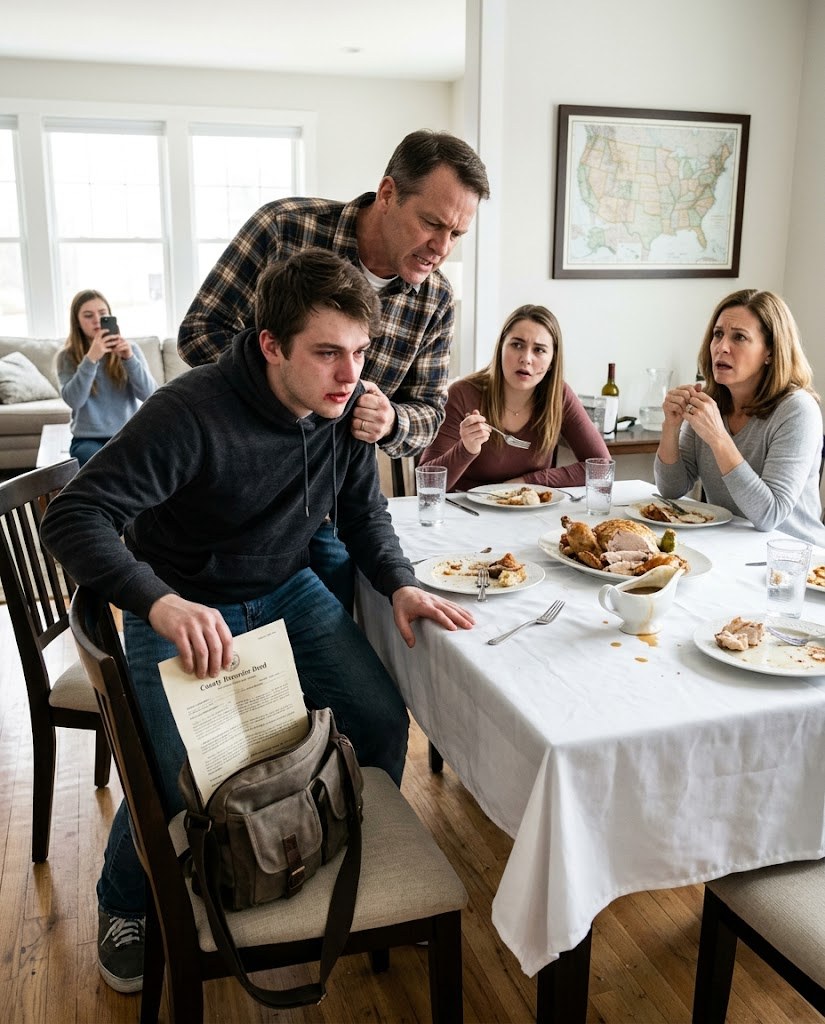
Dad slapped his palm on the table hard enough to make the forks jump.
“You’re going to help your sister,” he said.
His voice filled the room.
“That’s what men do.”
I looked at Madison.
She would not meet my eyes.
That told me everything.
This was not a request.
It was a staged collection.
“I’m not funding her lifestyle,” I said.
Mom laughed first.
It was quick, sharp, and pleased.
“Listen to the parasite talk like he has options.”
Madison rolled her eyes, but she did not tell Mom to stop.
She never did.
That was the arrangement.
Madison made the request.
Mom made it cruel.
Dad made it an order.
I was supposed to call the whole thing love.
I remember the table more clearly than their faces for a second.
The chicken sweating under foil.
The gravy skinning over.
The good plates with blue edges.
The tablecloth Mom ironed only when she wanted the house to look innocent.
For one ugly heartbeat, I pictured flipping it.
I pictured the chicken sliding onto the floor.
I pictured gravy across Dad’s shirt.
I pictured Madison’s sunglasses skidding under the cabinet.
Then I kept my hands flat.
“No,” I said.
Dad’s chair scraped back.
It was loud enough that Lily flinched on the couch.
“You don’t tell me no in my house.”
There it was.
The old sentence.
The one he used when I was fifteen and wanted to keep the money from my summer job.
The one he used when I was twenty and would not co-sign Madison’s used car.
The one he used whenever he wanted the room to forget I was an adult.
“I’m not paying for Madison to play rich in another state,” I said.
The silence after that did not land all at once.
It spread.
Madison’s mouth opened.
Mom’s eyes sharpened.
Dad’s jaw tightened.
Then he moved.
His hand grabbed my collar before I could stand.
The flannel of his sleeve filled my vision.
Chair legs cracked against the hardwood.
My hip hit the table.
Then my mouth struck the edge with a hard, bright pain that made the room flash white.
Copper filled my mouth.
The sound was not like movies.
It was smaller.
More personal.
A dull crack against wood, followed by the ugly silence of everyone deciding what kind of person they were going to be.
Madison made a noise, but it sounded more annoyed than scared.
Mom leaned back like a lesson had finally landed.
Lily froze with her phone in both hands.
The gravy boat trembled from the impact.
A fork rolled once, then stopped.
The ceiling fan clicked overhead.
The whole room held its breath except for my father.
He was breathing hard above me.
“You need to remember who raised you,” he said.
Mom tilted her head.
“Obedience,” she said. “That’s all we ever wanted you to learn.”
That sentence did something to me that the table had not.
The pain in my mouth was hot.
The taste of blood was real.
But her voice was colder than both.
Because she had finally said the honest thing.
Not love.
Not respect.
Obedience.
I wiped my mouth with the back of my hand.
Blood streaked my knuckles.
My lip throbbed, split and swelling, but my hands did not shake when I reached for my bag under the chair.
Dad sneered.
“What is that, another excuse?”
I did not answer.
My fingers found the folder.
Plain manila.
One crease on the corner.
Inside it was the stamped deed I had printed that morning, the receipt from the county recorder’s office, and the notice I had drafted three weeks earlier but had not planned to use unless they forced my hand.
I pulled out the deed first.
The paper made a soft sound against the tablecloth.
Madison glanced at it like she expected a bank statement she could mock.
Mom’s smile stayed put for exactly two seconds.
Then her eyes moved to the address.
The room changed.
Dad saw the address next.
His hand loosened from my collar.
It did not drop all at once.
It released me finger by finger, like he was afraid the paper might bite him.
Madison leaned in.
Her face tightened.
“That’s not…” she started.
She did not finish.
Because she recognized it.
They all did.
The house on the deed was not my apartment.
It was the Carter house.
My parents’ house.
The place where Dad had just told me I did not get to say no.
The place where Mom had laughed about obedience.
The place Madison kept coming back to whenever she needed someone else to finance her next reinvention.
Dad looked from the paper to me.
“This is fake.”
His voice was smaller than it had been a minute earlier.
I folded the bloody napkin once and set it beside my plate.
“Call the county office tomorrow,” I said. “Or check the receipt clipped behind it.”
Mom reached for the paper.
I put one finger on it before she could take it.
“No,” I said.
Her eyes flicked to mine.
For the first time all afternoon, she looked unsure.
Lily stood up from the couch.
Her phone was recording now.
Not hidden.
Not shaking.
Recording.
She looked at Mom and said, “You knew he bought it, didn’t you?”
That was the first surprise I had not expected.
Mom’s face folded in a way I had never seen before.
It was not guilt exactly.
Guilt has warmth in it.
This was calculation failing in public.
Madison’s eyes moved to the second page clipped behind the deed.
She reached faster than Mom did.
This time I let her take it.
Her nails were perfect, pale pink, the kind she always said made her feel like her life was finally beginning.
The paper shook between them.
It was not the purchase record.
It was the notice.
The one I had drafted after the third time Dad called me cheap for not paying Madison’s credit card.
The one I had saved after Mom told Lily she should not expect help from me because I was “tight with money now.”
The one I had not wanted to use because a part of me still wanted to believe a family dinner could end without someone reaching for my throat.
Madison read the heading.
Her polished smile collapsed.
“No,” she whispered. “No, you can’t do that.”
Dad looked at her.
Then at me.
Then at the paper.
“What is it?” he demanded.
I picked up the notice and held it where all three of them could see it.
My mouth hurt when I spoke, but I spoke clearly.
“It’s a thirty-day notice to vacate.”
The room went so quiet I could hear the fan click again.
Mom’s hand moved to the edge of the table.
Madison sat back like the chair had disappeared under her.
Dad stared at me like he had never seen my face before.
“You wouldn’t,” he said.
There it was again.
Not regret.
Not apology.
Not are you okay.
Just disbelief that I would stop letting them live inside the consequences they had been handing me for years.
I looked at my father, then at my mother, then at my sister.
“You put your hands on me in a house I own,” I said. “You called me a leech in a house I own. You demanded my money for Madison’s move in a house I own.”
Dad’s face flushed dark.
Mom shook her head slowly.
“You bought this to humiliate us.”
That almost made me laugh.
Almost.
“No,” I said. “I bought it at auction when the bank sent the notice you hid from everyone.”
Lily made a small sound.
Madison turned on Mom so fast her sunglasses fell from her head onto the table.
“What notice?”
Mom closed her eyes.
For one second, all her careful cruelty had nowhere to go.
Dad looked at her.
“Diane.”
She did not answer.
So I did.
“The foreclosure notice,” I said. “The one dated March 14. The one you told Dad was a refinancing letter. The one Madison never saw because you were still promising her I would help with L.A.”
Madison’s face went pale.
Lily lowered the phone just an inch, then raised it again.
She was crying now, but she kept recording.
I think that was the moment I finally understood she had been trapped in that house in a different way than I had.
She had not been the favorite.
She had not been the target.
She had been the witness.
Sometimes that does its own kind of damage.
Dad’s voice came out rough.
“You let us sit here and eat under your roof?”
“My roof,” I said. “That’s the part you should focus on.”
He took one step toward me.
Lily’s voice cut through the room.
“Don’t.”
Everyone looked at her.
She was still by the couch, phone up, hoodie sleeves swallowed over her hands.
“Don’t touch him again,” she said.
The words were soft.
But they landed.
Dad stopped.
Madison began crying then, but not the way people cry when they are sorry.
She cried like someone had unplugged the future she had been promised.
“What am I supposed to do?” she said.
I looked at her.
For years, that question had been handed to me like a debt.
What was Madison supposed to do if I did not help?
What was Mom supposed to say if I embarrassed the family?
What was Dad supposed to think if I acted like my money belonged to me?
Nobody had ever asked what I was supposed to do after being used up.
“You can get a job,” I said.
She stared like I had slapped her.
Dad grabbed the back of his chair, knuckles whitening.
Mom finally spoke.
“You’re angry,” she said. “You’re not thinking clearly.”
I touched my split lip with my tongue and tasted blood again.
“I’m thinking more clearly than I ever have.”
Then I opened the folder and took out the rest.
Receipts.
The auction paperwork.
The payment confirmation.
The email from the property manager.
Photos from the inspection.
Every page was another piece of the life I had built while they were laughing at the paycheck they thought was all I had.
Dad looked at the stack the way men like him look at a locked door.
Offended that it exists.
Certain it should open anyway.
“I raised you,” he said again.
This time, the sentence sounded tired.
I nodded.
“You did.”
He blinked, suspicious of the agreement.
“You raised me to document everything. You raised me to never trust a promise without proof. You raised me to know exactly what happens when people think kindness is weakness.”
Mom’s eyes filled, but I did not know whether the tears were real.
With her, tears had always been tools until proven otherwise.
“Ethan,” she whispered.
I hated that my name still sounded like a hook in her mouth.
I gathered the papers back into a neat stack.
The blood on my hand had dried in thin brown streaks across my knuckles.
The gravy had gone cold.
The roast chicken sat untouched.
The house that had spent my whole life teaching me I should be grateful for crumbs was suddenly silent under my ownership.
That is the part people misunderstand about revenge.
The satisfying moment is not the shouting.
It is not the fear on their faces.
It is the quiet second when you realize you do not need permission anymore.
I stood up slowly.
Dad did not stop me.
Mom did not laugh.
Madison did not roll her eyes.
Lily lowered her phone, and for the first time that day, she looked at me like I might actually get out.
I put the deed back in the folder.
Then I slid the thirty-day notice across the table.
“This is formal,” I said. “You’ll receive the mailed copy this week.”
Dad stared down at it.
Mom whispered, “Where are we supposed to go?”
I picked up my bag.
“That sounds like a family discussion.”
Madison’s mouth twisted.
“You’re really going to do this to us?”
I looked at the table.
At the fork that had jumped when Dad slapped his palm down.
At the smear of blood near my plate.
At the gravy stain spreading through the white cloth.
At the good plates Mom had set out to make the room look kinder than it was.
“No,” I said. “You did this. I just kept the paperwork.”
Lily walked me to the front door.
She did not hug me right away.
She stood beside me on the porch, still holding her phone, breathing like she had been underwater for years.
“I should’ve said something sooner,” she whispered.
I looked at her sleeves pulled over her hands.
“You said it today.”
Her face crumpled then.
I hugged her with one arm because my mouth hurt and my ribs ached from the table edge.
Inside, I could hear Dad shouting now.
Not at me.
At Mom.
Madison was crying louder.
The house had finally turned on itself.
Lily wiped her face with her sleeve.
“Are you really making them leave?”
I looked back through the window.
Mom was sitting at the table with the notice in front of her.
Dad stood over her, one hand on the chair, the other pressed to his forehead.
Madison had both hands in her hair, staring at a future without my wallet under it.
“Yes,” I said.
Lily nodded like she had expected that and feared it at the same time.
“Can I call you later?”
“Anytime.”
I meant it.
That was the difference between help and control.
One lets a person breathe.
The other keeps receipts.
I drove home with my split lip throbbing and the folder on the passenger seat.
At a red light, my phone buzzed.
Madison.
Then Mom.
Then Dad.
I did not answer.
When I got back to my apartment, I washed the blood from my knuckles and looked at myself in the bathroom mirror.
My lip was swelling.
There was a red mark near my jaw.
I looked tired.
But I did not look trapped.
That mattered more.
By Monday morning, I had three voicemails, eleven missed calls, and one text from Madison that said, “You’re destroying this family.”
I typed back one sentence.
“No, I’m resigning from funding it.”
Then I blocked her for the day.
Not forever.
Just long enough to enjoy the quiet I had earned.
The mailed notice went out that week.
The property manager handled the rest.
My parents did not become kinder overnight.
People like that rarely do.
Dad sent threats, then apologies, then threats again.
Mom tried tears, then Bible verses, then old photos of me as a kid standing in that same dining room with missing front teeth and a birthday cupcake.
Madison sent a long message about how family should help family.
I read it once.
Then I saved it in the Records folder.
A month later, Lily moved into my spare room for a while.
She brought two duffel bags, a stack of textbooks, and the same hoodie with the sleeves stretched out.
She paid me rent even when I told her she did not have to.
Not much.
Enough that she could feel like an adult.
Enough that help did not turn into another leash.
Sometimes, late at night, I heard her laughing on the phone with friends in the kitchen.
The sound made the apartment feel less like survival and more like a home.
The Carter house was eventually cleaned out.
My parents found a rental two towns over.
Madison did not move to L.A.
At least not that year.
I did not celebrate any of that.
I did not dance in the empty dining room or take pictures for proof.
I walked through once after they left.
The table was gone.
The walls had pale squares where family photos used to hang.
The back windows still trapped the heat.
The ceiling fan still clicked.
I stood in the doorway and remembered the taste of copper, the sound of the fork rolling, and my mother saying obedience like it was love.
Then I locked the door.
I changed the locks.
I filed the receipt.
And for the first time in my life, the house that had taught me to feel small became just another property in a folder.
Not a wound.
Not a throne.
Just paper.
Mine.